
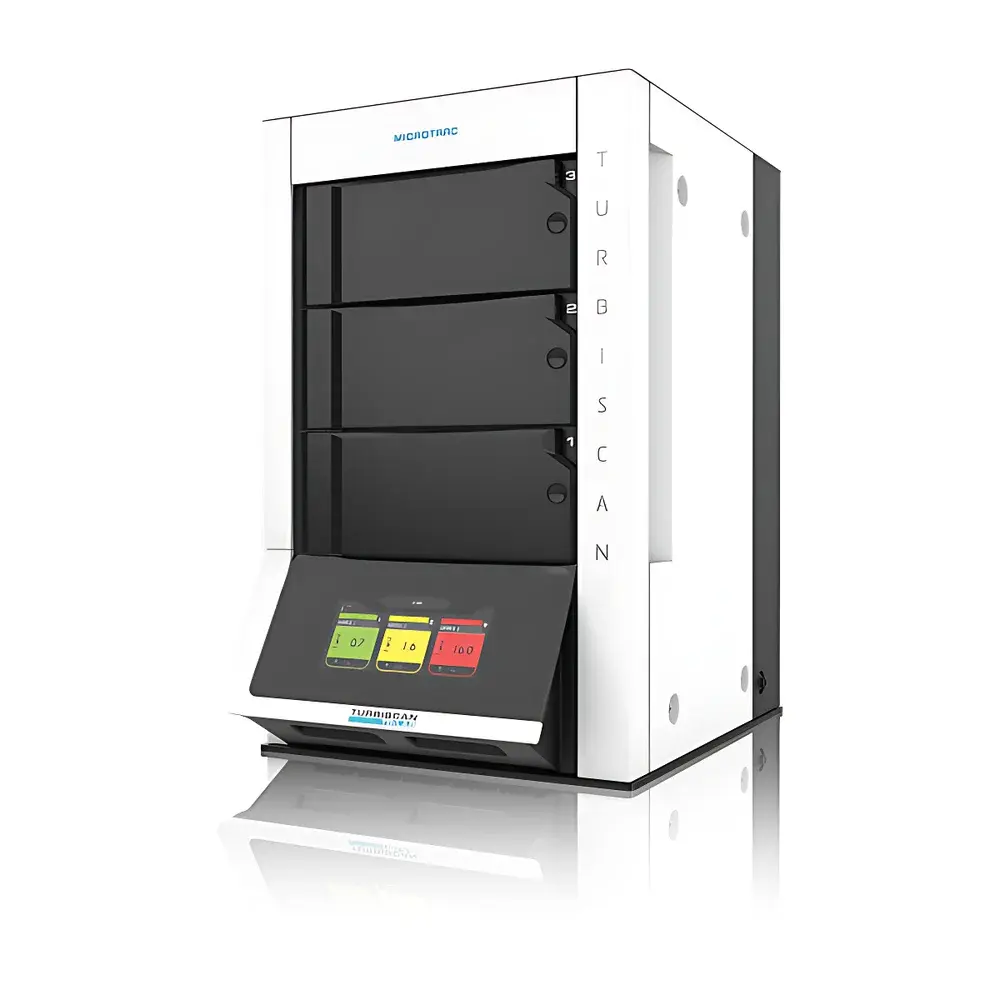
Formulaction TURBISCAN TRI-LAB Static Multiple Light Scattering (SMLS) Stability Analyzer
| Brand | Formulaction |
|---|---|
| Origin | France |
| Model | TRI-LAB |
| Light Source | 880 nm NIR LED |
| Sample Volume | 1.5–30 mL |
| Temperature Range | 20–60 °C |
| Sample Positions | 1–3 |
| Concentration Range | 0.0001–95% v/v |
| Detection Principle | Synchronized Transmittance (T) and Backscattering (BS) Profiling |
| Measurement Mode | Non-invasive, label-free, no dilution required |
| Compliance | Designed for GLP/GMP-aligned pharmaceutical stability assessment |
Overview
The Formulaction TURBISCAN TRI-LAB is a static multiple light scattering (SMLS) stability analyzer engineered for quantitative, non-invasive characterization of colloidal and dispersed systems across the full concentration spectrum—from dilute suspensions to highly concentrated pastes, emulsions, foams, gels, and slurries (up to 95% v/v). Unlike conventional techniques requiring centrifugation, dilution, or particle tracking, the TRI-LAB operates on first-principles optical physics: it simultaneously records vertical profiles of transmitted (T) and backscattered (BS) light intensities using an 880 nm near-infrared LED source. This dual-signal acquisition enables real-time, spatially resolved monitoring of local changes in particle size distribution and concentration gradients along the sample height—directly linked to destabilization mechanisms including sedimentation, creaming, flocculation, coalescence, and phase separation. The instrument’s core architecture eliminates mechanical perturbation, ensuring measurement integrity and enabling true shelf-life prediction under isothermal or accelerated conditions (20–60 °C).
Key Features
- True Static Measurement: No sample agitation, shaking, or dilution—preserves native dispersion state and avoids artifact-induced destabilization.
- Dual-Channel Optical Profiling: Independent, synchronized detection of transmittance and backscattering at 100 µm vertical resolution over the full 40 mm sample path length.
- High-Concentration Capability: Validated performance from 10−4% v/v (e.g., nanosuspensions) to 95% v/v (e.g., toothpaste, battery slurries), eliminating pre-analytical preparation.
- Multi-Sample Throughput: Three independent sample positions with individual thermal control allow parallel comparative studies (e.g., formulation variants, excipient screening, temperature ramping).
- Quantitative Stability Index (TSI): Algorithm-derived single-value metric integrating all destabilization events across time and height—enabling objective ranking and pass/fail thresholds per ICH Q5C and USP <1208> guidelines.
- Real-Time Visualization: Onboard LCD display shows evolving T/BS profiles, TSI kinetics, and instability maps during acquisition—no post-processing delay.
Sample Compatibility & Compliance
The TRI-LAB accommodates opaque, turbid, and heterogeneous formulations without optical preconditioning—critical for biopharmaceuticals (e.g., monoclonal antibody aggregates), topical semisolids, oral suspensions, vaccine adjuvants, and advanced material dispersions. Its measurement protocol aligns with regulatory expectations for physical stability assessment: data traceability meets FDA 21 CFR Part 11 requirements when used with validated software configurations; raw profile data supports root-cause analysis per ICH Q5C (Stability of Biotechnological/Biological Products) and ISO 13321 (Particle Size Analysis – Dynamic Light Scattering). Instrument design conforms to CE marking standards and supports audit-ready documentation for GLP and GMP environments.
Software & Data Management
TURBISCAN Analysis Software (v4.x or later) provides comprehensive data interrogation tools: migration velocity calculation (µm/h), phase thickness quantification, kinetic modeling (exponential decay, power-law), hydrodynamic diameter estimation via BS/T ratio calibration, and re-dispersion efficiency scoring. All raw intensity profiles, metadata (temperature, timestamp, operator ID), and processed parameters are stored in vendor-neutral HDF5 format. Audit trail functionality logs user actions, method changes, and report generation events. Export options include CSV, PDF, and XML for integration into LIMS or statistical platforms (JMP, Minitab, Python pandas). Optional IQ/OQ/PQ validation packages support qualification in regulated laboratories.
Applications
- Accelerated stability screening of liquid dosage forms (suspensions, emulsions, liposomes) under controlled temperature stress (20–60 °C).
- Comparative assessment of surfactant efficacy, polymer stabilizers, and rheology modifiers in topical gels and creams.
- Monitoring aggregation onset and growth kinetics in protein therapeutics and mRNA-LNP formulations.
- Quantifying sediment compaction and supernatant clarity evolution in ceramic or electrode slurries.
- Validating reconstitution behavior of lyophilized powders and dry syrup granules.
- Supporting QbD (Quality by Design) initiatives through mechanistic understanding of dispersion failure modes.
FAQ
How does SMLS differ from dynamic light scattering (DLS) or laser diffraction?
SMLS measures spatial heterogeneity over time in undiluted, static samples—whereas DLS requires dilution and assumes monomodal, Brownian-diffusing particles, and laser diffraction demands optical transparency and homogenization.
Can the TRI-LAB detect submicron particles in opaque formulations?
Yes—880 nm NIR penetrates high-absorption matrices (e.g., pigmented suspensions, carbon-loaded pastes); particle size inference relies on BS/T ratio trends rather than absolute sizing algorithms.
Is temperature control precise enough for ICH-compliant stability studies?
The TRI-LAB achieves ±0.5 °C stability over 24 h per position, meeting ICH Q1A(R2) “long-term” and “accelerated” storage condition tolerances when calibrated per SOP.
What sample tube types are compatible?
Standard 10 mm square glass cuvettes (2–30 mL), custom stainless-steel cells for aggressive chemistries, and disposable polymer vials (certified low-autofluorescence).
Does the system require annual recalibration?
Optical alignment is factory-verified and drift-stable; annual verification using NIST-traceable reference standards (e.g., polystyrene latex suspensions) is recommended for regulated use.




