
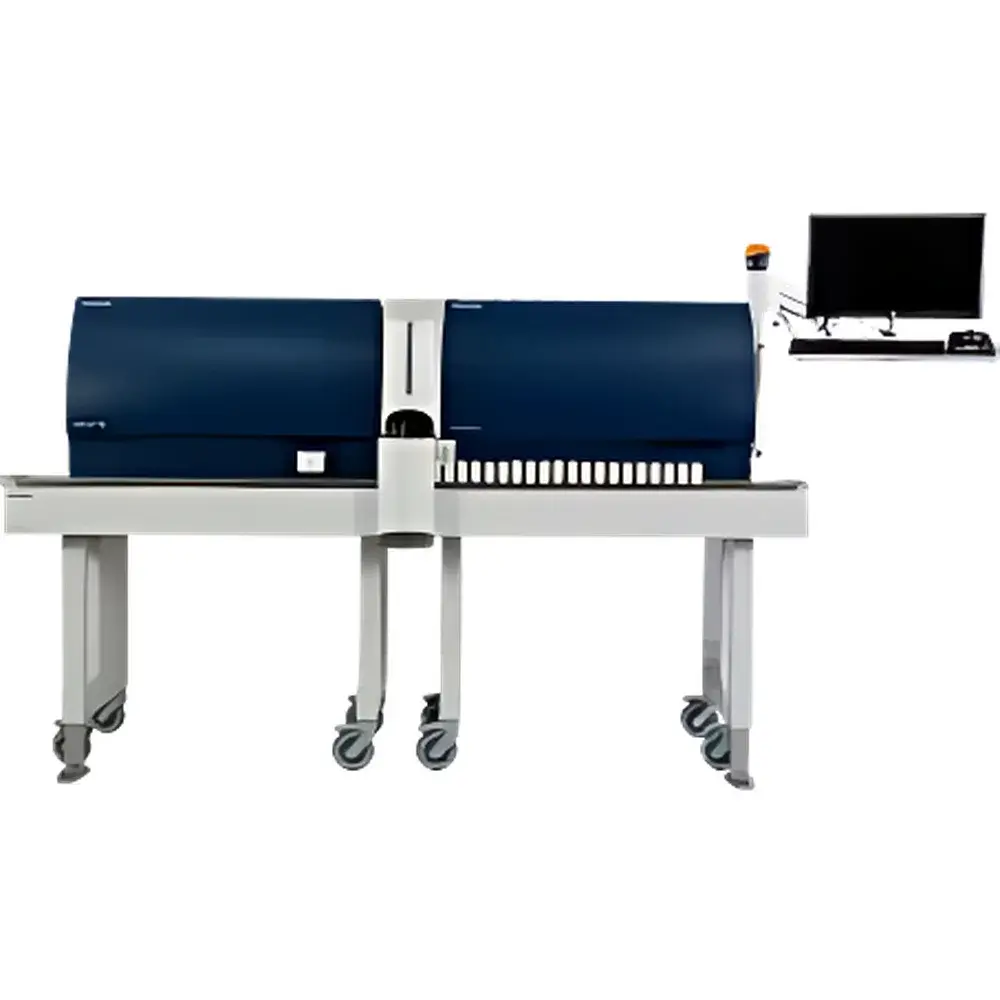
FOSS CombiFoss 7 Dairy Analyzer
| Brand | FOSS |
|---|---|
| Origin | Denmark |
| Model | CombiFoss 7 |
| Automation | Fully Automatic |
| Analysis Speed | Up to 600 samples/hour |
| Fat Detection Range | 0–15% |
| Repeatability (CV) | <0.5% |
| Fat Precision (CV) | <1.0% |
| Sample Types | Bovine, Ovine, Caprine, and Buffalo Milk |
| Key Parameters | Fat, True Protein, Crude Protein, Casein, Lactose, Total Solids, Non-Fat Solids, Urea, Citric Acid, Free Fatty Acids, Fatty Acid Profile, Freezing Point, pH, Ketosis Screening (BHB & Acetone), Adulteration Detection, Somatic Cell Count (SCC), Differential Somatic Cell Count (DSCC) |
Overview
The FOSS CombiFoss 7 Dairy Analyzer is a high-throughput, near-infrared (NIR) and flow cytometry–based integrated platform engineered for comprehensive, real-time compositional and quality assessment of raw milk and alternative dairy matrices. It combines the optical spectroscopy engine of the MilkoScan™ 7 RM with the cell-counting capability of the Fossomatic™ 7 or Fossomatic™ 7 DC in a single, synchronized hardware architecture. This integration enables simultaneous quantification of up to 19 regulatory and production-critical parameters—including Differential Somatic Cell Count (DSCC)—within six seconds per sample. Designed for dairy laboratories operating under ISO/IEC 17025, IDF, and ISO 9622 standards, the CombiFoss 7 delivers traceable, auditable results suitable for contractual milk payment, herd health monitoring, and supply chain compliance reporting.
Key Features
- Integrated dual-technology platform: NIR spectroscopy for compositional analysis (fat, protein, lactose, solids, urea, citric acid, freezing point, pH, FFA, fatty acid profile) combined with laser-based flow cytometry for somatic cell enumeration and DSCC classification.
- Diamond-grade observation chamber: A proprietary sapphire-reinforced optical flow cell rated for >10 years of continuous operation without degradation in spectral transmission or alignment stability.
- Modular sample transport system: Tool-free, quick-release sample track design enables rapid cleaning and validation—critical for multi-species milk analysis (bovine, ovine, caprine, buffalo) without cross-contamination risk.
- Consistent performance across throughput range: Maintains CV <0.5% repeatability and CV <1.0% fat precision whether processing 100 or 600 samples per hour, validated per ISO 9622:2013 Annex A protocols.
- Zero-downtime calibration architecture: Software-managed calibration updates and reference standard verification can be executed during active analysis cycles, eliminating scheduled instrument idle time.
Sample Compatibility & Compliance
The CombiFoss 7 supports homogenized, non-frozen raw milk from multiple species—cattle, sheep, goats, and water buffalo—with automated matrix-specific calibration switching. All reported parameters comply with internationally recognized reference methods: fat and protein by ISO 9622, SCC by ISO 13366-1, freezing point by ISO 5767, and urea by ISO 14807. The system meets GLP requirements for data integrity, including full audit trail logging (user actions, calibration events, result modifications), electronic signature support, and 21 CFR Part 11–compliant software configuration when deployed with FOSS Unity™ Enterprise Edition.
Software & Data Management
Controlled via FOSS Unity™ Desktop software, the CombiFoss 7 allows centralized management of up to 16 instruments from a single workstation. Data workflows include automatic export to LIMS (via ASTM E1384 or HL7-compliant interfaces), batch-level statistical process control (SPC) charting, trend analysis across farms or collection centers, and configurable alarm thresholds for adulteration markers (e.g., added water, neutralizers, antibiotics). All raw spectra, cell histograms, and metadata are stored in encrypted, timestamped binary archives with SHA-256 hash verification for forensic traceability.
Applications
- Milk payment testing: Accurate, certified fat, protein, and SCC values for fair pricing based on contractual quality specifications.
- Mastitis surveillance: DSCC provides early differentiation between inflammatory and non-inflammatory elevated SCC, enabling targeted udder health interventions.
- Ketosis screening: Quantitative detection of β-hydroxybutyrate (BHB) and acetone supports metabolic disorder monitoring during transition periods.
- Adulteration verification: Multivariate NIR pattern recognition identifies anomalies associated with dilution, reconstitution, or addition of foreign substances.
- Product development & breeding programs: High-resolution fatty acid profiling and citric acid measurement inform nutritional labeling and genetic selection indices.
FAQ
What regulatory standards does the CombiFoss 7 meet for routine dairy testing?
It complies with ISO 9622 (milk composition), ISO 13366-1 (somatic cell counting), ISO 5767 (freezing point), and ISO 14807 (urea), and supports GLP/GMP documentation requirements when configured with Unity™ Enterprise.
Can the instrument analyze goat or sheep milk without recalibration?
Yes—pre-installed, species-specific calibrations are included; users select the appropriate matrix prior to analysis, and the system auto-applies optimized spectral models and cell-counting algorithms.
Is Differential Somatic Cell Count (DSCC) traceable to an international reference method?
DSCC is measured using flow cytometric discrimination of polymorphonuclear leukocytes (PMN) vs. lymphocytes; methodology aligns with IDF Standard 193A:2019 for differential SCC interpretation in mastitis management.
How is data security ensured during remote instrument monitoring?
All network communications use TLS 1.2+ encryption; local data storage employs AES-256 encryption at rest, and user access is governed by role-based permissions with session timeout and forced password rotation policies.




