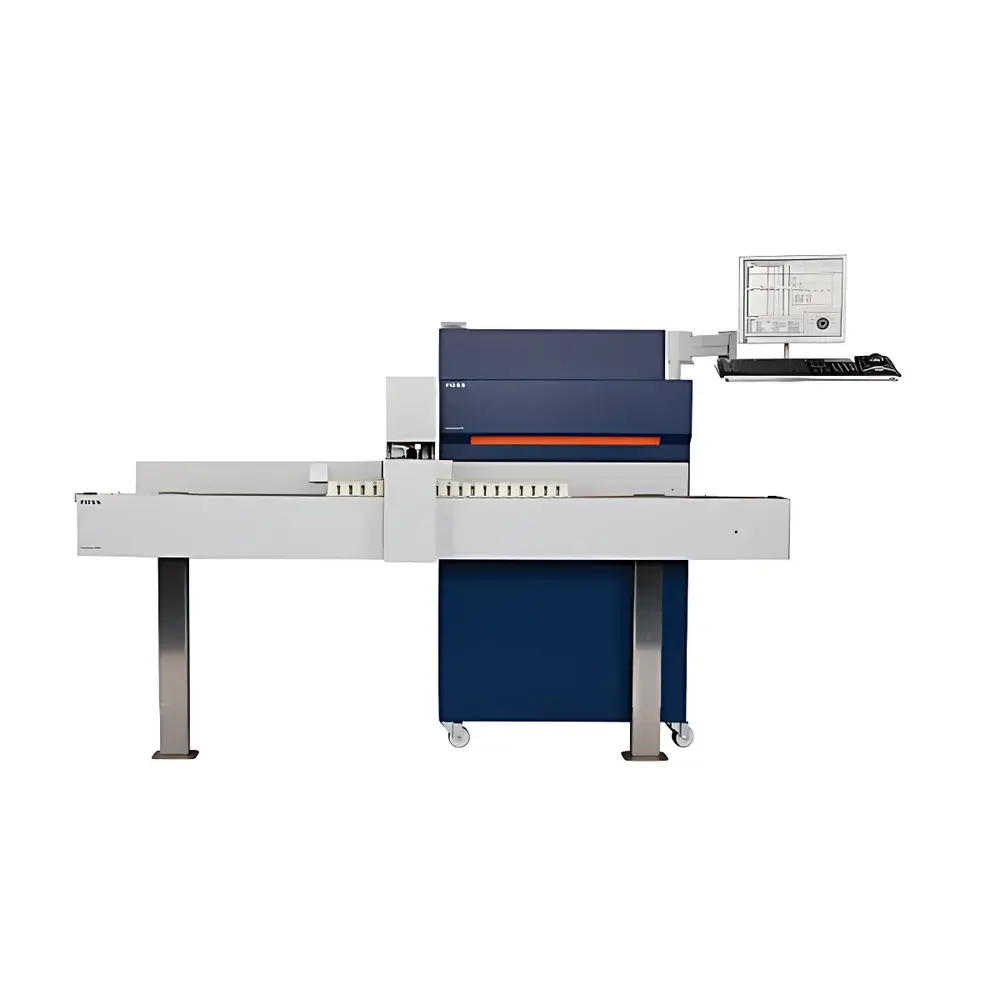
FOSS Fossomatic 7 Automated Somatic Cell Counter for Dairy Milk Analysis
| Brand | FOSS |
|---|---|
| Origin | Denmark |
| Model | Fossomatic 7 |
| Automation Level | Fully Automatic |
| Analysis Speed | Up to 600 samples/hour |
| Detection Range | 0–10 × 10⁶ cells/mL |
| Repeatability | CV < 4% at 500,000 cells/mL |
| Accuracy | < 10% deviation vs. direct microscopic count |
| Technology | Flow Cytometry |
| Compliance | ISO 13366-1, IDF 148, FDA/NCIMS Grade A Standards |
| Software Platform | Foss Integrator NOVA |
| Sample Types | Bovine, ovine, caprine, and buffalo milk |
| Configuration Options | Fossomatic 7 (total SCC) and Fossomatic 7 DC (somatic cell differential counting) |
Overview
The FOSS Fossomatic 7 is a fully automated, high-throughput somatic cell counter engineered specifically for dairy quality control laboratories operating under stringent regulatory and contractual requirements. It employs validated flow cytometry principles—where individual cells in a milk sample are hydrodynamically focused, stained with fluorescent nucleic acid dyes, and detected via laser-induced fluorescence—to deliver rapid, objective, and traceable somatic cell counts (SCC). Unlike manual microscopy or older impedance-based methods, the Fossomatic 7’s optical detection architecture ensures discrimination between intact nucleated somatic cells and non-cellular debris or lysed fragments, thereby improving biological relevance and analytical robustness. Its design aligns with internationally recognized reference methodologies, including ISO 13366-1 (Milk — Determination of somatic cell count — Part 1: Fluorometric method using flow cytometry) and IDF Standard 148, and meets the performance criteria stipulated in the U.S. FDA/NCIMS Pasteurized Milk Ordinance (PMO) Grade A laboratory accreditation program.
Key Features
- Modular fluidic architecture enabling rapid access to critical components—including flow cells, peristaltic pumps, and reagent manifolds—for routine cleaning and scheduled maintenance without specialized tools.
- Enhanced operational efficiency: improved work coefficient from 300 to 100 (i.e., reduced instrument downtime per sample batch), achieved through optimized valve sequencing and minimized rinse cycle duration.
- Flexible reagent handling: supports both pre-mixed reagent cartridges and user-configurable manual mixing—allowing labs to balance cost control with protocol standardization.
- Continuous operation capability: cleaning solution reservoirs can be refilled during active analysis without interrupting sample throughput or requiring system shutdown.
- Low-maintenance sample transport: open-loop sample track design eliminates compressed air dependency; all surfaces contacting milk or reagents are accessible for wipe-down or steam sterilization.
- Integrated hardware diagnostics: real-time monitoring of laser alignment stability, photomultiplier tube gain, and fluid pressure profiles ensures consistent measurement integrity across shifts and operators.
Sample Compatibility & Compliance
The Fossomatic 7 accepts raw, pasteurized, and standardized milk from bovine, ovine, caprine, and buffalo sources without modification to core assay parameters. Its calibration and verification protocols are traceable to NIST-traceable reference materials and certified reference laboratories participating in international proficiency testing schemes (e.g., ICAR, ERM). Regulatory compliance extends beyond method validation: the system supports audit-ready documentation required for GLP and GMP environments, including full electronic records retention, user-access logging, and change-control tracking per FDA 21 CFR Part 11 when deployed with Foss Integrator NOVA software in validated configurations.
Software & Data Management
Foss Integrator NOVA serves as the unified control, analysis, and reporting platform for the Fossomatic 7. It provides role-based user authentication, configurable data export formats (CSV, XML, LIS-compatible HL7 v2.x), and automated generation of QC reports aligned with ISO/IEC 17025 clause 7.7 requirements. The software maintains full audit trails—including timestamped operator actions, calibration events, and result modifications—with cryptographic hashing of critical data objects. Instrument-to-LIMS integration is supported via secure RESTful API endpoints or direct ODBC connectivity, enabling seamless incorporation into enterprise-wide quality management systems.
Applications
- Dairy farm gate testing and supplier qualification programs requiring rapid SCC screening prior to bulk tank loading.
- Regulatory surveillance laboratories performing official milk quality assessments under national food safety frameworks.
- Research institutions investigating mastitis biomarkers, immune response dynamics, or breed-specific SCC thresholds.
- Contract testing facilities delivering accredited SCC data for export certification (e.g., EU Regulation (EC) No 853/2004 Annex III).
- Process optimization studies correlating SCC trends with milking hygiene practices, udder health interventions, or herd management changes.
FAQ
What regulatory standards does the Fossomatic 7 comply with?
It conforms to ISO 13366-1, IDF 148, and FDA/NCIMS Grade A laboratory performance criteria for somatic cell enumeration.
Can the instrument differentiate between live and dead somatic cells?
No—the Fossomatic 7 quantifies total nucleated somatic cells using membrane-permeant DNA dyes; it does not incorporate viability staining protocols.
Is the Fossomatic 7 DC model capable of reporting lymphocyte/neutrophil ratios?
Yes—the DC variant applies multivariate scatter plot gating to distinguish morphologically distinct subpopulations based on forward/side scatter and fluorescence intensity profiles.
Does the system require daily calibration with reference standards?
Daily verification using certified control materials is recommended; full calibration is performed during initial installation and after major hardware service events.
How is data integrity ensured during long-term deployment?
Through hardware-enforced write-once storage of raw acquisition files, digital signature validation of report exports, and time-synchronized network logging compliant with IEC 62443-3-3 security levels.