
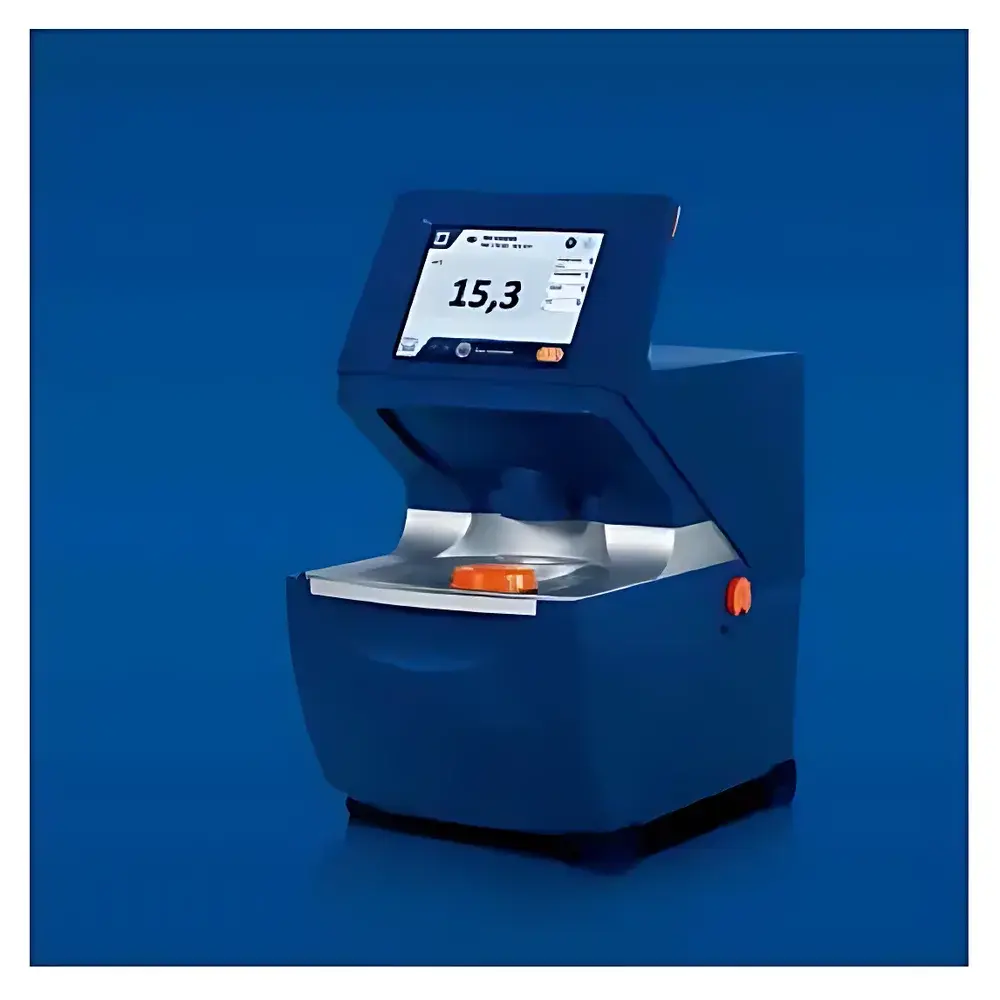
FOSS MeatScan Portable Near-Infrared Spectrometer for Rapid Meat Composition Analysis
| Brand | FOSS |
|---|---|
| Origin | Denmark |
| Model | MeatScan |
| Instrument Type | Laboratory NIR Spectrometer |
| Principle | Grating-based non-scanning array detector |
| Wavelength Range | 850–1050 nm |
| Scan Time | 45 seconds per sample (including 15 subsamples) |
| Data Sampling Interval | 1 nm |
| Measurement Mode | Transmission |
| Chemometrics Software | Artificial Neural Network (ANN)-based calibration |
| Sample Form | Homogenized meat mince (pork, poultry, beef, lamb) |
| Output Parameters | Fat content (%), Moisture content (%) |
| Weight | 12 kg |
| Compliance | Designed for GLP-compliant environments |
Overview
The FOSS MeatScan is a purpose-engineered portable near-infrared (NIR) spectrometer optimized for rapid, non-destructive quantification of fat and moisture in homogenized meat samples. Operating on the principle of transmission-mode NIR spectroscopy, the instrument directs broadband light (850–1050 nm) through a uniformly prepared meat sample, where absorption features—primarily from C–H and O–H overtones and combination bands—are captured by a fixed grating and linear diode array detector. Unlike scanning monochromator systems, its non-scanning architecture eliminates moving parts, ensuring high optical stability, long-term reproducibility, and minimal maintenance. The MeatScan is not a general-purpose spectrometer; it is a standardized, factory-calibrated analytical platform—preloaded with ANN-based multivariate calibrations validated across diverse meat matrices—including pork, chicken, beef, and lamb—enabling direct, operator-independent reporting without user-developed models or secondary reference methods.
Key Features
- Portable design (12 kg) with integrated handle and ruggedized housing for deployment across production lines, quality control labs, and R&D facilities.
- Transmission-mode optics engineered for robust performance with heterogeneous biological matrices—no sample compaction or pelletization required.
- Fixed grating + array detector architecture ensures spectral fidelity, wavelength repeatability (< ±0.5 nm), and immunity to mechanical drift.
- Pre-installed ANN calibration models eliminate need for in-house method development, primary reference analysis (e.g., Soxhlet extraction), or routine recalibration.
- No consumables, no reagents, and no lamp replacement—operational cost per analysis is effectively zero beyond electricity and labor.
- Full system integration with FOSS Manager™ software for centralized configuration, firmware updates, usage logging, and remote diagnostics across multi-instrument networks.
Sample Compatibility & Compliance
The MeatScan accepts homogenized meat mince (particle size ≤ 2 mm) prepared using standard laboratory grinders or industrial mincers. It is validated for raw, cooked, and cured formulations—including emulsified sausages and comminuted blends—with no interference from salt, phosphates, or common preservatives. All calibrations are developed per ISO 12099:2017 (Animal feeding stuffs, cereals and milled products — Guidelines for the application of near infrared spectroscopy) and aligned with AOAC Official Method 2000.06 for fat determination in meat. The instrument supports GLP- and GMP-aligned workflows: FOSS Manager™ enforces user authentication, electronic signatures, and full audit trails compliant with FDA 21 CFR Part 11 requirements for data integrity and traceability.
Software & Data Management
FOSS Manager™ serves as the unified software backbone—deployable on Windows-based workstations or virtualized servers—for instrument control, calibration management, and data governance. It provides role-based access control (administrator, analyst, viewer), automatic generation of PDF reports with embedded spectra and statistical confidence metrics (SECV, R²), and export to CSV, LIMS-compatible XML, or SQL databases. Raw spectral data (absorbance at 1 nm intervals across 850–1050 nm) is stored in vendor-neutral HDF5 format, enabling third-party chemometric validation or model refinement using MATLAB, Python (scikit-learn), or Unscrambler®. All measurement events—including operator ID, timestamp, sample ID, and instrument status—are logged with cryptographic hashing to prevent post-acquisition modification.
Applications
- Real-time fat/moisture verification during raw material intake and blend formulation in meat processing plants.
- Process endpoint monitoring for thermal treatment (e.g., cooking, drying) where moisture loss kinetics directly impact yield and shelf life.
- QC release testing in accordance with EU Regulation (EC) No 853/2004 on hygiene rules for food of animal origin.
- Research applications in food science departments evaluating lipid oxidation, protein denaturation, or ingredient substitution effects using spectral residual analysis.
- Supplier qualification programs requiring rapid, standardized assessment of incoming carcass trimmings or offal batches.
FAQ
Does the MeatScan require daily calibration verification with reference standards?
No. Its factory-loaded ANN models include built-in performance monitoring; routine verification is performed automatically via internal reference checks before each measurement sequence.
Can the instrument analyze intact meat cuts or only ground samples?
Only homogenized mince is supported. Transmission geometry requires optical path consistency; intact cuts introduce scattering artifacts incompatible with the pre-validated calibration domain.
Is spectral data export possible for external model development?
Yes. Full-resolution absorbance spectra (850–1050 nm at 1 nm steps) are accessible in HDF5 format via FOSS Manager™, enabling independent algorithm development or cross-platform model transfer.
What regulatory documentation accompanies the instrument for audit readiness?
Each unit ships with a Factory Calibration Certificate, IQ/OQ documentation package, and FOSS Manager™ Part 11 compliance report—fully editable for site-specific validation protocols.
How is instrument-to-instrument reproducibility ensured across a multi-unit installation?
All MeatScan units undergo inter-instrument standardization using NIST-traceable ceramic reference tiles prior to shipment, guaranteeing < ±0.15% absolute fat difference across identical samples measured on different units.




