
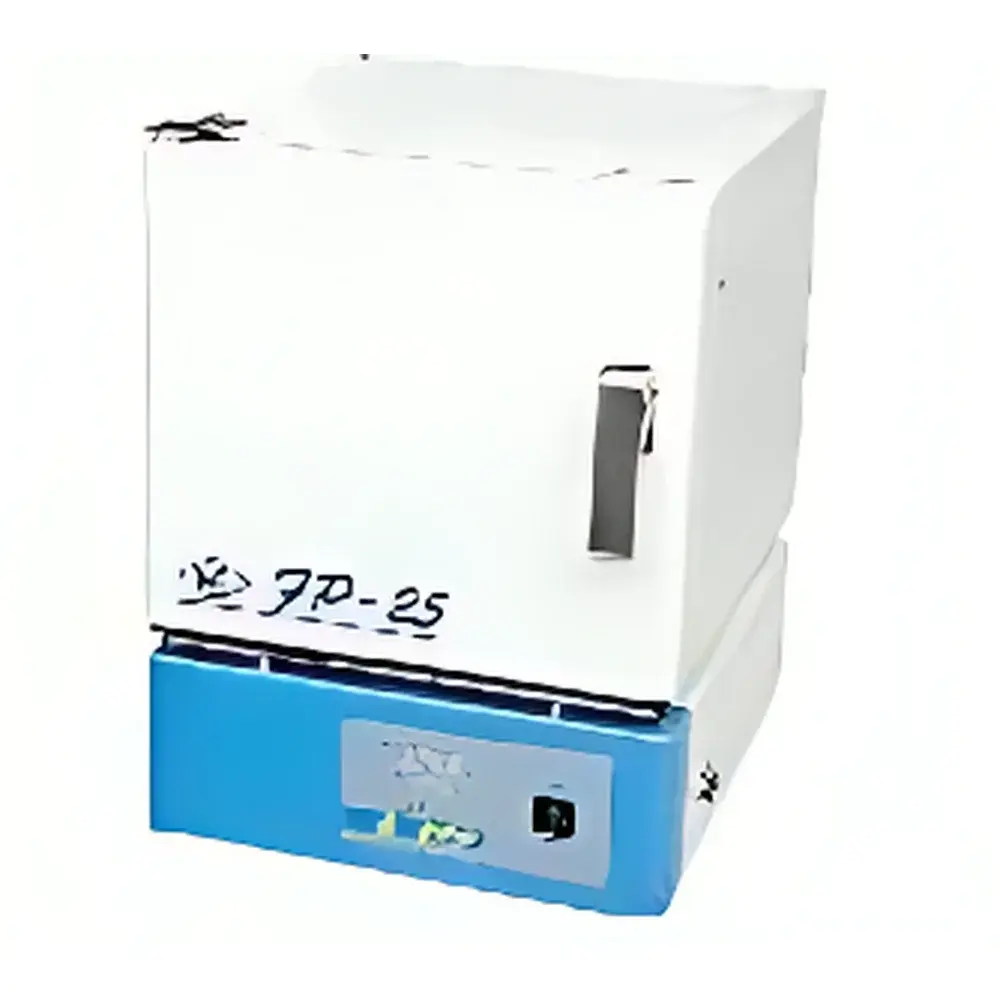
FP-40 Ceramic Fiber Muffle Furnace
| Origin | Shanghai, China |
|---|---|
| Manufacturer Type | Authorized Distributor |
| Country of Origin | PRC |
| Model | FP-40 |
| Voltage/Power | 220 V / 4000 W |
| Chamber Dimensions (W×D×H) | 300 × 200 × 120 mm |
| Maximum Operating Temperature | 1000 °C |
| Construction | Cold-Rolled Steel Outer Casing + High-Density Ceramic Fiber Insulation |
| Compliance | CE-marked per IEC 61000-6-3 (EMC) and IEC 61000-6-2 (Immunity) |
Overview
The FP-40 Ceramic Fiber Muffle Furnace is a compact, energy-efficient high-temperature heating system engineered for routine thermal processing in analytical laboratories, materials research facilities, and quality control environments. Utilizing resistive heating elements embedded within a monolithic ceramic fiber insulation chamber, the furnace achieves uniform temperature distribution and rapid thermal response while minimizing heat loss. Its maximum operating temperature of 1000 °C supports a broad range of thermally driven protocols—including ashing, calcination, heat treatment of small metallic specimens (e.g., annealing, tempering, and stress-relieving), sintering of oxide ceramics, and preparatory sample conditioning for elemental analysis (e.g., AAS, ICP-OES). The muffle design ensures complete thermal isolation between the heating chamber and external components, eliminating cross-contamination risks and enabling precise, repeatable thermal cycles without atmospheric interference.
Key Features
- High-efficiency ceramic fiber insulation (density ≥ 128 kg/m³) provides exceptional thermal retention—reducing standby power consumption by up to 40% compared to traditional brick-lined furnaces.
- Robust cold-rolled steel outer casing with epoxy-polyester powder coating resists corrosion and mechanical abrasion under daily laboratory use.
- Precisely wound Kanthal A1 resistance wire heating elements ensure long service life and stable heat output across the full temperature range.
- Front-loading chamber with reinforced ceramic fiber door seal minimizes thermal leakage during operation and facilitates safe, ergonomic sample loading.
- Integrated over-temperature protection circuit (independent of main controller) automatically cuts power if internal sensor readings exceed 1050 °C—meeting EN 61010-1 Class II safety requirements.
- Lightweight construction (net weight ≈ 38 kg) enables repositioning on standard lab carts or mobile workbenches without structural reinforcement.
Sample Compatibility & Compliance
The FP-40 accommodates crucibles (alumina, quartz, stainless steel), ceramic boats, and graphite holders up to 280 mm wide. It is routinely deployed in ASTM E1662 (ash content determination), ISO 1171 (determination of ash in coal and coke), and USP (residue on ignition) workflows. While not certified for GMP production environments, its temperature stability (±5 °C at 900 °C, 30-minute dwell) and traceable calibration support GLP-compliant documentation when used with external NIST-traceable thermocouples. All electrical interfaces comply with IEC 61000 electromagnetic compatibility standards; no additional shielding is required in typical shared-lab infrastructure.
Software & Data Management
The FP-40 operates via a dual-display PID temperature controller with manual ramp/soak programming (up to 9 segments). Optional RS485 Modbus RTU interface enables integration into centralized lab monitoring systems (e.g., LabVantage, Siemens Desigo CC) for audit-ready thermal log capture. When paired with compliant data acquisition software, the unit supports 21 CFR Part 11–aligned electronic records—including user authentication, change tracking, and immutable timestamped event logs—facilitating regulatory submissions where thermal process validation is required.
Applications
- Pre-treatment of environmental samples (soil, sludge, plant tissue) prior to heavy metal quantification.
- Heat treatment of tool steels, spring alloys, and bearing components during metallurgical R&D.
- Sintering of alumina, zirconia, and silicon carbide compacts in ceramic engineering labs.
- Residue-on-ignition testing for pharmaceutical excipients and dietary supplements.
- Calibration verification of thermogravimetric analyzers (TGA) using certified reference materials (CRMs).
- Controlled oxidative decomposition of polymer composites for composition profiling.
FAQ
What is the recommended maintenance interval for the FP-40’s heating elements?
Under continuous operation at ≤900 °C, inspect elements annually; replace if visible sagging, discoloration, or resistance deviation >15% from nominal value.
Can the FP-40 be used under inert or reducing atmospheres?
No—the standard configuration lacks gas inlet/outlet ports and is rated only for ambient air operation. Custom modifications require third-party engineering review and void the CE declaration.
Is the temperature uniformity validated across the entire chamber volume?
Per factory acceptance test (FAT), uniformity is ±8 °C at 1000 °C (measured at 5 points: center, corners, mid-height), conforming to ASTM E2203 Class B specifications.
Does the unit include a certificate of conformance?
Yes—a signed CoC listing model, serial number, measured max temperature, and compliance references (IEC 61010-1, EN 61000-6-2/3) is shipped with each unit.
What type of thermocouple is used for internal sensing?
Type K (Chromel–Alumel), grounded junction, calibrated to ±1.5 °C accuracy over 0–1000 °C range.



