
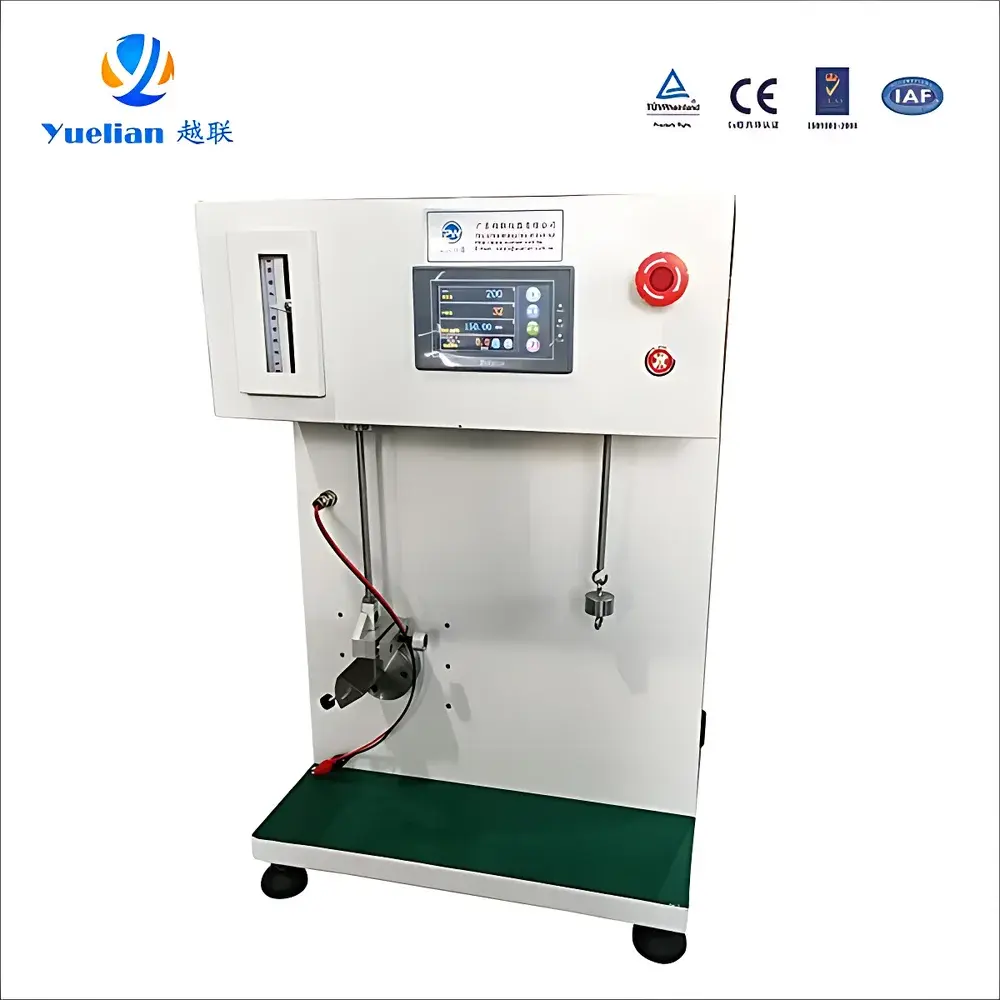
FPC Flexural Endurance Tester PW-6603
| Brand | YUELIAN / PW |
|---|---|
| Origin | Guangdong, China |
| Manufacturer Type | Authorized Distributor |
| Origin Category | Domestic (China) |
| Model | PW-6603 |
| Pricing | Available Upon Request |
Overview
The FPC Flexural Endurance Tester PW-6603 is a precision-engineered electromechanical testing system designed for evaluating the dynamic bending fatigue resistance of flexible printed circuits (FPCs) and other thin-film electronic interconnects. It operates on the principle of controlled angular oscillation—repetitive flexing of specimens between programmable upper and lower limits—to simulate real-world mechanical stress encountered in foldable smartphones, wearable displays, medical endoscopes, and automotive infotainment modules. The tester implements standardized cyclic bending per JIS C 6471 (Flexible Printed Boards – Test Methods), supporting both qualification testing and accelerated life-cycle validation under defined amplitude, frequency, and load conditions. Its architecture integrates closed-loop motion control with electrical continuity monitoring, enabling simultaneous mechanical endurance assessment and functional failure detection.
Key Features
- Robust powder-coated steel chassis with optimized structural rigidity to minimize vibration-induced measurement drift during high-frequency cycling.
- Dedicated AC/DC rectifier circuitry ensures stable power delivery to the stepper motor and actuation assembly, enhancing long-term operational reliability and electromagnetic compatibility (EMC) in shared lab environments.
- High-resolution stepper motor drive system delivers repeatable angular positioning accuracy within ±0.5° across the full range; low-noise operation supports unattended overnight testing.
- Automated homing sequence eliminates manual repositioning—PLC-controlled origin search ensures consistent start-point alignment prior to each test run.
- 7-inch capacitive touchscreen interface with intuitive icon-based navigation enables rapid parameter configuration without external software or PC dependency.
- Real-time conductive continuity monitoring integrated into the test cycle: automatic termination upon open-circuit detection (i.e., trace fracture or solder joint failure), preserving specimen integrity data and preventing over-testing.
- Modular tooling design allows quick interchange of radius-specific bending mandrels (0.38 mm, 0.8 mm, 1.2 mm, 2.0 mm) to match application-specific bend radii per IPC-2221B or IEC 62320-1 requirements.
Sample Compatibility & Compliance
The PW-6603 accommodates single-lane FPCs up to 30 mm wide with customizable clamping geometry. Specimen thickness range: 0.05–0.3 mm (standard); extended configurations support rigid-flex hybrids upon request. All mechanical adjustments—including stroke length (20–100 mm), angular range (±0–135°, extendable to ±180°), and dwell time—are manually calibrated and digitally locked via PLC memory. The system complies with JIS C 6471 Section 6.3 (Bending Durability Test), and its test methodology aligns with supplementary guidance in IPC-TM-650 2.4.1 (Flexural Fatigue Testing). Optional conductive monitoring meets functional pass/fail criteria referenced in MIL-STD-202G Method 212 (Electrical Continuity Under Flexure). Full audit trail logging supports GLP/GMP-aligned test documentation when paired with optional USB data export.
Software & Data Management
Although standalone operation is fully functional via embedded HMI, the PW-6603 supports optional RS-232/USB serial output for integration into centralized QC databases. Test parameters—including angle setpoint, cycle count, speed (10–180 cycles/min), and failure event timestamp—are stored in non-volatile memory. Cycle counters maintain six-digit resolution (0–999,999) with pre-set limit triggering and hardware-latched stop signals. Exported CSV logs include cycle number, elapsed time, status flag (PASS/OPEN), and operator ID field—enabling traceability per ISO/IEC 17025 Clause 7.7. No proprietary drivers or cloud dependencies are required; raw data is compatible with Excel, LabVIEW, or LIMS platforms.
Applications
- Qualification of coverlay adhesion and copper trace ductility in consumer electronics FPCs.
- Comparative analysis of polyimide substrate formulations (e.g., Kapton vs. Upilex) under repeated dynamic strain.
- Validation of solder mask cracking resistance at bend zones adjacent to ZIF connectors.
- Reliability screening for automotive ADAS camera modules subjected to thermal-mechanical cycling.
- Process capability studies for roll-to-roll printed electronics manufacturing lines.
FAQ
Does the PW-6603 support automated data reporting compliant with FDA 21 CFR Part 11?
No—this model lacks electronic signature capability and audit trail encryption. For regulated environments requiring Part 11 compliance, contact our engineering team regarding validated firmware upgrades and third-party IQ/OQ documentation packages.
Can the machine test multi-layer FPC stacks simultaneously?
It is configured for single-station testing only. Dual- or quad-channel configurations are available as custom OEM builds with synchronized actuation control.
What is the maximum allowable specimen stiffness for reliable torque transmission?
The system is rated for specimens with bending modulus ≤ 1.2 N·mm² at 0.1 mm thickness. Stiffer laminates require optional high-torque motor upgrade and reinforced mandrel sets.
Is calibration certification included with shipment?
A factory-verified angular displacement certificate (traceable to NIM China) is provided. On-site calibration services and annual recalibration kits are available under separate service agreement.
How is maintenance access designed for long-term uptime?
All drive belts, limit switches, and bearing assemblies are front-accessible without disassembly of the main frame; recommended preventive maintenance interval is every 10,000 cycles or 12 months, whichever occurs first.



