
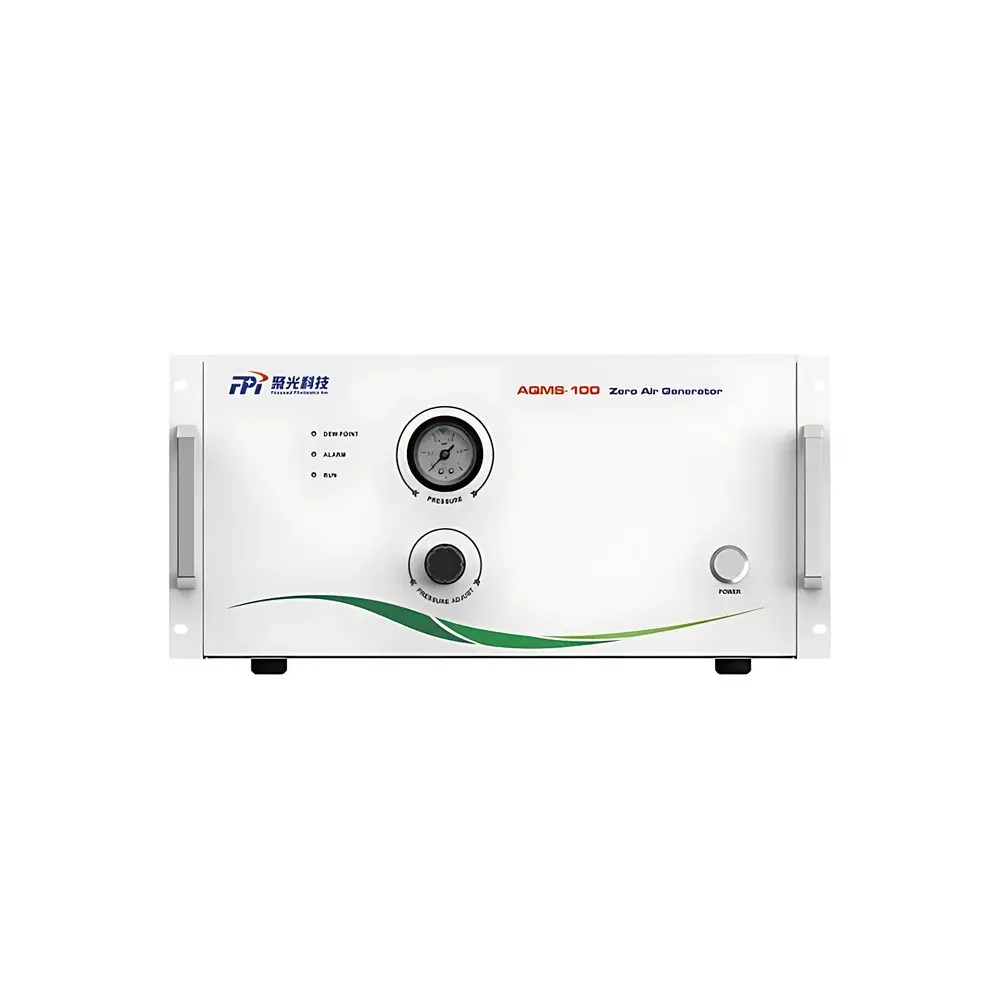
FPI AQMS-100 Zero Air Generator
| Brand | FPI |
|---|---|
| Origin | Zhejiang, China |
| Manufacturer Type | OEM/ODM Manufacturer |
| Product Category | Domestic (China-made) |
| Model | AQMS-100 |
| Pricing | Upon Request |
| Zero Air Purity | Not Specified |
| Flow Rate | Up to 20 L/min |
| Output Pressure | Adjustable |
| Dew Point | Not Specified |
| Flow Measurement Accuracy | Not Specified |
Overview
The FPI AQMS-100 Zero Air Generator is an engineered solution designed specifically for environmental monitoring laboratories and continuous emission monitoring systems (CEMS) requiring ultra-low contaminant air for calibration, instrument zeroing, and carrier gas applications. It operates on a multi-stage purification principle—combining catalytic oxidation, selective adsorption, molecular sieving, and particulate filtration—to remove trace gaseous interferents including CO, SO₂, O₃, H₂S, NO, NO₂, NH₃, volatile organic compounds (VOCs), and sub-micron particulates from compressed ambient air. The resulting zero air meets the stringent purity requirements defined in EPA Method TO-14A, ISO 8573-1 Class 1 (for particles), and ASTM D6167–22 for zero air used in ambient air quality analyzers. Unlike compressed cylinder-based alternatives, the AQMS-100 delivers consistent, on-demand zero air without logistical constraints or supply chain dependencies—critical for unattended operation in remote monitoring stations or 24/7 laboratory environments.
Key Features
- Stable, controllable output flow up to 20 L/min with continuously adjustable pressure regulation—optimized for compatibility with UV photometric ozone analyzers, chemiluminescence NOx analyzers, and FTIR gas monitors.
- Integrated dew point monitoring with audible and visual alarm triggers when condensation risk exceeds safe operational thresholds—supporting compliance with ISO 8573-3 for compressed air quality.
- Intelligent fault diagnostics with real-time status indicators for filter saturation, catalyst depletion, and system overpressure—enabling predictive maintenance scheduling per ISO 55001 asset management guidelines.
- Human-centered front-panel interface with intuitive LED display and tactile buttons—designed for rapid setup and minimal operator training, aligning with GLP-compliant lab workflows.
- Low-maintenance architecture featuring long-life catalytic converters (≥12 months under typical lab use), replaceable coalescing and activated carbon filters, and self-draining external air compressor integration for fully autonomous operation.
- Robust industrial-grade enclosure rated IP54, suitable for deployment in outdoor kiosks, mobile monitoring vans, and controlled laboratory spaces alike.
Sample Compatibility & Compliance
The AQMS-100 is validated for use with regulatory-grade ambient air monitoring platforms—including but not limited to Thermo Fisher Scientific 42i/43i series, Horiba APNA-370, and Teledyne API 400 series analyzers—as a primary zero air source during daily zero/span verification per EPA 40 CFR Part 58 Appendix A and EU Directive 2008/50/EC Annex IX. Its purified output supports method-defined zero air specifications for USP (residual solvent analysis), ASTM D6420–22 (GC carrier gas), and ISO 14644-1 cleanroom testing protocols where hydrocarbon-free air is required. All internal wetted materials comply with USP Class VI biocompatibility standards, and electrical safety conforms to IEC 61010-1:2010.
Software & Data Management
While the AQMS-100 operates as a standalone hardware unit, its analog output signals (0–5 V DC or 4–20 mA) are compatible with SCADA systems, LabVIEW-based DAQ platforms, and centralized CEMS data loggers. Optional RS-485 Modbus RTU interface enables remote status interrogation—including runtime hours, alarm history, and filter life estimation—for integration into enterprise-level CMMS (Computerized Maintenance Management Systems). Audit trails for critical events (e.g., dew point exceedance, power interruption recovery) are timestamped and retained locally for ≥30 days—supporting 21 CFR Part 11-aligned electronic record integrity when paired with validated third-party logging software.
Applications
- Zero-point calibration of ambient air quality analyzers (O₃, NOx, SO₂, CO) in national reference stations and urban monitoring networks.
- Carrier and makeup gas supply for GC-FID, GC-TCD, and online process gas chromatographs in petrochemical and semiconductor manufacturing facilities.
- Baseline drift correction in Fourier-transform infrared (FTIR) spectrometers used for stack emissions testing.
- Reference air generation for indoor air quality (IAQ) test chambers per ISO 16000-23 and ASTM E2925–21.
- Support gas for laser-based particle counters and condensation particle counters (CPCs) requiring hydrocarbon-free sheath air.
FAQ
What standards does the AQMS-100 meet for zero air purity?
It complies with EPA Method TO-14A trace-level contaminant limits (<0.1 ppb hydrocarbons, <0.5 ppb NO, <1 ppb SO₂), and satisfies ISO 8573-1 Class 1 for particles and Class 2 for water content when operated within specified ambient conditions.
Can the AQMS-100 be integrated into an existing CEMS rack?
Yes—it features standardized 19-inch rack-mount brackets (optional), 24 VDC or 110/220 VAC input flexibility, and analog/Modbus outputs compatible with major CEMS controllers including Siemens Desigo, Honeywell Experion, and Emerson DeltaV.
What maintenance intervals are recommended?
Pre-filters require replacement every 3 months; main catalytic and carbon beds every 12 months under continuous operation at ≤20 L/min; desiccant cartridges every 6 months—documented in the included GLP-compliant maintenance log template.
Is the unit suitable for use with portable analyzers in field deployments?
Yes—its shock-resistant chassis, wide operating temperature range (5–40 °C), and low acoustic noise (<55 dB(A)) make it appropriate for mobile labs and roadside monitoring units.
Does FPI provide IQ/OQ documentation support?
Yes—factory-verified Installation Qualification (IQ) and Operational Qualification (OQ) protocols are available upon request, aligned with ISO/IEC 17025 and GMP Annex 15 requirements.







