
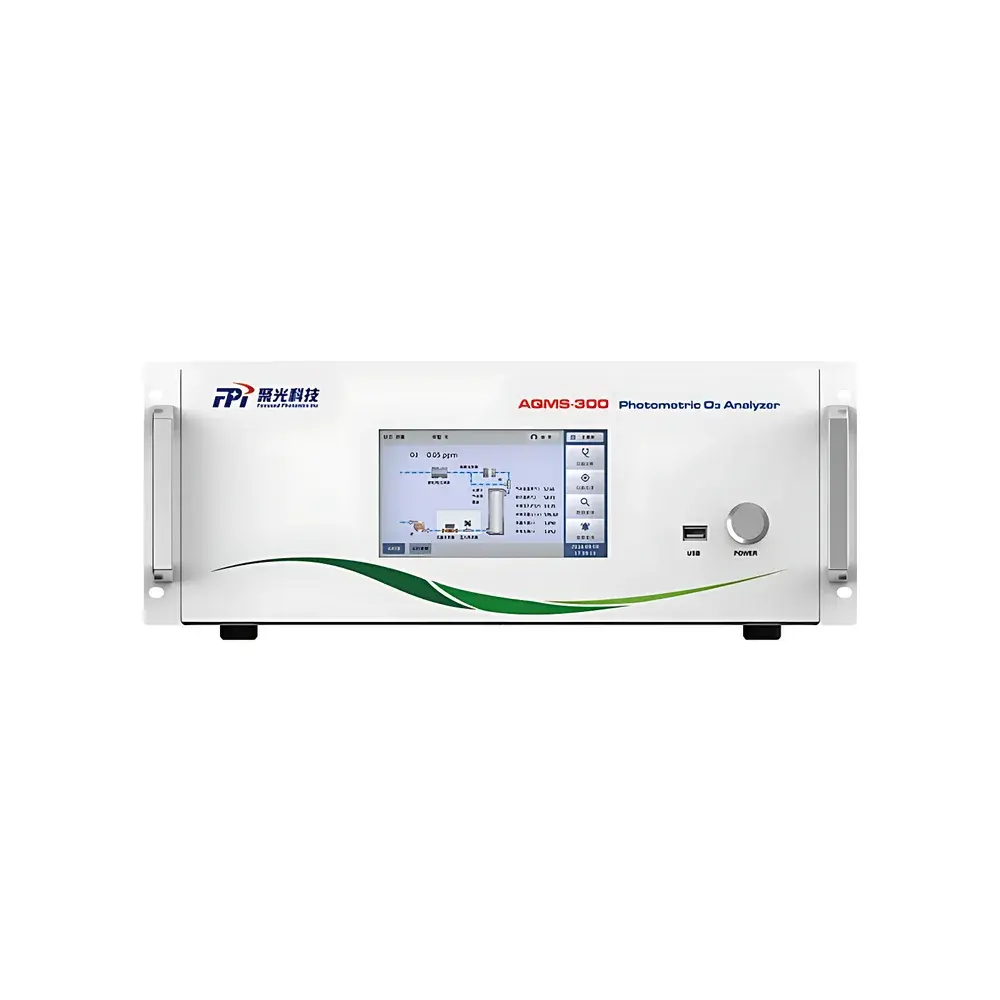
FPI AQMS-300 Ozone Analyzer
| Brand | FPI |
|---|---|
| Origin | Zhejiang, China |
| Manufacturer Type | OEM/ODM Manufacturer |
| Country of Origin | China |
| Model | AQMS-300 |
| Instrument Type | Online Fixed-Mount Analyzer |
| Detection Principle | UV Photometry (254 nm) |
| Compliance | Designed for EPA EQOA-01, ISO 13964, and EN 14625 compliance frameworks |
| Output Interfaces | RS232, RS485, Ethernet, 4–20 mA analog output |
| Calibration | Remote automatic zero/span calibration with programmable schedule |
| Lamp Monitoring | Integrated mercury lamp intensity self-diagnostic with lifetime estimation |
| Flow Protection | Auto-shutdown at sub-threshold sample flow rate |
| Security | Role-based remote access control with firmware upgrade authorization |
| Enclosure Rating | IP54 (indoor industrial use) |
Overview
The FPI AQMS-300 Ozone Analyzer is an online, fixed-position ultraviolet (UV) photometric analyzer engineered for continuous, high-reliability measurement of ozone (O₃) concentration in ambient air, stack emissions, and process gas streams. It operates on the fundamental Beer–Lambert law, utilizing dual-beam UV absorption at the characteristic 254 nm wavelength—where ozone exhibits strong and selective absorbance. The system implements time-multiplexed optical path switching: one beam passes through a catalytic ozone scrubber (removing O₃), while the other traverses unscrubbed sample gas. The differential absorbance between these two states yields a direct, interference-compensated ozone concentration value—eliminating drift from lamp aging, window fouling, or photodetector degradation. This architecture ensures long-term stability without reliance on external reference gases, making it suitable for unattended operation in regulatory-grade ambient monitoring networks and industrial emission compliance systems.
Key Features
- Dual-path UV photometry with real-time scrubber-integrated differential measurement for inherent zero-drift compensation
- Integrated mercury vapor lamp with continuous intensity monitoring and predictive lifetime estimation—enabling proactive maintenance scheduling
- Modular mechanical and electronic architecture: optical module, gas handling unit, and control board are independently serviceable to minimize downtime
- Programmable auto-calibration sequence supporting remote zero and span verification using internal or external ozone generators (span gas optional)
- Intelligent flow management: sampling pump automatically deactivates when volumetric flow falls below user-defined threshold (e.g., <0.8 L/min), preventing sensor contamination and extending component life
- Multi-layer security model: role-based authentication (operator, engineer, administrator), encrypted firmware updates, and audit-trail-enabled configuration changes compliant with GLP/GMP documentation requirements
- Industrial-grade I/O suite: isolated 4–20 mA analog output (NIST-traceable), RS232/RS485 serial interfaces, and 10/100BASE-T Ethernet with Modbus TCP and HTTP(S) API support
Sample Compatibility & Compliance
The AQMS-300 is validated for use with ambient air (EPA Method EQOA-01), flue gas (post-SCR/oxidation), indoor air quality (IAQ) ducts, and disinfection chamber effluents. Sample conditioning is compatible with standard Nafion dryers and particulate filters (0.3 µm cut-off). It meets the functional performance criteria outlined in ISO 13964:2022 (Ambient air—Determination of ozone—Ultraviolet photometric method) and EN 14625:2012+A1:2017 (Air quality—Standard reference method for the measurement of ozone in ambient air). While not certified as a Reference Equivalent Method (REM) per EU Directive 2008/50/EC without third-party validation, its design adheres to metrological traceability requirements for Class 1 ambient monitoring stations. All firmware and data logging modules support time-stamped, tamper-evident records aligned with FDA 21 CFR Part 11 Annex 11 principles for electronic records integrity.
Software & Data Management
The embedded Linux-based controller runs FPI’s OzoneLink™ firmware v3.2+, providing local web UI (HTTPS), RESTful JSON API, and native integration with SCADA platforms via Modbus TCP. Data logging includes raw photodiode voltages, scrubber status flags, lamp intensity metrics, flow rate history, and calibration event metadata—all timestamped to UTC with microsecond precision. Internal storage retains ≥12 months of 1-minute averaged data (configurable). Remote diagnostics include spectral baseline trending, optical path cleanliness scoring, and pump duty-cycle analytics. Firmware updates are delivered as signed packages with SHA-256 verification; rollback capability is retained for critical deployments.
Applications
- Ambient air quality monitoring networks (AQN) for regulatory reporting under national ambient air quality standards (NAAQS, EU AQD, China GB 3095-2012)
- Continuous emissions monitoring systems (CEMS) for ozone-generating processes (e.g., water treatment, semiconductor cleanrooms, pharmaceutical sterilization)
- Urban photochemical smog research requiring high-temporal-resolution O₃ time-series with low maintenance overhead
- Calibration laboratories performing transfer standards verification against primary UV photometers
- Indoor environmental quality (IEQ) assessment in hospitals, laboratories, and HVAC commissioning
FAQ
Does the AQMS-300 require periodic lamp replacement? How is lamp health monitored?
Yes—the mercury vapor lamp is a consumable with typical service life of 12–18 months under continuous operation. The instrument continuously measures relative UV intensity at 254 nm and extrapolates remaining operational life using factory-characterized decay curves. A warning triggers at 80% estimated end-of-life, and full shutdown occurs at 95% depletion unless overridden by authorized personnel.
Can the AQMS-300 be integrated into existing SCADA or EMS platforms?
Yes—it supports Modbus TCP (function codes 03/04/16), HTTP(S) GET/POST endpoints for real-time data retrieval, and MQTT over TLS for cloud telemetry. Configuration templates for Siemens Desigo, Honeywell Experion, and Schneider EcoStruxure are available upon request.
Is ozone scrubber regeneration required during operation?
No—the catalytic scrubber uses manganese dioxide (MnO₂) with >5-year service life under typical ambient conditions. No thermal or chemical regeneration is needed; replacement is only recommended after confirmed catalytic saturation via diagnostic mode.
What cybersecurity certifications does the device hold?
The AQMS-300 conforms to IEC 62443-3-3 SL1 requirements for industrial control systems. It implements TLS 1.2+ encryption, RBAC with password complexity enforcement (8+ chars, upper/lower/digit/symbol), and secure boot with signed firmware images. Third-party penetration test reports are available under NDA.
How is measurement traceability maintained across instrument fleets?
Each unit ships with a factory calibration certificate referencing NIST-traceable ozone standards (SRM 2690c). Field recalibration uses documented procedures aligned with ISO/IEC 17025:2017, and all calibration events—including operator ID, timestamp, and deviation logs—are immutably stored in the device’s audit trail database.







