
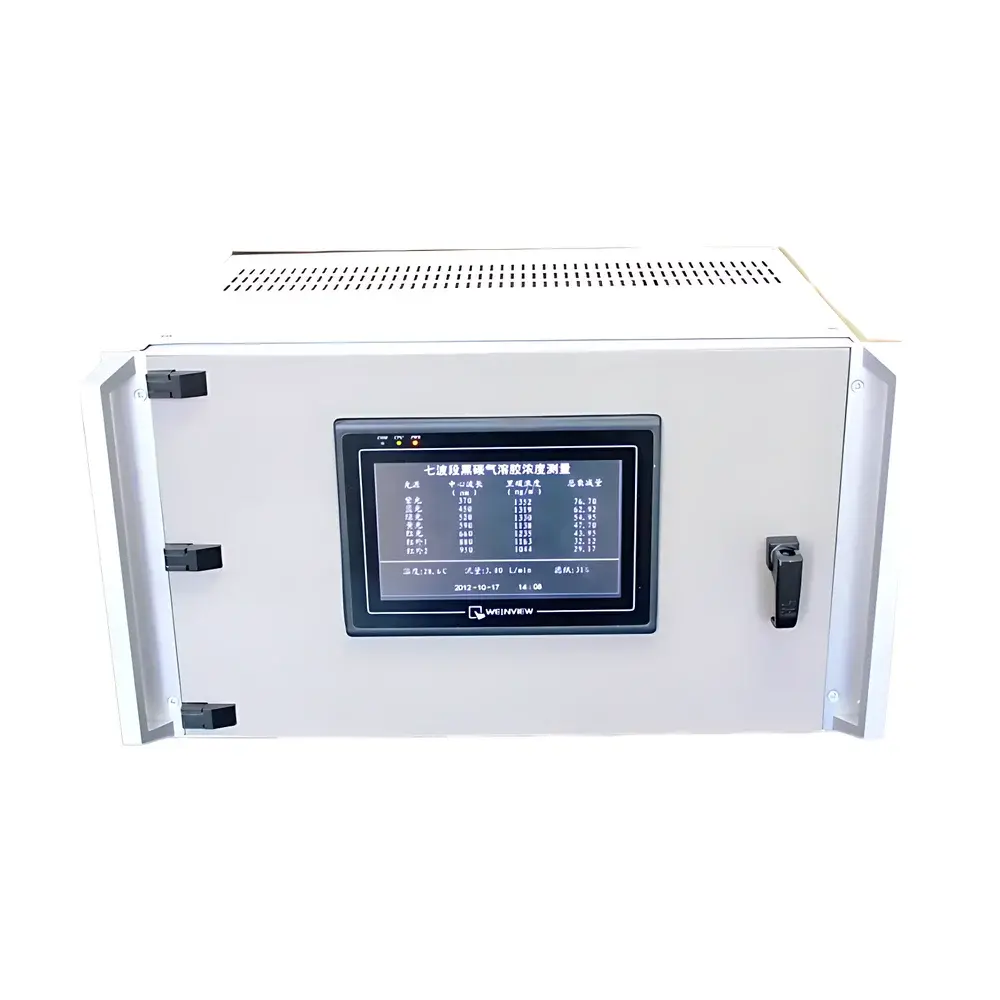
FPI BC-7000 Atmospheric Black Carbon Aerosol Analyzer
| Brand | FPI (Focus Photonics Inc.) |
|---|---|
| Origin | Zhejiang, China |
| Manufacturer Type | OEM Manufacturer |
| Instrument Type | Aerosol Black Carbon Analyzer |
| Measurement Principle | Optical Attenuation (Filter-Based Transmission) |
| Wavelength Channels | 7-channel (370, 450, 520, 590, 660, 880, 950 nm) |
| Primary Output | Black Carbon Mass Concentration (µg/m³) and Wavelength-Dependent Absorption Coefficient (Mm⁻¹) |
| Compliance | QX/T 68–2007 (China Meteorological Administration Standard) |
| Flow Control | Integrated Precision Mass Flow Controller |
| Detection System | Dual Photodetector Correction + Charge-Integrating ADC Architecture |
| Data Output | Real-time, Continuous, On-line |
Overview
The FPI BC-7000 Atmospheric Black Carbon Aerosol Analyzer is a research-grade, filter-based optical attenuation instrument engineered for continuous, real-time quantification of elemental carbon (EC) — commonly referred to as black carbon (BC) — in ambient aerosols. It operates on the principle of light transmission attenuation across a particle-laden quartz fiber filter tape: as aerosols are drawn through the filter at a controlled volumetric flow rate, BC deposits accumulate, progressively reducing the intensity of incident light at multiple discrete wavelengths. The instrument calculates BC mass concentration using the attenuation-to-mass conversion factor derived from the well-established Beer–Lambert relationship, calibrated against reference standards traceable to NIST-traceable soot materials. Designed specifically for long-term unattended operation in field monitoring stations, urban air quality networks, and atmospheric science laboratories, the BC-7000 delivers high temporal resolution (1–5 minute averaging intervals), low detection limits (<0.1 µg/m³ at 5-minute integration), and robust performance under variable humidity and temperature conditions.
Key Features
- Seven-wavelength optical detection system (370, 450, 520, 590, 660, 880, and 950 nm) enables spectral absorption analysis critical for source apportionment and refractive index estimation.
- Dual photodetector correction architecture compensates for filter loading artifacts, lamp drift, and scattering interference — significantly improving measurement reproducibility across extended deployment cycles.
- Charge-integrating analog-to-digital converter (ADC) with ultra-low noise floor ensures high-fidelity acquisition of weak photocurrent signals, particularly at low BC concentrations and short time bases.
- Integrated thermal mass flow controller maintains stable sampling flow (typically 16.7 L/min ±1%) independent of ambient pressure and temperature fluctuations, meeting ISO 21501-4 requirements for aerosol sampling consistency.
- Automated periodic zero calibration via clean-air purge and reference filter blanking, supporting GLP-compliant data integrity protocols.
- Onboard data logging with timestamped, dual-channel output: BC mass concentration (µg/m³) and wavelength-resolved absorption coefficient (Mm⁻¹) at each channel.
Sample Compatibility & Compliance
The BC-7000 is optimized for ambient airborne particulate matter (PM2.5 and PM10) collected on Pallflex EFA-0600WT or Zefluor 25-mm quartz fiber filters. It is compatible with standard inlet systems including PM2.5 cyclones, virtual impactors, and diffusion dryers (optional). The instrument complies fully with QX/T 68–2007, the only nationally endorsed standard in China for optical attenuation–based BC measurement. While not certified to EPA PS-11 or EN 12341, its methodology aligns with the scientific consensus underpinning EC quantification in IPCC AR6 and WHO Global Air Quality Guidelines. Data outputs support audit-ready traceability for environmental monitoring programs operating under ISO/IEC 17025 or national air quality reporting frameworks.
Software & Data Management
The BC-7000 interfaces via RS-232 or Ethernet to FPI’s BC-View™ software suite, which provides real-time visualization, spectral fitting (e.g., Ångström exponent calculation), and automated flagging of filter saturation or flow anomalies. Raw attenuation data, flow logs, and diagnostic parameters are stored in ASCII-delimited files compliant with FAIR data principles. Export formats include CSV, NetCDF, and EPA AQS-compatible XML schemas. The system supports optional 21 CFR Part 11–compliant user access control, electronic signatures, and audit trail generation when deployed in regulated QA/QC environments.
Applications
- Long-term trend analysis of BC in urban, rural, and background monitoring sites.
- Source identification and contribution assessment using multi-wavelength absorption signatures (e.g., distinguishing traffic vs. biomass burning BC).
- Validation of satellite-derived aerosol absorption products (e.g., from PACE, TEMPO, or Sentinel-5P).
- Process studies linking BC optical properties to aging, coating thickness, and mixing state via tandem differential mobility analyzer (TDMA) or volatility tandem DMA (V-TDMA) coupling.
- Health impact research correlating BC exposure metrics with respiratory morbidity endpoints in epidemiological cohorts.
FAQ
What is the primary measurement principle used by the BC-7000?
It employs filter-based optical attenuation at seven discrete wavelengths, applying the mass-specific attenuation cross-section (σATN) model to derive black carbon mass concentration.
Does the instrument require external calibration gases or reference standards during routine operation?
No—zero calibration is performed internally using filtered air; span calibration is recommended annually using NIST-traceable diesel soot reference material (e.g., NIST SRM 2975) or equivalent certified BC standards.
Can the BC-7000 operate unattended for extended periods?
Yes—designed for continuous 24/7 operation with automatic filter tape advancement, self-diagnostic routines, and remote monitoring capability via Modbus TCP or SNMP.
Is the data output compatible with international air quality databases such as EEA or AQS?
Yes—output formats and metadata structures conform to EEA AirBase and U.S. EPA AQS Level 2 specifications, including required units, uncertainty flags, and QC status codes.
How does the dual-detector system improve measurement accuracy?
One detector measures sample-side attenuation; the other monitors reference-beam stability in real time, enabling dynamic correction for lamp intensity drift, filter heterogeneity, and scattering-induced bias.
Related Products







