
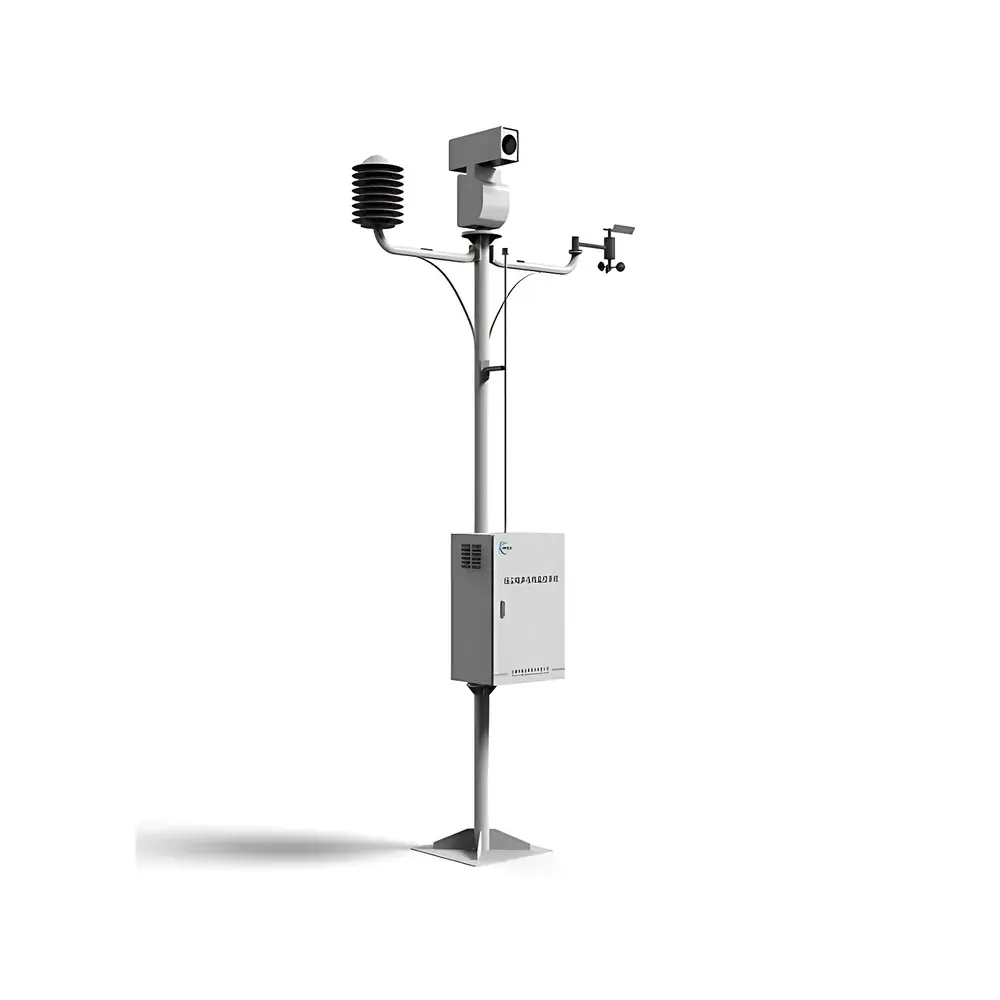
FPI CDMS-1000 Urban Dust Online Monitoring System
| Brand | FPI (Hangzhou Focus Science & Technology Co., Ltd.) |
|---|---|
| Origin | Zhejiang, China |
| Manufacturer Type | OEM/ODM Manufacturer |
| Country of Origin | China |
| Model | CDMS-1000 |
| Pricing | Available Upon Request |
Overview
The FPI CDMS-1000 Urban Dust Online Monitoring System is an integrated environmental monitoring platform engineered for continuous, real-time surveillance of airborne particulate matter (PM) and associated ambient parameters in urban and peri-urban settings. Built upon FPI’s proprietary optical sensing architecture, the system employs forward light scattering technology to quantify mass concentrations of total suspended particles (TSP), PM10, and PM2.5—with optional cyclone-based size-selective inlets compliant with ISO 7708 and EN 481 standards. Unlike point-sampling gravimetric or beta-attenuation methods, the CDMS-1000 delivers rapid-response, high-temporal-resolution data without consumables or manual filter changes. Its operational design addresses regulatory requirements for construction site compliance, municipal air quality management, and event-driven emission control—particularly during major public events where dust suppression enforcement must be auditable and traceable.
Key Features
- Multi-parameter synchronous acquisition: Simultaneous measurement of PM mass concentration (TSP/PM10/PM2.5), A-weighted sound pressure level (LAeq, Lmax, Lmin), and meteorological variables—including wind speed/direction, temperature, relative humidity, and atmospheric pressure.
- Intelligent visual correlation: Integrated high-definition pan-tilt-zoom (PTZ) camera with auto-triggering logic—activates on PM exceedance, records synchronized video/audio, and performs wind-direction-informed reverse-angle imaging to identify probable emission sources.
- Robust environmental resilience: Operational range from −30 °C to +50 °C; cold-start capability at −30 °C; non-volatile memory retention of configuration and calibration history during power interruption.
- Self-maintaining optical sensor: Equipped with automatic desiccant regeneration, pulsed air self-cleaning (reverse blowback), and zero-point drift compensation—reducing field maintenance intervals to ≤6 months under typical urban deployment conditions.
- Modular hardware architecture: Decoupled subsystems (particulate analyzer, acoustic module, meteorological station, communication unit) enable hot-swappable replacement and field-level diagnostics without full-system downtime.
Sample Compatibility & Compliance
The CDMS-1000 is validated for long-term deployment in heterogeneous urban microenvironments—including construction perimeters, arterial roadways, municipal open spaces, industrial stockyards, and mining access zones. Its particulate measurement methodology aligns with reference-equivalent performance criteria defined in HJ 653–2013 (China), EPA Method PS-11, and EU CEN/TS 16450:2017 for optical aerosol monitors. Meteorological sensors meet WMO Class B specifications. Acoustic measurements conform to IEC 61672-1:2013 Class 2. All embedded firmware and data transmission protocols support audit-ready logging required under local environmental supervision frameworks and are compatible with national-level platforms such as China’s National Urban Air Quality Real-time Publishing Platform.
Software & Data Management
The system interfaces with FPI’s cloud-native Environmental Intelligence Platform (EIP), a web-based application supporting multi-tier administrative access (municipal, district, site-level). EIP provides GIS-integrated mapping with real-time layering of PM and noise values across monitored nodes; dynamic heatmaps generated via spatial interpolation (IDW method) overlaid with wind vector fields for source attribution analysis. The platform supports automated reporting per GB 3095–2012 and HJ 633–2012 thresholds, including SMS/email alerts on parameter exceedance, statistical summaries (hourly/daily/weekly/monthly), and exportable CSV/PDF reports compliant with internal QA/QC documentation workflows. Full audit trail functionality—including user login history, parameter modification logs, and data ingestion timestamps—is retained for ≥18 months, satisfying GLP-aligned data integrity expectations.
Applications
- Regulatory enforcement at construction sites: Automated detection of unauthorized excavation or demolition activity through correlated PM spikes and PTZ-triggered visual verification.
- Municipal road dust management: Longitudinal trend analysis of roadside PM10 coupled with traffic volume and precipitation data to optimize street sweeping frequency.
- Event-based air quality assurance: Pre-event baseline profiling and real-time threshold monitoring during national conferences, sports events, or cultural festivals.
- Industrial boundary monitoring: Continuous assessment of fugitive dust emissions from bulk material handling facilities, quarries, and thermal power plant coal yards.
- Urban epidemiological studies: High-resolution spatiotemporal PM2.5 datasets integrated with health registry data for exposure–response modeling.
FAQ
Does the CDMS-1000 comply with Chinese national ambient air quality standards?
Yes—the system’s PM measurement performance meets the technical requirements of HJ 653–2013 and is certified by provincial-level environmental metrology institutes.
Can the system operate independently without a central server?
Yes—local edge storage retains 30 days of raw data; all modules function autonomously during network outages and resume synchronized upload upon reconnection.
Is remote calibration supported over cellular networks?
Automatic zero calibration is performed daily; span calibration requires physical reference aerosol injection but can be scheduled and initiated remotely via secure TLS-encrypted command interface.
What data security protocols are implemented?
All data transmissions use AES-256 encryption; platform authentication follows OAuth 2.0; database backups adhere to ISO/IEC 27001-aligned retention policies.
How is meteorological data used in source identification?
Wind direction and speed data drive the PTZ camera’s inverse-path targeting algorithm and feed into dispersion modeling modules within the EIP software for probabilistic source localization.
Related Products







