
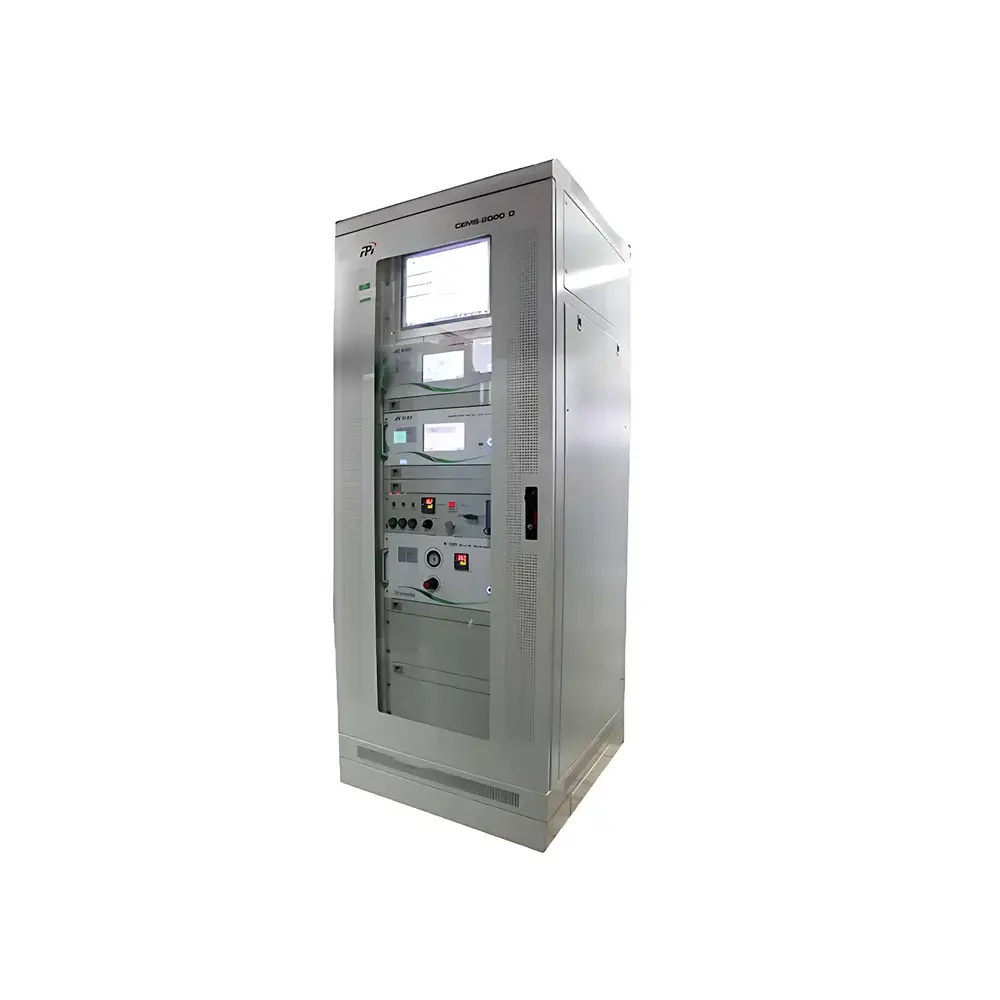
FPI CEMS-2000 D Dilution-Extractive Continuous Emission Monitoring System
| Brand | FPI (Fortune Photonics Instrumentation) |
|---|---|
| Origin | Zhejiang, China |
| Manufacturer Type | Original Equipment Manufacturer (OEM) |
| Product Category | Domestic |
| Model | CEMS-2000 D |
| Instrument Type | Continuous Emission Monitoring System (CEMS) |
| Measured Parameters | SO₂, NOₓ (NO + NO₂), O₂, H₂O (wet-basis) |
| Analytical Methods | Ultraviolet Fluorescence (SO₂), Chemiluminescence (NOₓ), Capacitive Humidity Sensing (H₂O), Zirconia Electrochemical Cell (O₂) |
| System Architecture | Dilution-extractive sampling with integrated calibration, data acquisition, and communication modules |
| Compliance Framework | Designed to support compliance with GB/T 16157, HJ 75–2017, HJ 76–2017, and compatible with EPA Method 6C / 7E / 3A / 4 for reference equivalence |
Overview
The FPI CEMS-2000 D is a dilution-extractive Continuous Emission Monitoring System engineered for long-term, unattended operation in demanding industrial flue gas environments. Unlike extractive systems operating at raw gas temperature or cold-dry configurations requiring aggressive conditioning, the CEMS-2000 D employs a precisely controlled, heated dilution probe that draws hot, moist flue gas and mixes it with clean, dry zero air at a fixed, certified dilution ratio (typically 50:1 to 100:1). This process lowers the dew point of the sample stream well below ambient conditions—enabling transport through standard heated sample lines to the analyzer shelter without condensation, corrosion, or analyte loss. The system integrates four core analytical modules: ultraviolet fluorescence detection for SO₂, chemiluminescence detection for NO and NO₂ (summed as NOₓ), zirconia-based electrochemical sensing for O₂, and capacitive humidity measurement for H₂O concentration—enabling true wet-basis quantification without external drying or permeation devices.
Key Features
- Dilution-extractive architecture eliminates need for gas cooling, refrigerated dryers, or Nafion™ dryers—preserving SO₂ and NOₓ integrity during sampling
- Heated, stainless-steel dilution probe with integrated filter and automatic purge cycle minimizes particulate fouling and extends maintenance intervals beyond 90 days under typical coal-fired boiler conditions
- On-board zero/span calibration capability using certified gas standards (NIST-traceable), supporting automated daily or user-scheduled verification per HJ 75–2017 requirements
- Modular analyzer design allows field-replaceable optical cells, reaction chambers, and sensor cartridges—reducing mean time to repair (MTTR) to under 30 minutes
- Embedded Linux-based data acquisition unit with dual Ethernet ports, RS-485/232 interfaces, and native Modbus TCP/RTU protocol stack for seamless integration into plant DCS and environmental information platforms
- Real-time data logging with 1-second resolution, local SD card storage (≥1 year at 1-min intervals), and optional 4G/LTE telemetry for remote diagnostics and firmware updates
Sample Compatibility & Compliance
The CEMS-2000 D is validated for continuous operation across flue gas matrices from coal-fired power plants, municipal solid waste incinerators, pulp & paper recovery boilers, and catalytic cracking units in petrochemical refineries. Its dilution approach inherently accommodates high moisture content (up to 25% v/v), elevated particulate loading (<100 mg/Nm³), and transient temperature fluctuations (120–220 °C at probe tip). All analytical methods conform to Chinese national standards GB/T 16157 (sampling), HJ 75–2017 (performance testing), and HJ 76–2017 (technical specification for CEMS). System architecture supports audit-ready data integrity features including electronic signatures, immutable event logs, and time-stamped calibration records—aligning with GLP-aligned operational practices and facilitating third-party verification against ISO/IEC 17025 requirements.
Software & Data Management
FPI CEMS Manager™ software provides a browser-based interface for configuration, real-time monitoring, historical trend analysis, and regulatory reporting. It generates automated compliance reports in XML format compliant with China’s National Environmental Monitoring Network (NEMN) data upload protocols. The software includes configurable alarm thresholds, drift compensation algorithms, and statistical process control (SPC) charts for key parameters. Audit trails record all user actions—including parameter changes, calibration events, and manual overrides—with SHA-256 hashing and timestamping. Data export supports CSV, PDF, and OPC UA server connectivity for enterprise-level integration. Optional FDA 21 CFR Part 11-compliant mode enables electronic signature enforcement and role-based access control for regulated facilities.
Applications
- Coal- and biomass-fired thermal power generation units subject to ultra-low emission standards (e.g., ≤35 mg/Nm³ SO₂, ≤50 mg/Nm³ NOₓ)
- Municipal solid waste (MSW) and hazardous waste incineration plants requiring continuous HCl, HF, and dioxin precursor monitoring (with optional add-on modules)
- Kraft recovery boilers in pulp & paper mills where high alkali content and sticky condensables challenge conventional CEMS
- Fluid catalytic cracking (FCC) and delayed coking units in refineries where hydrocarbon slip and catalyst fines necessitate robust sampling design
- Cement kilns and glass melting furnaces operating under high-dust, high-alkali conditions
FAQ
What is the certified dilution ratio range for the CEMS-2000 D system?
The system operates at factory-calibrated dilution ratios of 50:1, 75:1, or 100:1 (sample:zero air), each verified via gravimetric flow calibration and documented in the system’s Certificate of Conformance.
Does the system support wet-basis reporting required by Chinese emission standards?
Yes—the integrated capacitive H₂O sensor enables direct, real-time moisture measurement, allowing all gaseous concentrations to be reported on a wet-basis without mathematical correction or external humidity input.
How does the system handle calibration traceability?
All internal calibration gases are supplied in NIST-traceable cylinders certified to ISO 6141; calibration events are logged with gas lot numbers, expiration dates, and pressure decay verification timestamps.
Can the CEMS-2000 D integrate with existing DCS or SCADA infrastructure?
Yes—native Modbus TCP/RTU, OPC UA, and analog 4–20 mA outputs (optional) ensure plug-and-play compatibility with Siemens Desigo, Honeywell Experion, Emerson DeltaV, and ABB 800xA systems.
Is remote diagnostic support available outside business hours?
FPI offers 24/7 secure remote access via encrypted VPN tunnel; engineers can monitor instrument health, retrieve diagnostic logs, and perform firmware updates without onsite presence.
Related Products







