
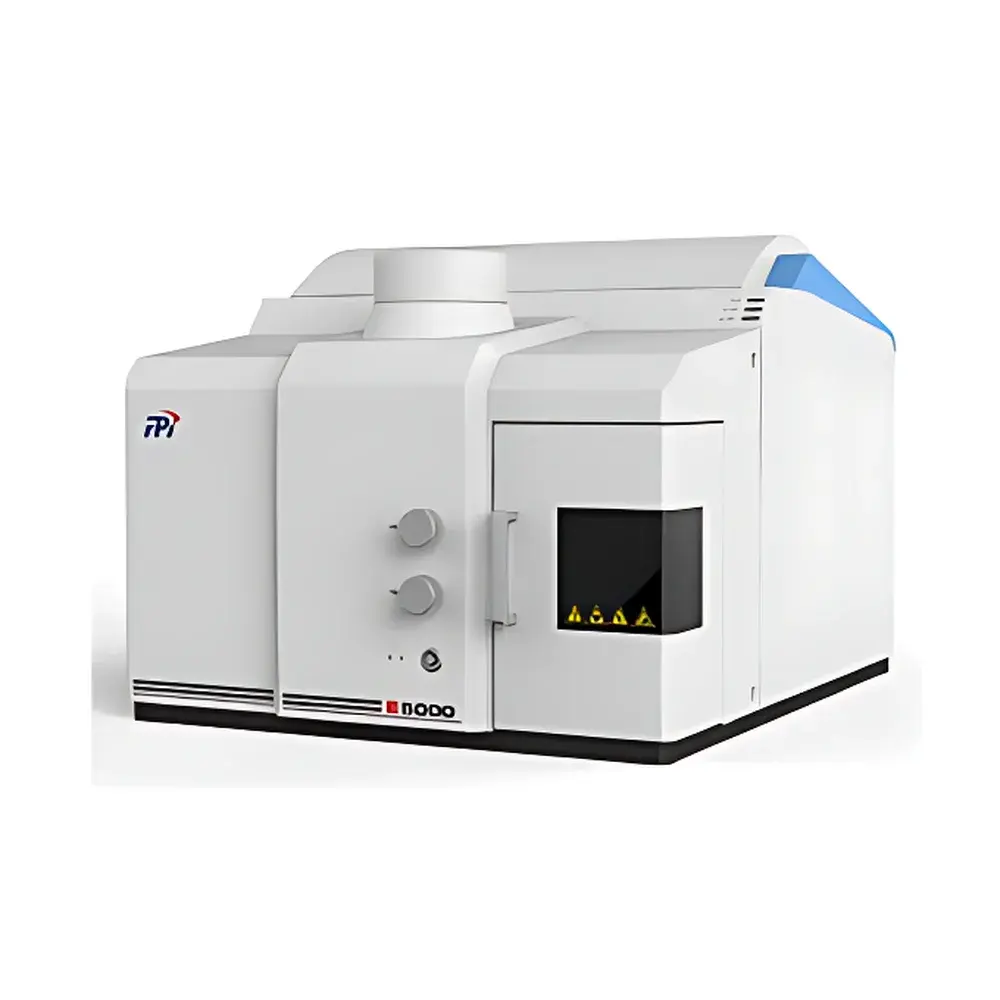
FPI E5000 Arc-Excited Direct-Reading Emission Spectrometer
| Brand | FPI |
|---|---|
| Origin | Zhejiang, China |
| Model | E5000 |
| Instrument Type | Benchtop |
| Excitation Source | High-Power Numerically Controlled Arc |
| Detector | CCD Array |
| Focal Length | 400 mm |
| Grating Grooves | 2400 lines/mm |
| Wavelength Range | 190 nm – 680 nm |
| Detection Mode | Full-Spectrum Simultaneous Acquisition |
| Optical Design | Paschen–Runge Mount |
| Cooling | Water-Cooled Electrodes & Arc Source |
| Safety Interlocks | Real-Time Monitoring of Cooling Water Flow, Exhaust Ventilation, and Torch Chamber Door Status |
| Software Compliance | Supports Audit Trail, User Access Control, and Method Validation per GLP/GMP Requirements |
| Data Acquisition | Overflow-Protected CCD with Dynamic Integration |
Overview
The FPI E5000 Arc-Excited Direct-Reading Emission Spectrometer is a benchtop analytical instrument engineered for rapid, precise elemental analysis of solid conductive and non-conductive powdered samples via arc emission spectroscopy. It operates on the principle of atomic emission spectroscopy (AES), where a high-energy electric arc vaporizes and atomizes sample material, exciting electrons in constituent elements; subsequent relaxation emits characteristic photons across the UV–visible spectrum (190–680 nm). The emitted light is dispersed by a fixed Paschen–Runge optical system featuring a 400 mm focal length and 2400 lines/mm holographic grating, enabling high-resolution spectral separation. A thermally stabilized, all-reflective optical path minimizes thermal drift and mechanical misalignment, while an overflow-protected CCD array detector captures the full spectrum simultaneously—eliminating sequential scanning delays and ensuring consistent integration time across all wavelengths. Unlike spark-based or ICP-OES systems, the E5000’s arc excitation provides superior sensitivity for refractory elements (e.g., B, C, P, S, As, Sn) in metallurgical powders, ores, ceramics, and geological matrices without requiring dissolution or pelletization.
Key Features
- High-power numerically controlled arc source with programmable current, voltage, and frequency parameters—enabling optimization for trace vs. major element detection and suppression of matrix effects
- Automated infrared laser-guided electrode alignment system ensuring reproducible inter-electrode gap (±2 µm precision) and minimizing manual intervention
- Compact Paschen–Runge optical mount with sealed, temperature-stabilized spectrometer chamber—reducing thermal lensing and long-term wavelength drift to <0.005 nm/h
- Full-spectrum CCD acquisition architecture supporting simultaneous detection of >10,000 spectral data points per exposure, facilitating robust background modeling and interference correction
- Dynamic integration algorithm extending effective linear dynamic range of the CCD beyond 10⁵:1 without hardware binning or gain switching
- Integrated water-cooling loop for both arc generator and electrode holder—maintaining thermal equilibrium during extended multi-sample runs
- Hardware-enforced safety interlocks monitoring coolant flow rate, exhaust airflow, chamber door status, and critical component temperatures—with real-time visual alerts and automatic source shutdown on fault detection
Sample Compatibility & Compliance
The E5000 accepts directly loaded solid powder samples (5–200 mg), including ferrous and non-ferrous metal powders, sintered alloys, catalysts, mineral concentrates, and ceramic precursors. Non-conductive samples are analyzed using graphite or copper powder dilution with certified reference materials (CRMs) traceable to NIST SRMs. The system complies with ISO/IEC 17025 requirements for calibration and measurement uncertainty estimation. Its software architecture supports 21 CFR Part 11–compliant audit trails, electronic signatures, and role-based access control—making it suitable for regulated environments operating under GLP or GMP frameworks. All spectral calibrations are performed using CRMs aligned with ASTM E1184 and ISO 11575 standards for emission spectrometry.
Software & Data Management
The E5000’s proprietary analysis platform provides a hierarchical, context-sensitive interface designed for both routine operators and method developers. It includes pre-loaded certified calibration curves for over 30 elements (Al, Ca, Cr, Cu, Fe, Mg, Mn, Ni, Si, Ti, V, Zn, etc.), each with multiple analytical lines optimized for concentration range and spectral interference profile. Advanced algorithms include multi-peak Gaussian fitting for line deconvolution, adaptive background subtraction (left/right edge, linear, and curved models), and intelligent spectral drift correction using internal reference lines. Raw spectral data (intensity vs. pixel) is stored in HDF5 format with embedded metadata (instrument configuration, environmental conditions, operator ID). Export options include CSV, XML, and PDF reports compliant with LIMS integration protocols. Method validation tools support limit of detection (LOD), limit of quantification (LOQ), repeatability (RSD < 1.5% at mid-range), and spike recovery testing.
Applications
The E5000 delivers quantitative elemental composition data for quality control in powder metallurgy, additive manufacturing feedstock verification, catalyst formulation, and raw material certification. Its arc excitation enables reliable determination of light elements (C, N, O, P, S) in steel and superalloy powders—where spark sources often yield poor precision due to surface oxidation. In geochemical laboratories, it supports rapid screening of exploration core samples and tailings analysis without acid digestion. Environmental labs use it for heavy metal speciation in fly ash and slag, while R&D teams leverage its open-method architecture to develop custom calibrations for novel composite materials. The instrument’s ability to analyze unprepared powders reduces sample preparation time by >70% compared to wet-chemistry or XRF workflows.
FAQ
What sample forms are compatible with the E5000?
Powdered solids (conductive or non-conductive), typically sieved to <75 µm particle size. Graphite or copper powder dilution is used for insulators.
Does the E5000 require daily standardization?
No—its intelligent drift correction algorithm uses internal reference lines to maintain calibration stability for up to 8 hours of continuous operation.
Can the E5000 quantify light elements like carbon and sulfur?
Yes—its UV-sensitive CCD and 190 nm low-wavelength cutoff enable direct measurement of C I (193.09 nm), S I (180.73 nm), and P I (178.28 nm) with detection limits of 5–20 ppm depending on matrix.
Is method development supported?
Yes—the software exposes all acquisition parameters (integration time, gate delay, arc timing sequence) and provides spectral visualization tools for line selection, interference assessment, and multivariate regression modeling.
How is data integrity ensured?
All analyses generate immutable records with timestamps, operator credentials, instrument state logs, and raw spectral files—fully traceable and exportable for regulatory review.
Related Products




