
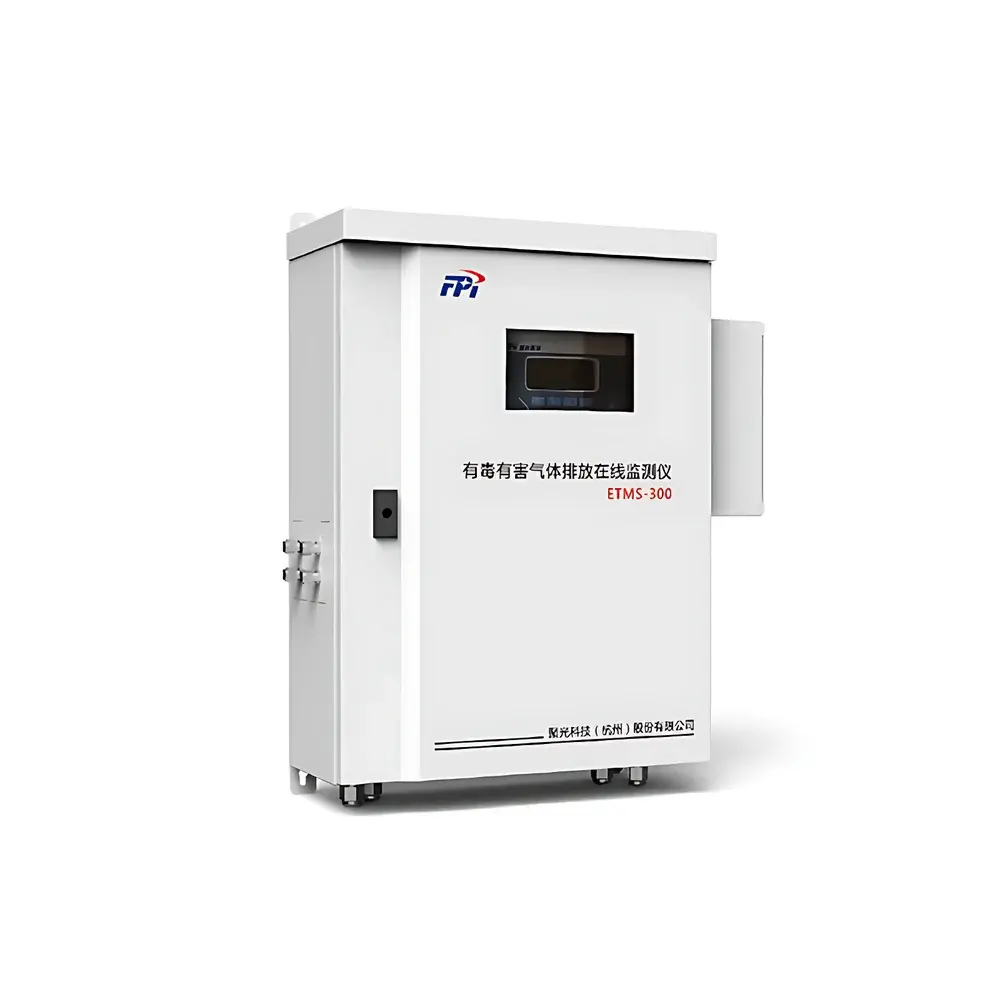
FPI ETMS-300 Inorganic Exhaust Gas Online Monitoring System
| Brand | FPI |
|---|---|
| Origin | Zhejiang, China |
| Manufacturer Type | Original Equipment Manufacturer (OEM) |
| Country of Origin | China |
| Model | ETMS-300 |
| Pricing | Available Upon Request |
Overview
The FPI ETMS-300 Inorganic Exhaust Gas Online Monitoring System is an industrial-grade, real-time emission monitoring solution engineered for continuous measurement of inorganic gaseous pollutants in exhaust streams from chemical manufacturing, metallurgical processing, and other heavy industrial facilities. Unlike optical or chromatographic analyzers, the ETMS-300 employs electrochemical and metal oxide semiconductor (MOS) sensor technology—proven for high selectivity and stability in harsh, variable-concentration environments typical of inorganic process off-gases. The system operates on a direct-sampling principle with integrated gas conditioning, enabling reliable quantification of key regulatory analytes including hydrogen sulfide (H₂S), carbon monoxide (CO), chlorine (Cl₂), ammonia (NH₃), nitrogen dioxide (NO₂), and sulfur dioxide (SO₂). Designed to meet the operational demands of continuous emissions monitoring systems (CEMS) in non-ferrous smelting, acid production, and waste incineration plants, the ETMS-300 delivers robust performance across ambient temperatures ranging from −20 °C to +50 °C, with optional heated sample lines maintaining line temperature above 120 °C to prevent condensation and adsorptive loss of reactive species.
Key Features
- Multi-analyte capability: Simultaneous real-time monitoring of up to four inorganic gases via modular sensor cartridges—each calibrated and certified per IEC 60079-29-1 for hazardous area use.
- Integrated sample conditioning: Features a multi-stage pre-treatment unit comprising sintered stainless-steel particulate filtration (≤0.5 µm), precision mass flow control (±1% full scale), and automated ultrasonic cleaning cycles to maintain sensor integrity during extended unattended operation.
- Heated gas path architecture: Entire sample transport line—from probe tip to sensor chamber—is actively heated and insulated to ≥130 °C, minimizing wall adsorption losses of polar or reactive compounds such as H₂S and NH₃, thereby preserving measurement fidelity and reducing zero drift.
- Intrinsically safe & compact form factor: Certified to ATEX II 2G Ex db IIB T4 Gb / IECEx DBEX 22.0027X for Zone 1 installation; footprint measures only 450 × 320 × 210 mm (W × D × H), enabling direct mounting at stack or duct interface—eliminating long sample lines and associated lag time or cross-interference.
- Intuitive human-machine interface: 7-inch resistive touchscreen with localized Chinese-language UI, supporting on-device calibration verification, alarm threshold configuration, and diagnostic status reporting without external software dependency.
Sample Compatibility & Compliance
The ETMS-300 is validated for use with flue gases containing particulate loadings ≤100 mg/m³, moisture content ≤20% v/v, and operating pressures from −5 to +5 kPa(g). It complies with China’s HJ 75-2017 and HJ 76-2017 technical specifications for CEMS, and its sensor modules conform to GB/T 30431–2021 for laboratory and field gas analyzers. While not certified to EPA Method 30B or EN 15267, the system supports data export in Modbus RTU and TCP/IP protocols for integration into third-party SCADA or environmental management information systems (EMIS) compliant with ISO 14001 and ISO 50001 frameworks. All firmware logs include timestamped audit trails for maintenance actions and calibration events, satisfying basic GLP traceability requirements.
Software & Data Management
Data acquisition is handled by embedded Linux-based firmware with dual SD card redundancy for local storage (up to 18 months of 1-minute averaged records). Raw sensor outputs are linearized using factory-applied polynomial correction coefficients traceable to NIM (National Institute of Metrology, China) reference standards. Export formats include CSV and XML, compatible with national environmental monitoring platforms such as China’s National Emission Permit Management Information Platform. Remote access is supported via secure HTTPS and SSH, with role-based user permissions (operator, technician, administrator). Optional cloud synchronization enables centralized fleet monitoring through FPI’s proprietary iMonitor platform—supporting automated report generation aligned with provincial environmental bureau templates.
Applications
- Continuous compliance monitoring of stack emissions from sulfuric acid production units and phosphate fertilizer plants.
- Process safety interlock support in chlorine-alkali electrolysis facilities, where rapid detection of Cl₂ or H₂ leakage is critical.
- Workplace air quality surveillance in enclosed reactor halls handling volatile inorganic reagents (e.g., HF, HCl, NH₃).
- Environmental impact assessment (EIA) baseline studies and post-commissioning verification testing for new chemical production lines.
- Integration into smart factory architectures for predictive maintenance of scrubber efficiency via trend analysis of inlet/outlet H₂S and SO₂ ratios.
FAQ
Does the ETMS-300 support automatic zero/span calibration?
Yes—the system includes programmable auto-calibration sequences using external standard gas cylinders (certified to GB/T 5274), with configurable frequency and pass/fail criteria based on ±2% span deviation tolerance.
Can sensor modules be replaced in-field without system downtime?
Each sensor cartridge is hot-swappable; full replacement takes under 5 minutes and triggers automatic re-initialization and baseline stabilization—no firmware reload required.
Is the system compatible with third-party data acquisition servers?
Yes—Modbus RTU (RS-485) and Modbus TCP (Ethernet) interfaces are standard; OPC UA and MQTT adapters are available as optional add-ons.
What is the recommended maintenance interval for the pre-treatment unit?
Filter elements require replacement every 3 months under continuous operation; the ultrasonic cleaning cycle activates automatically every 24 hours, extending service life of downstream components.
How is measurement uncertainty characterized for regulatory reporting?
Per HJ 76-2017, total system uncertainty is ≤±5% FS for CO and H₂S, and ≤±8% FS for Cl₂ and NH₃, validated annually using certified reference materials traceable to national metrological standards.







