
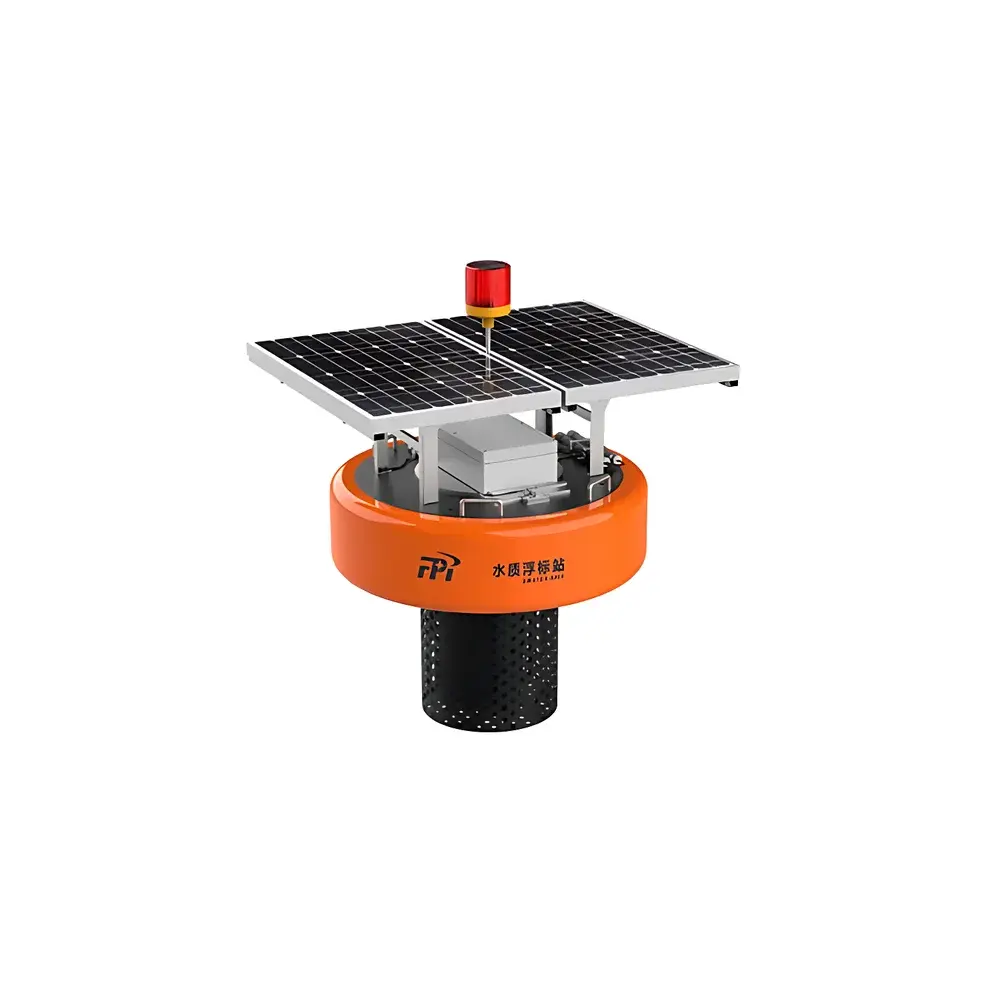
FPI FMSW-1000 Integrated Buoy-Based Online Water Quality Monitoring System
| Brand | FPI |
|---|---|
| Origin | Zhejiang, China |
| Manufacturer Type | Original Equipment Manufacturer (OEM) |
| Country of Origin | China |
| Model | FMSW-1000 |
| Pricing | Upon Request |
Overview
The FPI FMSW-1000 Integrated Buoy-Based Online Water Quality Monitoring System is an autonomous, in-situ environmental monitoring platform engineered for long-term, unattended deployment on natural and urban water bodies. Designed according to the principles of buoyancy-stabilized surface profiling and multi-sensor fusion, the system performs real-time, continuous measurement of critical water quality parameters without requiring shoreline infrastructure, land acquisition, or fixed pier installations. Its compact 0.7-meter-diameter buoyant housing integrates three complementary analytical subsystems: a full-spectrum UV-Vis spectrophotometric analyzer for nutrient quantification (e.g., total phosphorus, ammonia nitrogen), a reagent-based wet-chemistry module for chemical oxygen demand (COD) determination, and a multi-parameter electrochemical/physical sensor array for conventional parameters—including dissolved oxygen, pH, conductivity, turbidity, temperature, and oxidation-reduction potential (ORP). This tri-modal architecture ensures cross-validated, high-reproducibility data across diverse water matrices, from eutrophic urban canals to oligotrophic reservoirs.
Key Features
- Modular architecture enabling flexible configuration of optical, wet-chemical, and sensor-based modules—users select only required parameters to optimize cost, power budget, and maintenance frequency.
- Compact integrated buoy design (Ø700 mm) minimizes hydrodynamic drag and visual footprint, facilitating dense spatial deployment across rivers, lakes, and small water bodies with minimal regulatory permitting.
- Dual-power management system featuring high-efficiency monocrystalline solar panels coupled with industrial-grade lithium iron phosphate (LiFePO₄) batteries, incorporating under-voltage, over-voltage, and over-current protection circuits compliant with IEC 62133.
- Ultra-low-power embedded control unit with adaptive sampling logic—reducing active measurement cycles during stable conditions while increasing resolution during diurnal or event-driven transients (e.g., stormwater inflow).
- Ruggedized marine-grade ABS housing with IP68-rated submersible connectors and anti-fouling coatings for sensor surfaces, validated for continuous operation in turbid, high-organic-load environments including black-odor rivers and wastewater-impacted canals.
- Embedded LTE-M/NB-IoT cellular modem with TLS 1.2 encrypted data transmission, supporting remote firmware updates, diagnostic telemetry, and command-and-control via standardized MQTT or HTTP(S) protocols.
Sample Compatibility & Compliance
The FMSW-1000 is validated for in-situ analysis of freshwater systems ranging from low-conductivity mountain streams (<50 µS/cm) to brackish estuarine interfaces (<5,000 µS/cm). Sensor calibration traceability follows ISO/IEC 17025–accredited procedures; spectrophotometric methods align with ASTM D515-18 (phosphate) and ASTM D1426-22 (ammonia nitrogen), while COD measurements adhere to ISO 15705:2002 principles using onboard digestion and photometric detection. The system supports GLP-compliant audit trails, including timestamped calibration logs, sensor drift compensation records, and raw spectral/signal archives—fully compatible with FDA 21 CFR Part 11–enabled data management platforms when deployed in regulated municipal or industrial discharge monitoring contexts.
Software & Data Management
Data acquisition and processing are managed by FPI’s proprietary EdgeSense™ firmware, which performs on-board signal filtering, outlier rejection (using iterative Thompson Tau method), and unit conversion prior to transmission. Raw and processed data streams are published to FPI Cloud—a secure, ISO 27001-certified SaaS platform offering role-based access control, customizable dashboards, automated alerting (SMS/email/webhook), and integration with third-party GIS (e.g., ArcGIS Online) and SCADA systems via RESTful APIs. All data exports comply with WQX (Water Quality Exchange) schema v3.0 and support direct ingestion into national monitoring networks such as China’s National Surface Water Quality Monitoring System (NSWQMS) or EPA’s STORET.
Applications
- Real-time monitoring of effluent discharge points at municipal wastewater treatment plants and industrial outfalls—supporting compliance reporting under local environmental regulations.
- Longitudinal water quality profiling along urban rivers to identify pollution hotspots, assess remediation efficacy, and inform adaptive management strategies.
- Early-warning surveillance in drinking water source reservoirs and lakes, detecting algal bloom precursors (e.g., chlorophyll-a surges, nutrient spikes) and hypolimnetic anoxia development.
- High-resolution temporal monitoring of micro-watersheds and peri-urban drainage ditches—enabling rapid attribution of non-point source contamination events following precipitation.
- Supporting scientific research campaigns requiring spatially distributed, synchronized, and time-stamped water quality datasets across heterogeneous aquatic ecosystems.
FAQ
What power supply options are supported beyond solar-battery operation?
The FMSW-1000 can be configured with AC mains input (100–240 VAC) for permanent dockside or bridge-mounted deployments where grid access is available.
How frequently does the system require on-site maintenance?
Under typical inland freshwater conditions, scheduled maintenance intervals are every 3–6 months—primarily involving optical window cleaning, reagent replenishment (for COD module), and sensor verification using NIST-traceable standard solutions.
Is the buoy designed to withstand ice cover or high-wind conditions?
Yes—the hull structure meets EN 13094:2020 mechanical load requirements for Category C (inland waters with wave height ≤0.5 m); optional ice-breaker skirts and mooring tension sensors are available for cold-climate deployments.
Can historical data be exported in CSV or JSON format for offline analysis?
Yes—FPI Cloud provides bulk export functionality with configurable time ranges, parameter subsets, and metadata inclusion (e.g., GPS coordinates, battery voltage, signal-to-noise ratios).
Does the system support third-party sensor integration?
The onboard RS-485 and SDI-12 interfaces allow certified analog/digital sensors (e.g., nitrate, chlorophyll-a, blue-green algae) to be added via FPI’s Sensor Integration Kit, subject to firmware compatibility validation.
Related Products







