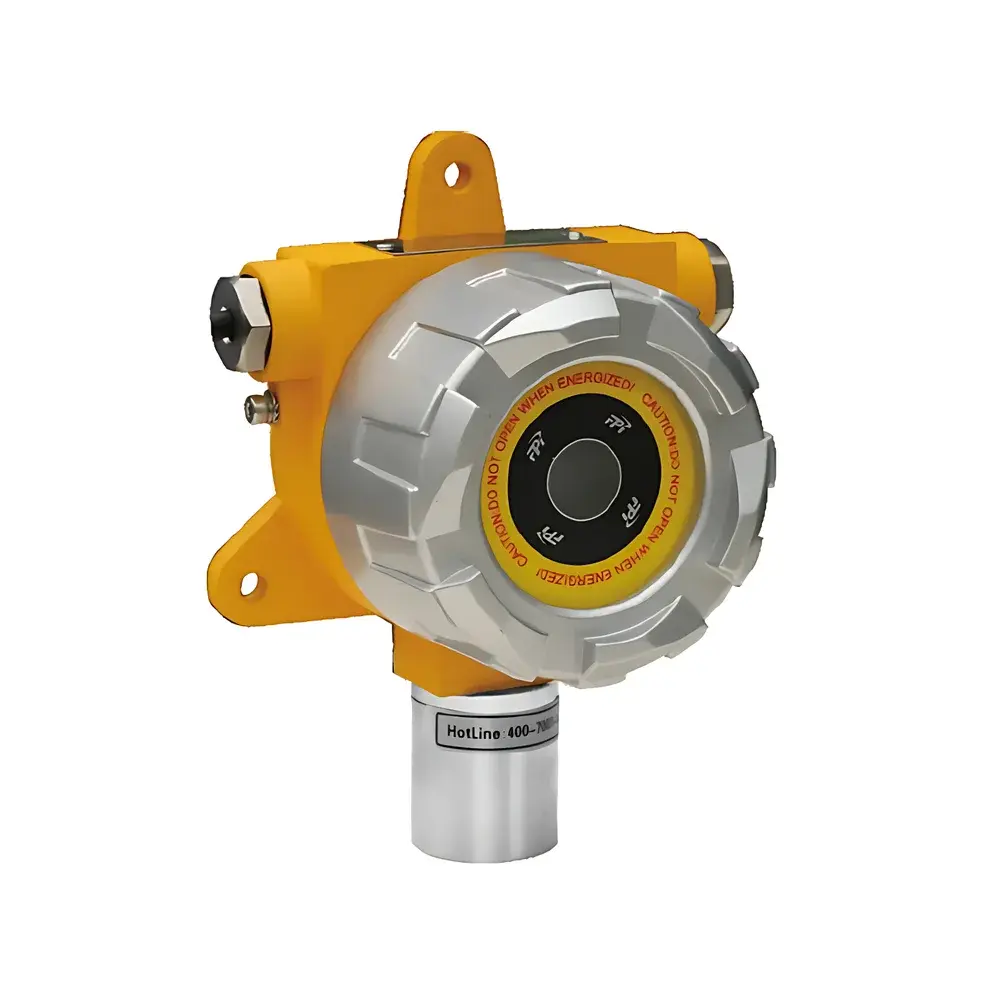
FPI GT-FL Series Fixed Gas Detector with RS485 Bus Communication
| Brand | FPI |
|---|---|
| Origin | Zhejiang, China |
| Manufacturer Type | Original Equipment Manufacturer (OEM) |
| Country of Origin | China |
| Model | GT-FL |
| Communication Interface | RS485 Modbus RTU |
| Maximum Node Capacity | 64 detectors per bus |
| Display | None (Bus-Only Variant) |
| Remote Configuration | Infrared bidirectional handheld remote (no cover removal required) |
| Sensor Compensation | Built-in temperature and concentration compensation algorithm |
| Status Indication | Dual-color (red/green) LED |
| Compliance | Designed for industrial hazardous area monitoring per GB 50493, compatible with SIL2-capable control systems |
Overview
The FPI GT-FL Series is a fixed-point, bus-type combustible gas detector engineered for continuous, cost-effective monitoring in industrial process environments where methane, propane, butane, hydrogen, and other hydrocarbon-based flammable gases pose operational or safety risks. Unlike standalone point detectors with local displays, the GT-FL operates as a node on an RS485 Modbus RTU network—eliminating redundant wiring infrastructure while maintaining high signal integrity over distances up to 1,200 meters (with proper termination and shielding). Its core sensing principle relies on catalytic bead (pellistor) technology, which provides stable, linear response across standard LEL (Lower Explosive Limit) ranges (0–100% LEL), with intrinsic thermal compensation ensuring minimal drift under ambient temperature fluctuations from −20 °C to +50 °C. The device is designed for permanent wall or conduit mounting in Zone 1/2 classified areas per IEC 60079-0 and GB 3836.1, and integrates seamlessly into distributed control systems (DCS), programmable logic controllers (PLC), and centralized alarm management platforms.
Key Features
- RS485 Modbus RTU communication protocol enables daisy-chain topology—reducing installation labor and cable costs by up to 70% compared to 4–20 mA analog wiring per sensor
- Infrared bidirectional remote controller allows full field configuration—including node address assignment, zero calibration, span adjustment, and alarm threshold setting—without opening the explosion-proof housing, minimizing downtime and eliminating exposure to hazardous atmospheres during maintenance
- Integrated dual-parameter compensation engine corrects for both ambient temperature drift and non-linear sensor response across the full measurement range, achieving ≤±3% FS repeatability under ISO 8573-1 referenced test conditions
- Supports up to 64 GT-FL units on a single RS485 bus segment, with automatic address conflict detection and configurable polling intervals (1–30 seconds) to optimize network bandwidth utilization
- Red/green dual-color LED provides immediate visual status feedback: steady green = normal operation; flashing green = pre-alarm (e.g., 20% LEL); steady red = alarm active (≥25% LEL); alternating red/green = fault condition (e.g., sensor timeout or communication loss)
Sample Compatibility & Compliance
The GT-FL Series is validated for use with Class I, Group B–D combustible gases per NFPA 505 and EN 60079-29-1. It meets the electromagnetic compatibility requirements of EN 61326-1 (industrial environment) and carries CE marking under the ATEX Directive 2014/34/EU (Category 2G, Ex db IIB T4 Gb). While not intrinsically safe by default, it is approved for use with associated apparatus (e.g., isolated barriers certified to IEC 60079-11) in Zone 1 installations. The device complies with China’s mandatory standard GB 50493–2019 “Code for Design of Flammable Gas and Toxic Gas Detection and Alarm System in Petrochemical Enterprises”, and supports audit-ready logging when integrated with SCADA systems that maintain timestamped event records per GLP/GMP traceability requirements.
Software & Data Management
Configuration and diagnostics are performed via FPI’s proprietary GT-Config PC utility (Windows-based), which supports bulk parameter upload/download, firmware version verification, and historical calibration log export in CSV format. When deployed within a Modbus-enabled DCS or safety instrumented system (SIS), the GT-FL transmits real-time gas concentration, sensor health status (e.g., heater resistance, bridge imbalance), and diagnostic flags (e.g., “sensor aged”, “compensation out of range”) as discrete 16-bit registers. Optional integration with FPI’s CloudLink gateway enables encrypted MQTT telemetry to cloud-based dashboards with configurable alarm escalation (SMS/email) and automated report generation aligned with ISO 55001 asset management frameworks.
Applications
- Refinery flare stack monitoring and vapor recovery unit (VRU) leak detection
- Chemical plant storage tank bund areas and loading rack zones
- Natural gas compressor stations and LNG transfer facilities
- Pharmaceutical clean utility rooms with solvent handling operations
- Municipal wastewater treatment biogas collection points and digester enclosures
FAQ
Does the GT-FL support HART or Foundation Fieldbus protocols?
No—the GT-FL is exclusively RS485 Modbus RTU compliant. For HART or FF integration, FPI recommends the GT-FL-HART or GT-FL-FF variants, which share identical mechanical and environmental specifications.
Can the infrared remote be used in dusty or humid outdoor environments?
Yes—the included IR remote operates reliably at up to 3 meters line-of-sight distance and is rated IP65. However, direct sunlight or heavy rain may attenuate signal strength; for fully exposed applications, optional stainless-steel remote mounting brackets with weather shields are available.
Is firmware upgrade possible in-field without physical access to the detector?
Firmware updates require local USB-to-RS485 adapter connection to the GT-FL’s service port and execution of GT-Config utility. Remote over-the-air (OTA) updates are not supported in this series.
What is the recommended calibration interval under continuous operation?
Per GB/T 23841–2009 and OSHA 1910.120, initial calibration is required before commissioning; subsequent bump testing every 30 days and full calibration every 6 months is advised for critical safety applications.
How does the GT-FL handle sensor poisoning in high-sulfur environments?
The pellistor sensor includes a sintered metal filter and proprietary catalyst formulation resistant to silicones and sulfides. For extended service life in sour gas applications, FPI recommends pairing the GT-FL with the optional sulfur-resistant sensor module (GT-FL-SR), which extends mean time between failures (MTBF) by ≥40%.