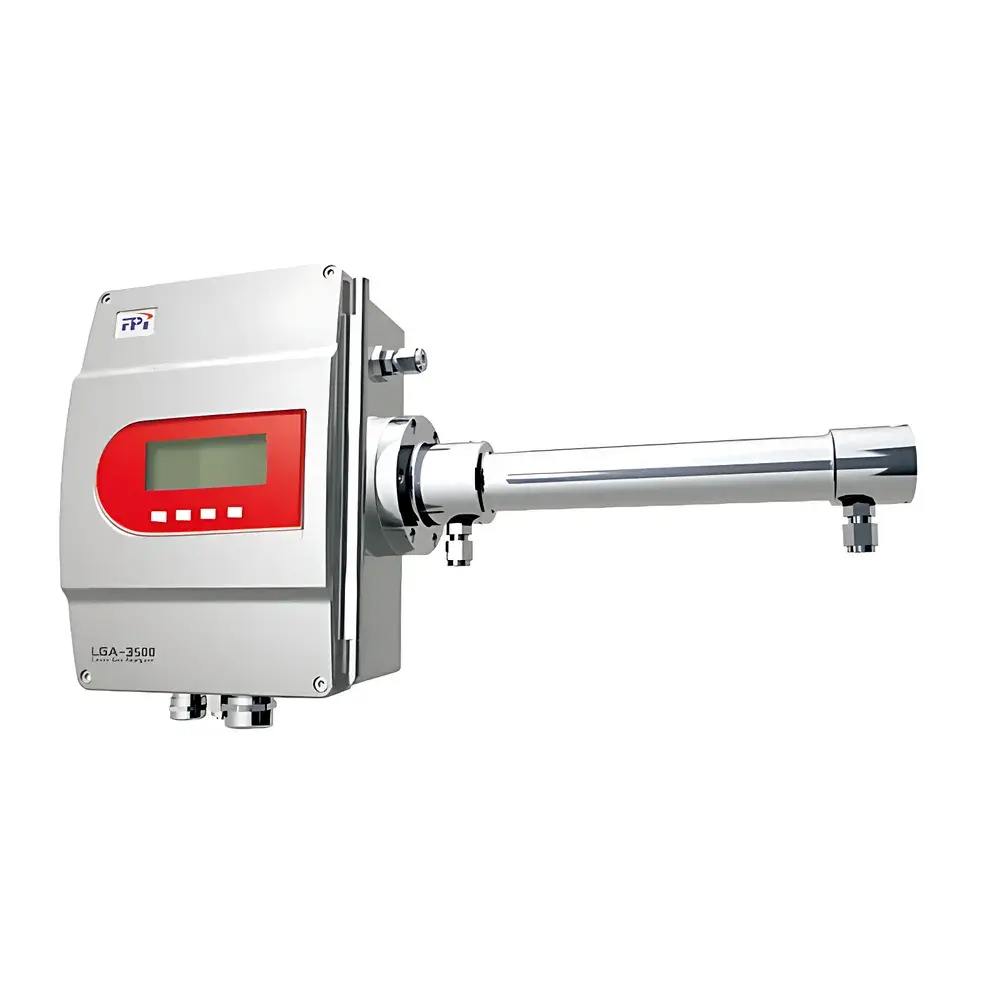
FPI LGA-3500 Laser Gas Analyzer
| Brand | FPI |
|---|---|
| Origin | Zhejiang, China |
| Manufacturer Type | Original Equipment Manufacturer (OEM) |
| Country of Origin | China |
| Model | LGA-3500 |
| Pricing | Available upon Request |
Overview
The FPI LGA-3500 Laser Gas Analyzer is an industrial-grade, in-situ online gas measurement system engineered for continuous, real-time monitoring of target gas concentrations in demanding process environments. It operates on the principle of Tunable Diode Laser Absorption Spectroscopy (TDLAS), a well-established variant of Direct Absorption Spectroscopy (DAS) that leverages narrow-linewidth semiconductor lasers to probe fundamental vibrational-rotational absorption lines of specific gas molecules—such as O₂, CO, CO₂, CH₄, NH₃, HCl, HF, and H₂O—in the near-infrared (NIR) and mid-infrared (MIR) spectral ranges. Unlike extractive sampling systems requiring gas conditioning, the LGA-3500 employs a true in-situ optical path across the process stream—typically mounted directly on ducts, stacks, or reactors—enabling measurement without sample transport delay, condensation risk, or catalytic loss. Its optical architecture is designed for high signal-to-noise ratio (SNR) and long-term wavelength stability, ensuring measurement repeatability better than ±1% of full scale under field conditions.
Key Features
- In-situ TDLAS measurement with dual-beam optical configuration for inherent compensation of beam attenuation caused by dust, fog, or window fouling.
- Robust mechanical design rated for continuous operation at ambient temperatures up to +60 °C and process gas temperatures up to 1,200 °C (with optional high-temp probe).
- Integrated explosion-proof enclosure conforming to China GB3836.1–2010 (equivalent to IEC 60079-0) for Class I, Division 1 / Zone 1 hazardous areas; optional ATEX/IECEx certification available per configuration.
- Compact form factor (W × H × D ≈ 320 × 220 × 450 mm) enabling installation in space-constrained locations without structural modification.
- Self-diagnostic firmware with real-time optical alignment monitoring, laser current/temperature tracking, and spectral baseline validation.
- No consumables, zero calibration gas requirement during routine operation—calibration traceability maintained via factory NIST-traceable reference spectra and embedded wavelength reference cell.
Sample Compatibility & Compliance
The LGA-3500 supports simultaneous or sequential analysis of up to two gas species within a single optical path, selected from a validated library of over 15 industrial gases. It is compatible with flue gases containing particulate loadings up to 10 g/Nm³, dew points ranging from −40 °C to +150 °C, and corrosive matrices including SO₂, NOₓ, and HCl at concentrations typical of cement kilns, waste incinerators, and chemical crackers. The analyzer complies with ISO 14001 environmental management requirements for emissions monitoring and meets technical prerequisites for integration into EPA Method 200.1–compliant CEMS (Continuous Emission Monitoring Systems). For pharmaceutical or food-grade applications, optional 316L stainless steel wetted parts and FDA-compliant surface finish (Ra ≤ 0.8 µm) are available upon specification.
Software & Data Management
The embedded Linux-based controller runs FPI’s proprietary GasView™ firmware, supporting Modbus TCP/RTU, Profibus DP, and Ethernet/IP protocols for seamless integration into DCS, SCADA, or MES platforms. All raw absorbance spectra, second-derivative peak fitting residuals, and diagnostic logs are timestamped and stored locally (8 GB internal flash) with configurable retention policies. Remote access is enabled via HTTPS-secured web interface or OPC UA server (compliant with OPC Foundation Part 1–3 specifications). Audit trail functionality satisfies GLP/GMP data integrity requirements per FDA 21 CFR Part 11, including electronic signatures, user role-based permissions, and immutable event logging for all configuration changes and measurement overrides.
Applications
- Cement production: Real-time kiln inlet/outlet O₂ and CO for combustion optimization and NOₓ precursor control.
- Coal-fired and biomass power plants: In-duct NH₃ slip monitoring post-SCR to ensure regulatory compliance and catalyst protection.
- Chemical synthesis reactors: In-situ CH₄/H₂ ratio tracking in steam reforming and Fischer–Tropsch units.
- Steel and non-ferrous metallurgy: CO concentration profiling in blast furnace top gas recycling loops.
- Municipal solid waste incineration: HCl and HF monitoring for acid gas abatement system feedback control.
- Biogas upgrading facilities: CH₄ purity verification prior to grid injection or vehicle fuel compression.
FAQ
Does the LGA-3500 require periodic calibration with certified gas standards?
No—routine calibration is not required. The analyzer uses absolute spectroscopic line parameters traceable to HITRAN database and internal wavelength reference cells. Field verification using a certified span gas is recommended annually or after major maintenance.
Can it operate in high-dust environments such as cement precalciner ducts?
Yes—the dual-beam optical design and adaptive signal processing algorithms maintain measurement integrity even under optical transmission losses exceeding 90%, provided the optical windows remain mechanically intact.
Is third-party certification (e.g., MCERTS, TÜV) available for emissions reporting?
FPI provides documentation packages supporting MCERTS Category 2 and TÜV-certified configurations; final certification is performed by accredited test laboratories per EN 15267-3 and EN 14181 requirements.
What is the minimum detectable concentration (MDC) for CO in a 10 m optical path?
Typical MDC is 0.5 ppmv (3σ, 1 Hz response), dependent on laser wavelength selection, path length, and gas temperature/pressure compensation accuracy.
How is alignment maintained during thermal cycling or mechanical vibration?
The optical head incorporates passive athermalization and kinematic mounting; active alignment correction is not used—design relies on mechanical stability verified per IEC 60068-2-6 (vibration) and IEC 60068-2-14 (thermal shock).