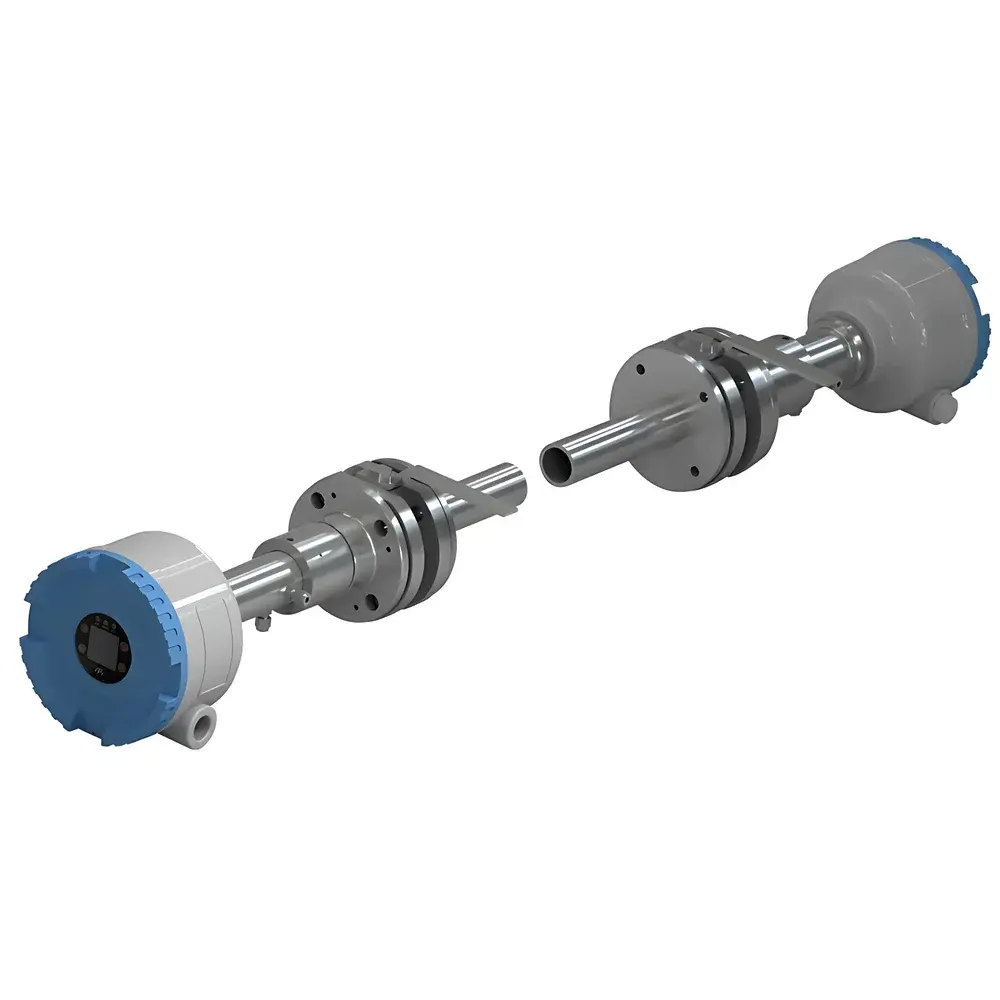
FPI LGA-8100 In-Situ Laser Gas Analyzer
| Brand | FPI |
|---|---|
| Origin | Zhejiang, China |
| Manufacturer Type | Original Equipment Manufacturer (OEM) |
| Country of Origin | China |
| Model | LGA-8100 |
| Pricing | Available Upon Request |
Overview
The FPI LGA-8100 In-Situ Laser Gas Analyzer is an industrial-grade tunable diode laser absorption spectroscopy (TDLAS) analyzer engineered for real-time, direct measurement of gas concentrations in harsh process environments. Unlike extractive systems requiring sample conditioning, the LGA-8100 performs true in-situ analysis—mounting directly on ducts, stacks, or reactors—eliminating sampling delays, condensation losses, and maintenance-intensive pre-treatment hardware. Its optical path traverses the process stream without physical contact, enabling robust operation at temperatures up to 1,200 °C, particulate loadings exceeding 10 g/m³, and corrosive atmospheres containing HCl, SO₂, NH₃, or HF. The instrument operates on Beer–Lambert law principles, using wavelength-modulated spectroscopy (WMS) with second-harmonic detection to achieve high selectivity against spectral interferences and low detection limits (sub-ppm level for target gases such as O₂, CO, CO₂, CH₄, NH₃, HCl, HF, and H₂S). As a contributor to GB/T 35217–2017 and IEC 61298-2 technical standards, FPI has integrated metrological traceability and long-term stability verification into the LGA-8100’s core architecture.
Key Features
- In-situ configuration with dual-beam optical alignment: eliminates calibration drift from optical misalignment and compensates for window fouling via real-time reference-path normalization.
- Functional safety compliant with IEC 61508: SIL2-certified hardware architecture includes redundant microcontrollers, watchdog timers, self-checking memory modules, and fail-safe output circuits.
- Explosion-proof enclosure rated Ex d IIB T4 Gb per GB 3836.1–2010 / EN 60079-0:2018, suitable for Zone 1 hazardous areas without purge air or pressurization.
- Integrated wavelength stabilization: onboard etalon-based spectral reference ensures continuous laser wavelength locking, enabling automatic zero/span validation and real-time linearity monitoring.
- Intelligent diagnostics engine: supports predictive maintenance alerts, optical path integrity assessment, signal-to-noise ratio trending, and internal temperature/pressure compensation algorithms.
- Modular I/O interface suite: configurable analog outputs (4–20 mA, HART), digital outputs (relays, RS-485 Modbus RTU), Ethernet (TCP/IP, Modbus TCP), and optional PROFIBUS DP or FOUNDATION Fieldbus integration.
Sample Compatibility & Compliance
The LGA-8100 is validated for continuous measurement of single or multi-component gas mixtures in flue gas, syngas, coke oven gas, blast furnace top gas, and reformer off-gas streams. It complies with ASTM D6522–20 for in-situ NOₓ monitoring, ISO 14064-1:2018 for GHG quantification, and EPA Method 3A for O₂ and CO. For regulated industries, firmware supports audit-trail logging per FDA 21 CFR Part 11 requirements when deployed with FPI’s optional secure data server module. All units undergo factory calibration traceable to NIM (National Institute of Metrology, China) certified gas standards and include full uncertainty budget documentation per ISO/IEC 17025:2017 guidelines.
Software & Data Management
The analyzer ships with FPI’s proprietary LGA-View™ configuration and diagnostic software, compatible with Windows 10/11 and accessible via local USB or remote web browser. Software functions include spectral visualization (raw absorbance vs. wavenumber), real-time interference identification, multi-point span validation logs, and export of time-stamped concentration data in CSV or XML format. Historical data storage supports ≥30 days of second-by-second records internally, expandable via external NAS or cloud-connected SCADA interfaces. Optional FPI CloudLink™ enables encrypted TLS 1.2 telemetry transmission, role-based user access control, and automated report generation aligned with ISO 50001 energy management system reporting frameworks.
Applications
- Combustion optimization in coal-fired and waste-to-energy boilers via real-time O₂ and CO feedback control.
- Ammonia slip monitoring downstream of SCR systems in power plants and nitric acid facilities.
- HCl and HF concentration tracking in municipal solid waste incinerators for regulatory compliance (EU Directive 2000/76/EC).
- CO and CH₄ monitoring in coke oven batteries and blast furnace stoves for explosion risk mitigation.
- Process gas composition verification in ethylene crackers, ammonia synthesis loops, and hydrogen purification units.
- Carbon capture readiness assessment through continuous CO₂ concentration profiling in flue ducts prior to amine scrubbing.
FAQ
Does the LGA-8100 require periodic recalibration with certified gas standards?
No—its in-situ design and built-in spectral reference eliminate routine span calibration; however, annual verification using traceable gas standards is recommended per ISO 14644-1 and plant QA/QC protocols.
Can the LGA-8100 measure multiple gases simultaneously?
Yes—through sequential multi-line scanning within a single optical path; up to four gases can be configured concurrently depending on spectral separation and required detection limits.
Is the analyzer compatible with existing DCS systems using legacy communication protocols?
Yes—hardware-configurable I/O modules support Hart 7, Modbus RTU/TCP, and optional HART-IP or OPC UA gateway integration for seamless DCS/PLC interoperability.
What is the typical optical path length range supported?
Standard configurations cover 0.5–10 meters; custom optics are available for extended paths up to 30 meters with signal-to-noise optimization.
How is measurement uncertainty quantified and documented?
Each unit ships with a Certificate of Conformance including expanded uncertainty (k=2) calculated per GUM (JCGM 100:2008), covering contributions from spectral noise, temperature drift, pressure transducer error, and line strength database variability.
Related Products