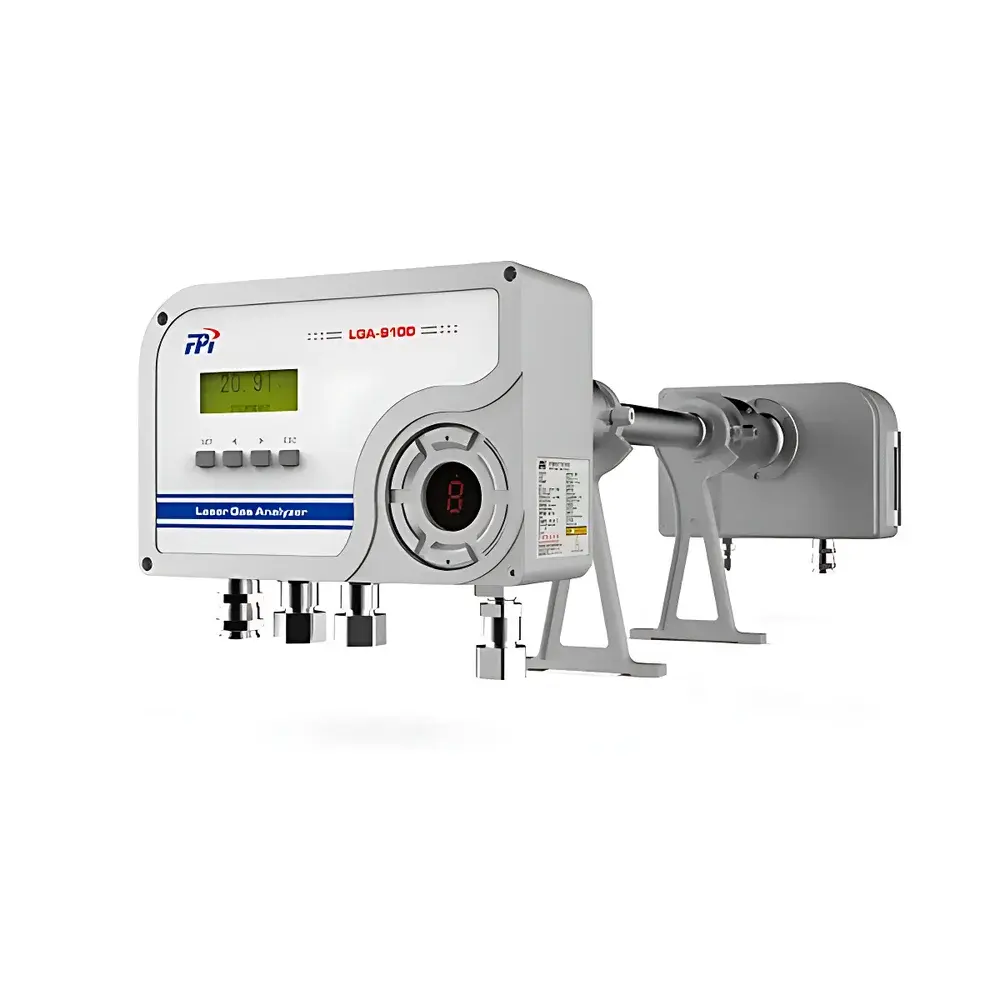
FPI LGA-9100 Laser Gas Analyzer
| Brand | FPI |
|---|---|
| Origin | Zhejiang, China |
| Manufacturer Type | OEM Manufacturer |
| Model | LGA-9100 |
| Measurement Principle | Tunable Diode Laser Absorption Spectroscopy (TDLAS) |
| Linearity Error | ≤ ±1% FS |
| Repeatability | ≤ ±1% FS |
| Span Drift | ≤ ±1% FS per 6 months |
| Response Time (T90) | ≤ 1 s |
| Explosion Protection Rating | Ex d mb op is px IICT6 Gb |
| Ingress Protection Rating | IP66 |
| Functional Safety Certification | SIL2 compliant |
| Compliance | Designed for continuous emission monitoring and process safety applications in accordance with IEC 61508 and IEC 61511 |
Overview
The FPI LGA-9100 Laser Gas Analyzer is an industrial-grade, in-situ online gas analyzer engineered for real-time, extractive-free concentration measurement of target gases—including O2, CO, CO2, CH4, NH3, H2S, HF, HCl, and others—using Tunable Diode Laser Absorption Spectroscopy (TDLAS). Unlike conventional NDIR or electrochemical sensors, the LGA-9100 employs wavelength-modulated spectroscopy (WMS) with a temperature-stabilized distributed feedback (DFB) laser diode, enabling selective detection of specific rovibrational absorption lines in the near-infrared (NIR) and mid-infrared (MIR) spectral ranges. This optical technique eliminates cross-sensitivity to background gas composition, particulate interference, and pressure fluctuations—making it uniquely suited for harsh process environments such as blast furnace off-gas ducts, syngas pipelines, flue stacks, and chlor-alkali electrolysis cells.
Key Features
- In-situ optical path design: Dual-beam configuration with integrated reference channel ensures long-term stability and compensates for optical attenuation caused by dust deposition or window fouling.
- Automatic wavelength locking: Real-time feedback control maintains laser alignment to the target absorption line center, sustaining measurement integrity over thermal cycling and mechanical vibration.
- High-speed response: T90 ≤ 1 second enables closed-loop control integration in fast-dynamic processes such as combustion optimization and emergency shutdown interlocks.
- Robust mechanical architecture: All-welded 316L stainless steel probe housing, ceramic-coated optical windows, and active purge ports support operation at temperatures up to 200 °C and dust loadings exceeding 10 g/m³.
- Functional safety certified: SIL2 compliance per IEC 61508/61511 validated through third-party assessment; supports fail-safe output signaling and diagnostic coverage >90%.
- Integrated intrinsic safety interface: Certified Ex d mb op is px IICT6 Gb enclosure permits direct installation in Zone 1 hazardous areas without external barriers.
Sample Compatibility & Compliance
The LGA-9100 is optimized for direct in-stack or in-pipe measurement of hot, wet, and corrosive process streams without sample conditioning. It tolerates H2O vapor concentrations up to 40 vol%, H2S up to 1000 ppm, and HCl up to 500 ppm without sensor poisoning or calibration drift. The analyzer meets IP66 ingress protection requirements for outdoor mounting and is compatible with ASME B31.4/B31.8 pipeline monitoring protocols. For regulated industries, its data logging and alarm handling functions are configurable to satisfy FDA 21 CFR Part 11 electronic record requirements when deployed with FPI’s certified Edge Control Module (ECM-200).
Software & Data Management
FPI’s proprietary LGA-Link™ software suite provides embedded web-based HMI, remote diagnostics, and automated calibration validation. The analyzer supports Modbus TCP, Profibus DP, and OPC UA communication protocols for seamless integration into DCS/SCADA systems (e.g., Siemens PCS7, Honeywell Experion, Emerson DeltaV). Audit trails, user role management, and digital signature capability ensure GLP/GMP traceability. Cloud connectivity via MQTT enables predictive maintenance analytics—including laser lifetime estimation, optical path degradation trending, and zero/span drift forecasting—through FPI’s secure Industrial IoT platform.
Applications
- Metallurgical processes: Blast furnace top gas analysis for CO/CO2 ratio control and energy recovery optimization
- Petrochemical refining: H2S monitoring in amine regenerator overheads and Claus tail gas streams
- Chlor-alkali production: Real-time Cl2 purity verification in electrolyzer cell exit gas
- Natural gas transmission: CH4/C2H6 ratio profiling for calorific value correction
- Coal gasification: NH3 and HCN detection in syngas for downstream catalyst protection
- Carbon capture units: CO2 concentration tracking across absorber/desorber columns
FAQ
Does the LGA-9100 require sample extraction or conditioning?
No—it performs in-situ measurement using a dual-path optical probe mounted directly on the process duct or pipe, eliminating the need for heated sample lines, filters, or dryers.
Can it operate in high-humidity environments?
Yes—the TDLAS measurement principle is inherently insensitive to water vapor interference when targeting non-overlapping absorption lines; optional H2O compensation algorithms are available for co-measurement scenarios.
What calibration procedures are supported?
Zero calibration using certified N2 or synthetic air; span calibration with traceable gas standards; automated daily zero-check via internal reference cell; no field recalibration required for 6 months under normal operation.
Is cybersecurity addressed in the firmware design?
Yes—TLS 1.2 encryption for cloud communications, configurable password policies, disabled default credentials, and regular security patch updates aligned with IEC 62443-4-2.
How is SIL2 compliance verified during installation?
Through documented proof testing, hardware fault tolerance analysis (FTA), and integration into the customer’s Safety Instrumented System (SIS) architecture per IEC 61511 lifecycle requirements.
Related Products