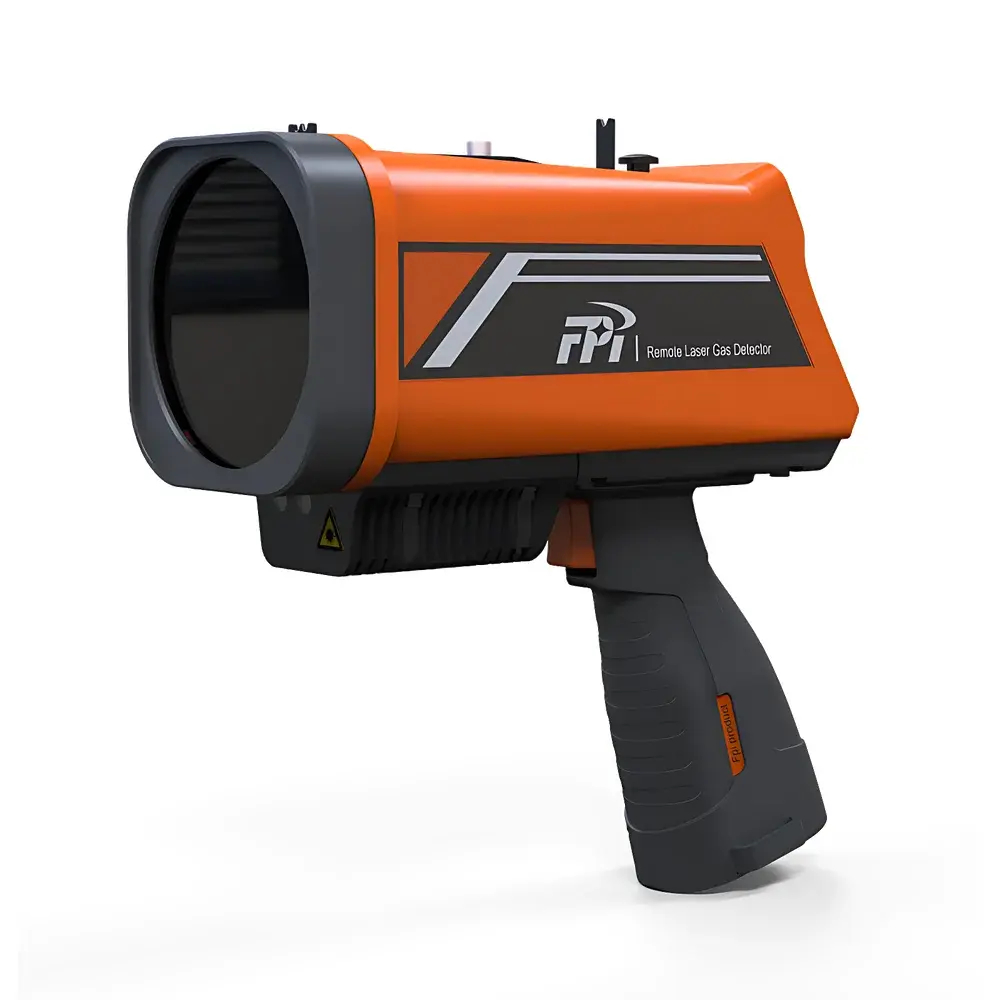
FPI LGRS-100 / LGRS-200 Tunable Diode Laser Absorption Spectroscopy (TDLAS) Remote Methane Gas Detector
| Brand | FPI |
|---|---|
| Origin | Zhejiang, China |
| Manufacturer Type | Original Equipment Manufacturer (OEM) |
| Regional Classification | Domestic (China) |
| Model | LGRS-100 / LGRS-200 |
| Pricing | Available Upon Request |
Overview
The FPI LGRS-100 and LGRS-200 are portable, field-deployable remote methane gas detection systems engineered for quantitative, non-contact monitoring over open-path distances up to 200 meters. These instruments utilize Tunable Diode Laser Absorption Spectroscopy (TDLAS) — a well-established, physics-based optical sensing technique — to measure methane (CH₄) concentration by analyzing the characteristic near-infrared absorption line at 1653.7 nm. Unlike catalytic bead or electrochemical sensors, TDLAS provides inherent selectivity for methane in complex ambient matrices, eliminating cross-sensitivity to hydrogen, volatile organic compounds (VOCs), or humidity fluctuations. The system operates on the principle of Beer–Lambert law, where laser beam attenuation is directly proportional to path-integrated gas concentration (ppm·m). Designed for continuous, unattended operation in industrial perimeter monitoring, leak surveying, and infrastructure integrity verification, the LGRS series delivers trace-level sensitivity (<1 ppm·m detection limit) with sub-second response time and zero drift over extended deployment cycles.
Key Features
- Open-path TDLAS architecture enabling real-time, non-intrusive methane detection without sample extraction or conditioning
- Dual-model configuration: LGRS-100 optimized for 10–100 m standoff range; LGRS-200 extends effective range to 200 m with enhanced signal-to-noise ratio
- Hermetically sealed, IP65-rated enclosure rated for operation across –20 °C to +50 °C ambient conditions
- Integrated dual-axis motorized gimbal for precise beam alignment and automated scanning across predefined azimuth/elevation sectors
- Onboard temperature and pressure compensation algorithms ensuring measurement accuracy under variable meteorological conditions
- Low-power consumption design (<12 W typical), compatible with battery packs or solar hybrid power systems for remote site deployment
- Self-diagnostic firmware with laser wavelength lock verification, detector responsivity monitoring, and optical path contamination alerts
Sample Compatibility & Compliance
The LGRS series is specifically calibrated for atmospheric methane detection in outdoor and semi-enclosed environments — including natural gas compressor stations, LNG terminals, pipeline right-of-ways, landfills, and biogas facilities. It does not require gas sampling lines, filters, or consumables, thereby eliminating maintenance-induced downtime. All optical components comply with IEC 61000-6-2 (immunity) and IEC 61000-6-4 (emissions) standards. While not certified to ATEX or IECEx for Zone 0/1 hazardous areas, the instrument meets EN 61326-1 for electromagnetic compatibility in industrial settings. Data output formats align with Modbus RTU/TCP and MQTT protocols, supporting integration into SCADA, DCS, and cloud-based emissions monitoring platforms compliant with EPA Method 21 and ISO 19880-3 (gaseous hydrogen fueling stations — adapted for CH₄ leak quantification).
Software & Data Management
The LGRS platform includes FPI’s proprietary GeoScan™ software suite, deployed on embedded Linux OS with secure SSH/TLS interface. Real-time spectral acquisition, baseline correction, and multi-line fitting (including water vapor interference subtraction) occur onboard. Measurement data — including integrated concentration (ppm·m), beam intensity, ambient T/P, and diagnostic flags — are timestamped with GPS-synchronized UTC and stored locally on industrial-grade microSD (up to 128 GB). Remote access enables firmware updates, spectral library management, and alarm threshold configuration via web-based dashboard. Audit trails comply with GLP principles, retaining full raw interferogram archives and processing metadata for regulatory review. Optional cloud gateway supports AWS IoT Core or Azure IoT Hub ingestion with configurable retention policies and role-based access control (RBAC).
Applications
- Perimeter monitoring of natural gas transmission infrastructure to detect fugitive emissions exceeding OSHA PEL (50 ppm) or EPA LDAR thresholds
- Routine mobile surveys using vehicle-mounted LGRS-200 units for rapid identification of subsurface leaks along pipeline corridors
- Continuous emission monitoring (CEM) at landfill gas collection sites, supporting GHG reporting under ISO 14064-1 and EU ETS requirements
- Verification of leak repair effectiveness per EPA OOOOa Subpart W compliance timelines
- Research-grade atmospheric boundary layer studies requiring high-temporal-resolution open-path CH₄ flux estimation
- Integration into drone-based inspection systems for elevated or inaccessible assets (e.g., flare stacks, tank roof seals)
FAQ
What is the minimum detectable methane concentration over a 100-meter path?
The LGRS-100 achieves a 1σ noise-equivalent detection limit of ≤0.8 ppm·m under standard conditions (25 °C, 101.3 kPa), corresponding to ~8 ppb average concentration over 100 m.
Does the system require periodic calibration with certified gas standards?
No. The TDLAS methodology relies on absolute spectroscopic parameters traceable to NIST, eliminating need for span gas calibration. Field validation is performed using built-in reference cell checks and ambient air zero-point verification.
Can the LGRS operate in rain, fog, or snow?
Performance degrades under heavy precipitation or dense fog due to optical scattering; however, the system maintains operational readiness with automatic beam power adjustment and weather-resistant housing. Recommended use in visibility >100 m.
Is the instrument compatible with third-party GIS or asset management platforms?
Yes. Geotagged measurement logs export in GeoJSON and CSV formats; RESTful API enables direct integration with Esri ArcGIS, Bentley AssetWise, and SAP PM modules.
What cybersecurity measures are implemented in the embedded firmware?
Firmware employs TLS 1.2 encryption, certificate-based authentication, disabled default credentials, and automatic security patching via signed OTA updates — aligned with NIST SP 800-193 guidelines for resilient IoT devices.