
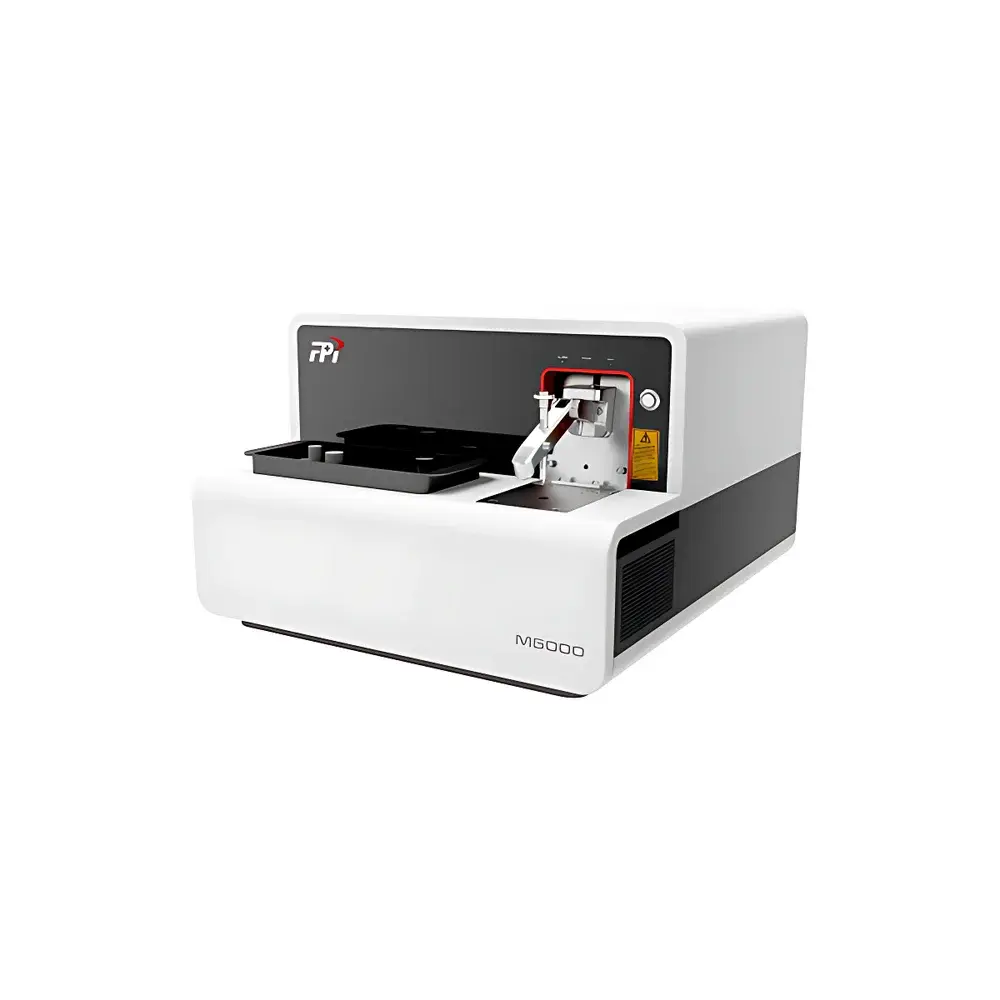
FPI M5000 N Benchtop CCD-Based Spark Optical Emission Spectrometer
| Brand | FPI |
|---|---|
| Origin | Zhejiang, China |
| Instrument Type | Benchtop |
| Excitation Source | Spark |
| Detector | Charge-Coupled Device (CCD) |
| Wavelength Coverage | Configurable (typically 130–800 nm) |
| Spectral Resolution | < 10 pm (at 200 nm) |
| Optical System | Pascchen-Runge Mount with Dual Chambers (UV + VIS) |
| Number of Simultaneous Spectral Lines | > 9,000 |
| Calibration Flexibility | Full-Spectrum Multi-Matrix Capability |
| Compliance | Designed to support ISO/IEC 17025 workflows, ASTM E415, E1086, and GB/T 4336 |
Overview
The FPI M5000 N is a benchtop spark optical emission spectrometer (OES) engineered for high-precision, rapid elemental analysis of metallic alloys in production-critical environments. Based on the Paschen-Runge optical layout, it employs a dual-chamber vacuum-optimized spectrometer housing—one dedicated to deep-ultraviolet (UV) transmission (down to 130 nm) and the other to visible (VIS) wavelengths—enabling robust quantification of light elements including C, P, S, and N alongside conventional alloying elements (e.g., Cr, Ni, Mo, Mn, Cu, Al, Si, Ti). Unlike fixed-channel instruments, the M5000 N captures full spectral data across its entire detectable range using an array of high-quantum-efficiency CCD detectors, eliminating pre-defined channel limitations and supporting post-acquisition reprocessing of spectral lines. Its spark excitation source utilizes a fully digital, programmable pulse generator with adjustable current, frequency, and discharge duration—ensuring stable plasma formation across diverse sample matrices (ferrous, non-ferrous, and superalloys) without hardware modification.
Key Features
- Dual optical chamber architecture: Independent UV and VIS chambers maintain optimal signal-to-noise ratio for both short-wavelength light elements and longer-wavelength transition metals.
- Full-spectrum acquisition: Captures >9,000 spectral lines simultaneously; enables retrospective line selection, interference correction, and multi-element calibration reuse.
- Intelligent line selection algorithm: Automatically identifies optimal analytical lines based on concentration level, inter-element overlap, and self-absorption risk—improving accuracy in high-alloy or trace-level applications.
- Self-calibrating optical system: Temperature-stabilized spectrograph (±0.05 °C) eliminates mechanical wavelength recalibration (i.e., “tracking”); drift compensation occurs via real-time background and reference peak monitoring.
- Open-design spark stand: Accommodates irregular, large, or small samples (up to Ø100 mm × 50 mm height); features automated argon flush control with low-consumption mode (< 3 L/min during standby).
- Digital spark source: Fully solid-state, maintenance-free excitation with configurable discharge parameters—optimized for reproducible ablation across castings, billets, machined parts, and scrap.
Sample Compatibility & Compliance
The M5000 N supports direct solid-metal analysis without dissolution or pelletization, compatible with as-cast, heat-treated, machined, and surface-ground specimens meeting ISO 11577 and ASTM E415 surface preparation guidelines. It complies with international standard test methods for metal analysis—including ASTM E1086 (stainless steels), E353 (chromium-nickel-manganese steels), and GB/T 4336 (Chinese carbon and low-alloy steels). The instrument’s firmware and software architecture support audit-trail generation, user-access controls, and electronic signature functionality aligned with GLP/GMP documentation requirements. While not FDA 21 CFR Part 11 certified out-of-the-box, its data management framework is configurable to meet regulated laboratory validation protocols.
Software & Data Management
FPI’s proprietary SpectraLink software provides integrated instrument control, spectral visualization, multivariate calibration modeling, and QC reporting. It supports custom curve linking logic (e.g., matrix-specific calibrations auto-applied by alloy type), automatic grade identification against user-defined libraries (ASTM, EN, JIS, GB), and customizable pass/fail criteria per element. All raw spectra are stored in vendor-neutral HDF5 format; processed results export to CSV, PDF, or LIMS-compatible XML. Built-in system diagnostics monitor lamp stability, argon purity, detector temperature, and spark energy—triggering maintenance alerts prior to performance deviation. Software updates are delivered via secure HTTPS with version-controlled release notes.
Applications
The M5000 N serves as a primary analytical tool in foundry process control, incoming material inspection, and final product certification. Typical use cases include: real-time melt composition verification during ladle metallurgy; rapid sorting of scrap alloys in recycling facilities; verification of heat-treatment compliance via residual element checks; certification of aerospace-grade nickel-based superalloys; and routine QA of automotive castings (Al-Si, Mg-Al) and stainless steel weldments. Its full-spectrum capability also supports method development for emerging materials—such as high-entropy alloys—where traditional channel-based OES lacks flexibility.
FAQ
Does the M5000 N require vacuum pumping for UV analysis?
No—it uses a sealed, nitrogen-purged or argon-purged UV chamber, eliminating the need for continuous vacuum operation and associated maintenance.
Can I add new elements or base materials after installation?
Yes. Full-spectrum data allows post-deployment calibration extension to new matrices (e.g., titanium alloys or copper-beryllium) without optical or hardware changes—only updated standards and model validation are required.
What is the typical detection limit for carbon in low-alloy steel?
Under optimized conditions (polished surface, 30-s integration, argon flush), the practical detection limit is ≤15 ppm with RSD < 2% at 0.1 wt% C.
Is remote diagnostics supported?
Yes—SpectraLink includes secure remote access capability (with user-configurable firewall rules) for technical support-assisted troubleshooting and preventive maintenance planning.
How often does the instrument require recalibration?
With stable environmental conditions and regular standardization (daily or per shift), recalibration intervals typically exceed 6 months; drift correction algorithms extend effective calibration lifetime without manual intervention.
Related Products





