
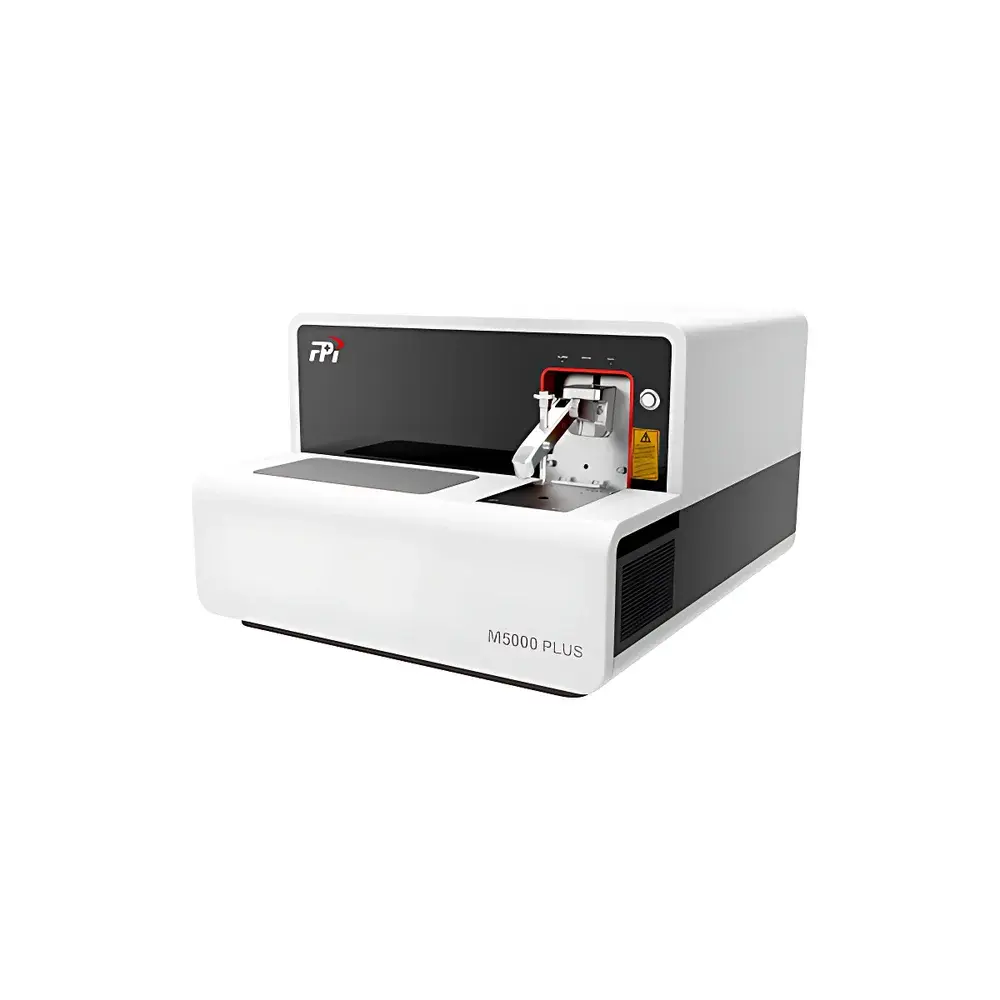
FPI M5000 PLUS N Benchtop Spark Emission Spectrometer
| Brand | FPI |
|---|---|
| Origin | Zhejiang, China |
| Instrument Type | Benchtop |
| Excitation Method | Spark |
| Detector Type | Scientific-grade CMOS |
| Wavelength Range | Configurable (130–800 nm) |
| Optical System | Dual-chamber with dedicated vacuum UV optical path for N, C, S, P |
| Spectral Resolution | ≤ 10 pm at 200 nm |
| Effective Pixel Count | ≥ 4.2 MP (full-frame CMOS) |
| Analysis Speed | < 30 s per sample (including flushing, sparking, and quantification) |
| Calibration Stability | ±0.5% RSD over 8 hours (under controlled lab conditions) |
| Compliance | Meets ISO 11577:2022, ASTM E415-22, GB/T 4333.1–2022 |
Overview
The FPI M5000 PLUS N is a benchtop spark emission spectrometer engineered for high-precision, multi-element quantitative analysis of metallic alloys in industrial quality control and materials research laboratories. It operates on the principle of atomic emission spectroscopy: a high-energy spark discharge vaporizes and excites surface atoms of a solid metal sample; the emitted light is dispersed by a fixed-grating optical system and detected across the full spectral range (130–800 nm) using a scientific-grade back-illuminated CMOS sensor. Unlike traditional PMT-based instruments, the M5000 PLUS N leverages full-spectrum acquisition to enable post-acquisition reprocessing, flexible element selection, and robust interference correction—making it especially suited for demanding applications involving nitrogen, carbon, sulfur, and phosphorus in ferrous and non-ferrous matrices.
Key Features
- Scientific-grade CMOS detector with >95% quantum efficiency in the vacuum UV region (130–190 nm), enabling direct, high-sensitivity detection of N, C, S, and P without supplemental coating or purging gas requirements.
- Dual optical chamber architecture: one optimized for visible/NIR (200–800 nm) and a separately sealed, compact UV chamber with minimized internal volume and multi-port argon purge flow, ensuring rapid atmospheric displacement (<60 s) and long-term spectral stability.
- RTMC (Real-Time Matrix Compensation) spectral optimization algorithm, integrated into firmware, dynamically corrects for matrix-induced line shifts and intensity drift during spark sequence execution.
- Full-digital pulsed spark source with adaptive energy regulation: automatically adjusts discharge parameters (peak current, pulse width, frequency) based on sample conductivity and surface condition to ensure reproducible ablation and excitation.
- Monolithic aluminum alloy optical chamber with four-stage stress-relief annealing and active temperature stabilization (±0.1 °C), minimizing thermal drift of spectral peak positions over extended operation.
- OEO (Optimal Element-Oriented) pixel readout architecture: enables selective region-of-interest extraction and noise-suppressed signal integration per analytical line, improving signal-to-noise ratio without hardware modification.
Sample Compatibility & Compliance
The M5000 PLUS N supports flat, polished solid metal samples (diameter ≥ 10 mm, thickness ≥ 4 mm) across major alloy families—including low-alloy steels, stainless steels, aluminum, copper, titanium, nickel, and magnesium-based alloys. Sample introduction conforms to ISO 11577:2022 (spark emission spectrometry — general requirements) and ASTM E415-22 (standard test method for analysis of steel by spark atomic emission spectrometry). The instrument’s software includes audit-trail logging compliant with GLP and GMP environments, and optional 21 CFR Part 11 electronic signature modules are available for regulated laboratories. All calibration and validation procedures align with ISO/IEC 17025:2017 requirements for testing laboratories.
Software & Data Management
FPI SpectraSuite v5.x provides a modular, role-based interface supporting method development, routine analysis, calibration management, and report generation. Key capabilities include intelligent curve modeling—automatically selecting optimal calibration models from a library of >200 pre-validated matrices—and unknown-sample classification via principal component analysis (PCA) prior to quantification. Raw spectral data (FITS format) and processed results are stored in an encrypted SQLite database with version-controlled backups. Remote maintenance functionality allows secure firmware updates, diagnostic log retrieval, and real-time instrument health monitoring via TLS-encrypted HTTPS connection. Data export supports CSV, PDF, XML, and LIMS-compatible ASTM E1382 formats.
Applications
The M5000 PLUS N delivers trace-level (sub-ppm) detection for critical residual and alloying elements in production-critical workflows: melt shop composition verification in primary steelmaking; incoming raw material screening at foundries; heat-to-heat certification in aerospace-grade titanium billets; nitrogen specification compliance in duplex stainless steels; and carbon equivalence calculation for weldability assessment in pipeline manufacturing. Its validated performance extends to third-party testing labs performing ISO/IEC 17025-accredited analyses for customs clearance (e.g., HS Code 9027.30), failure analysis in automotive component suppliers, and R&D support for advanced high-entropy alloy development.
FAQ
Does the M5000 PLUS N require external vacuum or inert gas purging for UV element analysis?
No—the dedicated UV optical chamber uses internal multi-port argon flow with dynamic pressure regulation, eliminating the need for external vacuum pumps or continuous helium supply.
Can I add new elements or base materials after purchase without hardware changes?
Yes—full-spectrum acquisition and software-based calibration allow expansion to additional elements (e.g., B, Sn, As) or new alloy types (e.g., cobalt superalloys) via updated calibrations and spectral libraries, with no optical or detector modifications required.
What is the typical recalibration interval under routine QC use?
With RTMC compensation and chamber thermal stability, recalibration is recommended every 48 operational hours or after 200 sparks—significantly extending intervals compared to conventional PMT-based systems.
Is spectral data export compatible with external multivariate analysis tools?
Yes—raw intensity arrays (wavelength × pixel) are exportable in standard FITS and HDF5 formats, enabling integration with Python (SciPy, scikit-learn), MATLAB, or commercial chemometrics platforms for custom model development.




