
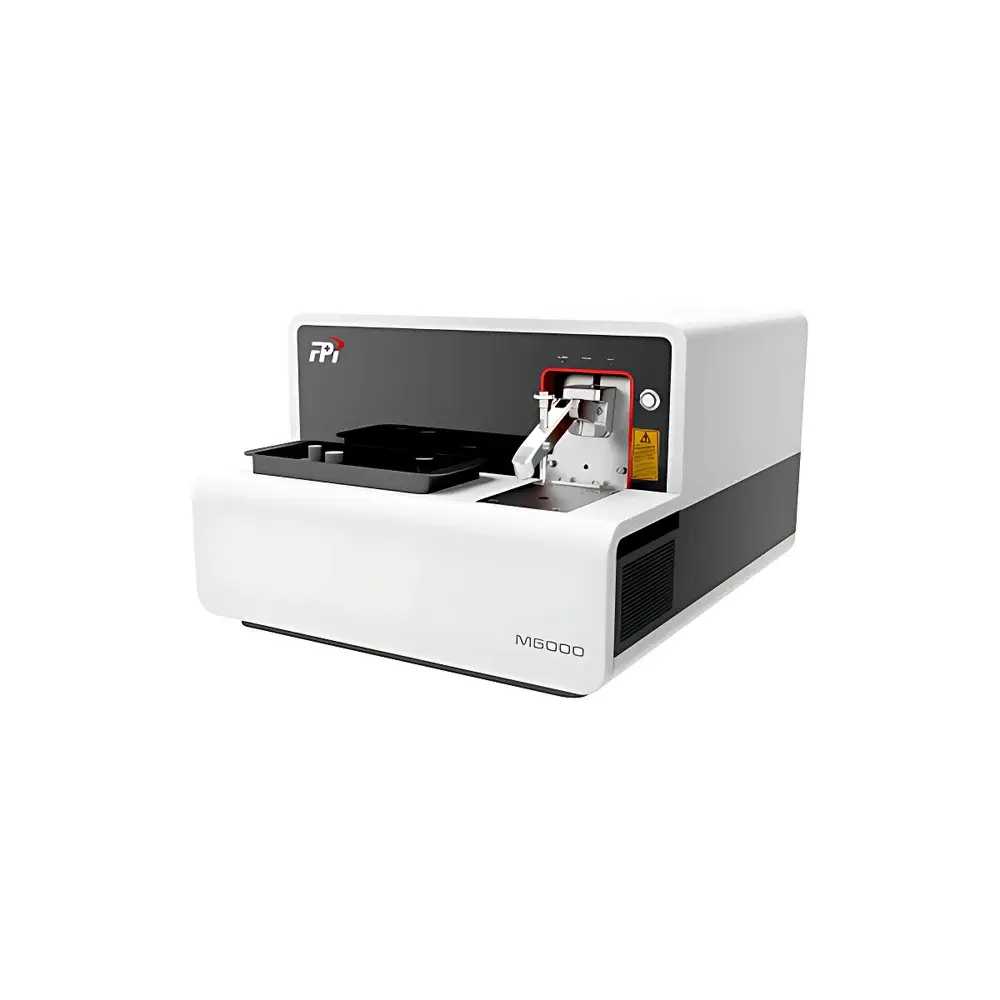
FPI M5000 CCD-Based Full-Spectrum Spark Optical Emission Spectrometer
| Brand | FPI |
|---|---|
| Origin | Zhejiang, China |
| Instrument Type | Benchtop |
| Excitation Source | Spark |
| Detector | CCD (Charge-Coupled Device) |
| Wavelength Range | Configurable (130–800 nm typical for spark OES) |
| Optical Configuration | Paschen-Runge mount with dual vacuum-UV/visible chambers |
| Number of Simultaneously Acquired Spectral Lines | >10,000 |
| Analytical Elements | Up to 72 metallic and non-metallic elements (e.g., C, P, S, N, Si, Mn, Cr, Ni, Cu, Al, Ti, Mo, V, Co, Nb, B, Ca, Mg, Zn, Pb, Sn, As, Bi, rare earths) |
| Calibration Flexibility | On-site matrix and element expansion without hardware modification |
| Compliance | Designed to support ISO/IEC 17025, ASTM E415, ASTM E1086, ASTM E3061, and GB/T 4336 workflows |
Overview
The FPI M5000 is a benchtop, full-spectrum spark optical emission spectrometer (OES) engineered for high-precision, rapid elemental quantification in solid metallic samples. It operates on the principle of spark-induced plasma excitation: a controlled high-voltage spark ablates a micro-volume of the conductive sample surface, generating transient plasma at temperatures exceeding 10,000 K. Emitted photons from excited atoms and ions are dispersed via a fixed Paschen-Runge optical system and captured simultaneously across the ultraviolet (UV) and visible (VIS) spectral ranges by multiple high-resolution CCD detectors. Unlike traditional channel-based spectrometers—where each element requires a dedicated photomultiplier tube and fixed grating position—the M5000 acquires the entire spectrum in real time, enabling retrospective re-analysis, interference correction, and dynamic line selection without hardware reconfiguration.
Key Features
- Full-Spectrum Acquisition: Captures over 10,000 spectral lines in a single exposure (130–800 nm), supporting simultaneous quantification of up to 72 elements—including light elements (C, P, S, N) via dedicated vacuum-UV optical chamber.
- Dual Optical Chambers: Independent UV and VIS chambers maintain optimal signal-to-noise ratio across short-wavelength emissions; UV chamber is sealed and purged to minimize atmospheric absorption.
- Intelligent Line Selection Algorithm: Automatically identifies optimal analytical lines per element based on concentration range, inter-element interference, self-absorption behavior, and background intensity—eliminating manual line selection and reducing calibration drift.
- Digital Spark Source: Fully programmable pulse-controlled digital generator delivers reproducible energy profiles (peak current, discharge duration, delay times), optimized for diverse alloy matrices (Fe-, Al-, Cu-, Ni-, Mg-, Ti-based).
- Self-Calibrating Optical System: Integrated wavelength reference lamps and real-time CCD temperature stabilization (±0.05 °C) replace mechanical retuning; drift compensation occurs automatically during analysis sequences.
- Open-Geometry Spark Stand: Accommodates irregular, large, or small samples (max. Ø100 mm × 50 mm height); argon flow path is dynamically regulated to ensure stable plasma formation while reducing consumption by up to 40% in Eco Mode.
Sample Compatibility & Compliance
The M5000 is validated for analysis of cast iron, carbon and alloy steels, stainless steels, aluminum alloys, copper alloys, nickel superalloys, titanium grades, and magnesium alloys. Sample preparation follows standard metallurgical practices: flat, clean, spark-polished surfaces with minimum thickness ≥4 mm and conductivity ≥10% IACS. The instrument supports traceability and audit readiness per ISO/IEC 17025:2017 requirements, including full electronic records of calibration curves, QC checks, maintenance logs, and user actions. Data integrity aligns with FDA 21 CFR Part 11 principles through role-based access control, electronic signatures, and immutable audit trails. Routine verification adheres to ASTM E415 (carbon steel), ASTM E1086 (stainless steel), and ASTM E3061 (aluminum alloys).
Software & Data Management
The proprietary FPI SpectroSuite software provides an integrated environment for method development, calibration management, QC monitoring, and reporting. It features embedded multivariate regression (PLS, MLR) for complex matrix corrections, automatic background subtraction using polynomial fitting, and inter-element interference modeling via coefficient libraries. All spectra are stored in vendor-neutral HDF5 format with embedded metadata (instrument ID, operator, timestamp, environmental conditions). Reports comply with EN 10204 Type 3.1/3.2 templates and support PDF, CSV, and LIMS export. Remote diagnostics, firmware updates, and spectral library sharing are enabled via secure HTTPS API.
Applications
The M5000 serves as a primary analytical tool in foundry process control (ladle analysis, melt adjustment), incoming raw material inspection (scrap sorting, alloy grade verification), finished product certification (heat lot release), and failure analysis laboratories. Its ability to quantify low-level carbon (≤0.005 wt%), sulfur (≤0.001 wt%), and nitrogen (≤0.002 wt%) makes it suitable for high-purity steel and specialty alloy production. In R&D settings, the full-spectrum capability enables discovery of unknown impurities, identification of segregation patterns, and development of custom grade specifications.
FAQ
What sample types can be analyzed on the M5000?
Solid, electrically conductive metallic samples—including ferrous and non-ferrous alloys—with flat, polished surfaces meeting ASTM E415 or ISO 11573 preparation guidelines.
Does the M5000 require vacuum pumping for UV analysis?
No—it uses a sealed, argon-purged UV optical chamber, eliminating mechanical vacuum pumps and associated maintenance.
Can new elements or base materials be added post-purchase without hardware changes?
Yes—full-spectrum architecture allows on-site method expansion via software calibration; no grating repositioning or detector replacement is needed.
How is instrument stability maintained over time?
Through real-time CCD temperature control, internal wavelength reference calibration before each sequence, and automated background/interference correction applied to every spectrum.
Is the system compliant with GLP/GMP documentation requirements?
Yes—audit trail, electronic signature, calibration history, and raw spectral data archiving meet ALCOA+ principles and support regulatory submissions.



