
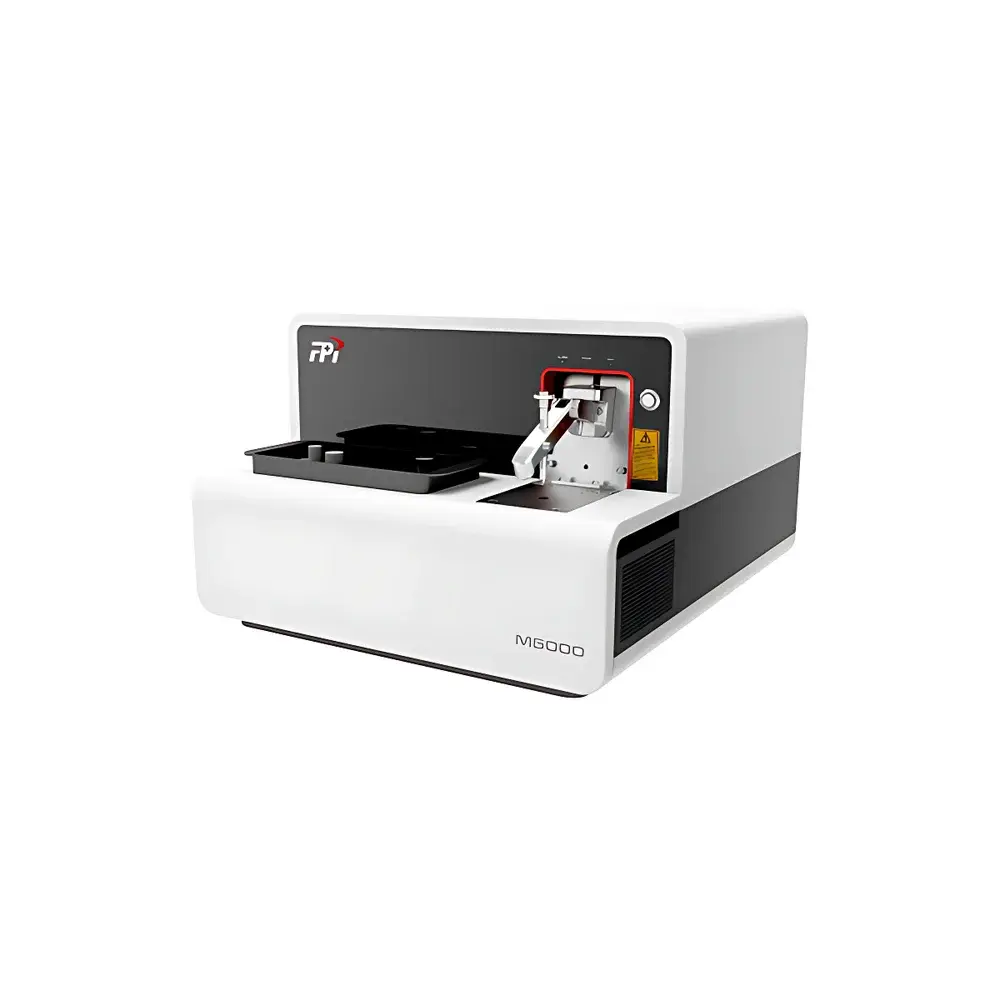
FPI M5000 S Direct-Reading Optical Emission Spectrometer (CCD-Based Spark Source)
| Brand | FPI |
|---|---|
| Origin | Zhejiang, China |
| Instrument Type | Benchtop |
| Excitation Source | Spark |
| Detector | Charge-Coupled Device (CCD) |
| Wavelength Coverage | Configurable (typically 130–800 nm) |
| Spectral Resolution | ≤ 10 pm (typical at 200 nm) |
| Optical System | Paschen-Runge Mount with Dual Chambers (UV + VIS) |
| Number of Simultaneously Acquired Spectral Lines | > 9,000 |
| Calibration Flexibility | Full-spectrum recalibration without hardware modification |
| Compliance | Designed to support ISO/IEC 17025 workflows, ASTM E415, E1086, and GB/T 4336 methodologies |
Overview
The FPI M5000 S is a benchtop direct-reading optical emission spectrometer (OES) engineered for high-precision, rapid elemental analysis of metallic alloys in industrial quality control environments. It employs spark source excitation coupled with a high-resolution Paschen-Runge optical system and multi-CCD detection to capture full spectral information across the ultraviolet and visible ranges (typically 130–800 nm). Unlike sequential or fixed-channel spectrometers, the M5000 S acquires >9,000 spectral lines simultaneously—enabling comprehensive qualitative and quantitative analysis of major, minor, and trace elements—including critical short-wavelength emitters such as C, P, S, and N. Its dual-chamber optical architecture isolates UV and VIS spectral regions, ensuring optimal signal-to-noise performance for both low-energy and high-energy transitions. The instrument is designed for routine use in foundries, metallurgical laboratories, and metal fabrication QA/QC departments where reproducibility, long-term stability, and compliance with standardized test methods (e.g., ASTM E415 for carbon steel, E1086 for stainless steels) are mandatory.
Key Features
- Full-spectrum CCD acquisition: Captures complete spectral data in a single exposure, eliminating channel selection constraints and enabling post-acquisition reanalysis.
- Dual optical chamber design: Independent UV and VIS chambers optimize sensitivity and resolution for short-wavelength elements (e.g., C I 165.69 nm, P I 178.28 nm, S I 180.73 nm) while maintaining robust performance for common alloying elements (Fe, Cr, Ni, Mn, Cu, Al, Si, Mo).
- Intelligent spectral line selection: Software-driven algorithm automatically identifies optimal analytical lines based on concentration level, inter-element interference, and self-absorption effects—enhancing accuracy without user intervention.
- Stabilized optical platform: Thermally regulated, sealed argon-purged spectrometer housing maintains optical alignment within ±0.005 nm over 8-hour operation; no mechanical wavelength scanning or manual retuning required.
- Digital spark generator: Fully programmable, current- and voltage-controlled discharge source ensures consistent plasma energy delivery across diverse matrix types (e.g., Al-, Mg-, Fe-, Cu-based alloys), minimizing memory effects and improving precision (RSD < 1.5% for certified reference materials).
- Open-style sample stand: Accommodates irregularly shaped specimens up to Ø40 mm × 50 mm height; integrated argon flow optimization reduces consumption by up to 40% versus conventional systems via dynamic gas regulation during pre-spark and integration phases.
Sample Compatibility & Compliance
The M5000 S supports solid metallic samples conforming to standard OES preparation requirements: flat, clean, homogeneous surfaces with minimum thickness ≥ 4 mm and surface roughness Ra ≤ 1.6 µm. It is validated for analysis of ferrous (carbon steels, stainless steels, cast irons), non-ferrous (aluminum, copper, zinc, titanium, magnesium alloys), and superalloys. Method development and validation align with ISO 11577 (metallic materials — spark emission spectrometric analysis), ASTM E415 (standard test method for analysis of carbon and low-alloy steels), and GB/T 4336 (Chinese national standard for carbon steel and medium-low alloy steel). Instrument firmware and software architecture support audit trails, electronic signatures, and configurable user access levels—facilitating implementation under GLP and GMP frameworks compliant with FDA 21 CFR Part 11 requirements when deployed with validated IT infrastructure.
Software & Data Management
The proprietary FPI SpectraSuite software provides a unified interface for instrument control, calibration management, spectral visualization, and report generation. Key capabilities include background subtraction using polynomial fitting, inter-element interference correction via multivariate regression models, and real-time drift compensation using internal reference lines. Calibration curves are stored as matrix-specific mathematical models (not fixed coefficients), allowing seamless extension to new base materials without physical recalibration. All raw spectra, processed results, and metadata (operator ID, timestamp, environmental conditions, spark parameters) are archived in an encrypted SQLite database with optional export to CSV, PDF, or LIMS-compatible XML formats. Software updates are delivered via secure HTTPS channels with SHA-256 integrity verification.
Applications
- Metallurgical process control: Real-time monitoring of melt composition during ladle refining and continuous casting.
- Supplier material verification: Rapid screening of incoming raw materials against purchase specifications (e.g., UNS, EN, ASTM grade limits).
- Finished product certification: Final inspection of forged, cast, or machined components prior to shipment.
- Failure analysis support: Identification of compositional deviations contributing to mechanical property failures or corrosion susceptibility.
- Scrap sorting & recycling: Discrimination between alloy grades (e.g., 304 vs. 316 stainless; 6061 vs. 7075 aluminum) using multivariate classification algorithms.
- Carbon equivalent (CE) and pitting resistance equivalent number (PREN) calculation: Customizable formula editor enables automatic derivation of metallurgically relevant indices from measured elemental concentrations.
FAQ
What sample preparation is required for accurate analysis?
Flat, ground, and polished surfaces free of oxidation, oil, or coating are mandatory. Minimum sample diameter: 10 mm; recommended: ≥20 mm. Surface roughness should not exceed Ra 1.6 µm.
Can the M5000 S analyze non-conductive materials?
No—it is designed exclusively for electrically conductive metallic solids. Non-metals (e.g., ceramics, polymers) or coated/insulated samples require alternative techniques such as XRF or ICP-OES.
Is external calibration necessary after installation?
Yes—a full initial calibration using certified reference materials (CRMs) traceable to NIST or equivalent national standards is required. Subsequent recalibrations may be performed in-house using matrix-matched CRMs.
How does the system handle spectral interference between elements like V and Mo?
The software applies peak deconvolution and multivariate interference correction using pre-characterized overlap matrices derived from CRM libraries—no manual peak masking or baseline adjustment needed.
What maintenance intervals are recommended?
Optical chamber purge gas filter: every 6 months. Spark stand cleaning and electrode replacement: after ~10,000 sparks or per visual inspection. Full system performance verification: annually or after major component service.




