
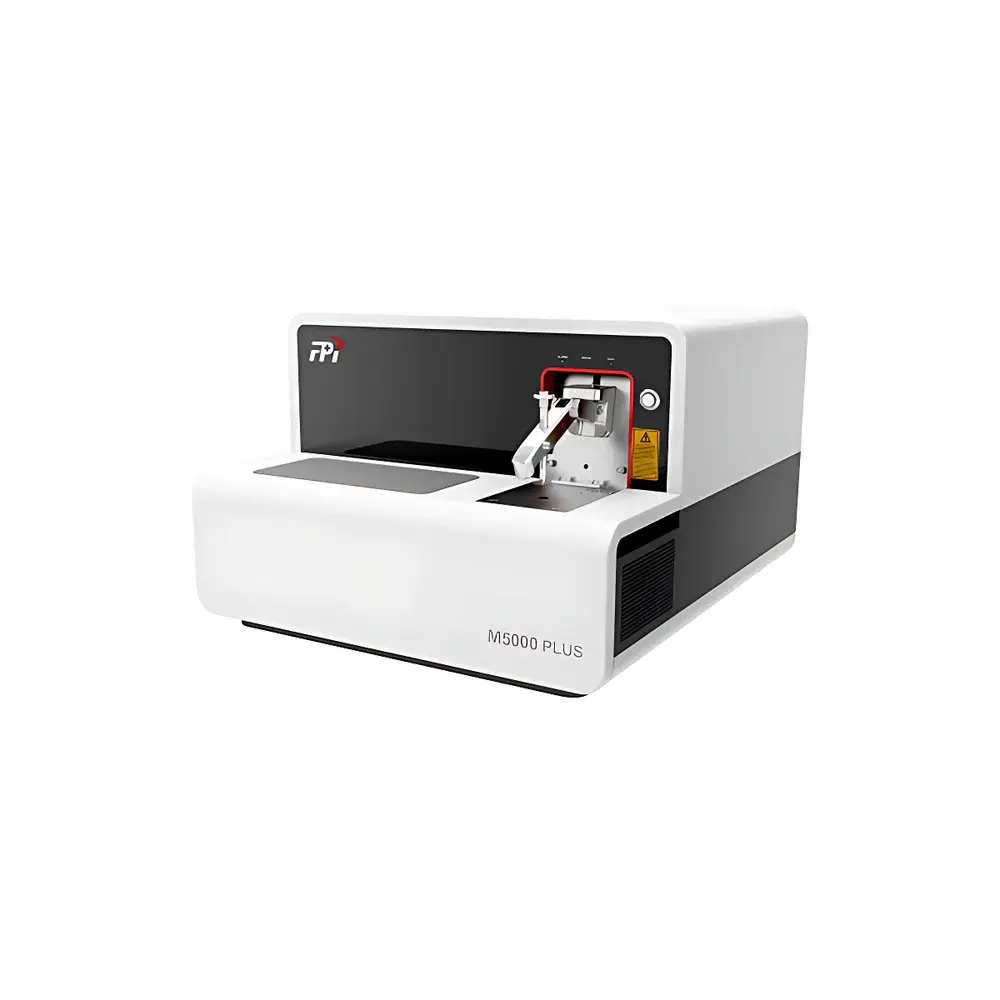
FPI M5000 PLUS S Direct-Reading Optical Emission Spectrometer (OES)
| Brand | FPI |
|---|---|
| Origin | Zhejiang, China |
| Instrument Type | Benchtop |
| Excitation Source | Spark |
| Detector | Scientific-grade CMOS |
| Wavelength Coverage | Configurable (130–800 nm typical) |
| Optical Configuration | Dual-chamber (Vacuum UV + Visible/NIR) |
| UV Optimization | Dedicated uncoated UV optical path for N, C, S, P analysis |
| Spectral Resolution | ≤ 10 pm at 200 nm (typical) |
| Channel Flexibility | Full-spectrum acquisition — no fixed channels |
| Software Compliance | Supports ASTM E415, E1086, ISO 11577, and GLP/GMP audit trails per FDA 21 CFR Part 11 requirements |
| Thermal Stability | Thermostatically controlled optical chamber (±0.1 °C) |
| Mechanical Construction | Stress-relieved die-cast aluminum optical housing (4-stage annealing) |
Overview
The FPI M5000 PLUS S is a benchtop spark optical emission spectrometer engineered for high-precision elemental analysis of metallic alloys in industrial and research laboratories. It operates on the principle of spark-induced plasma excitation, where a high-energy electrical discharge vaporizes and atomizes a solid metal sample surface, generating characteristic atomic emission lines across the ultraviolet to near-infrared spectrum (130–800 nm). Unlike traditional photomultiplier tube (PMT)-based OES systems with fixed-channel detection, the M5000 PLUS S employs a scientific-grade back-thinned CMOS detector enabling full-spectrum acquisition — capturing all emission lines simultaneously with high dynamic range and low readout noise. This architecture supports quantitative multi-element analysis (including light elements C, P, S, and N) without hardware reconfiguration, delivering trace-level detection limits down to sub-ppm concentrations in optimized matrices.
Key Features
- Scientific CMOS detector with ultra-low dark current and anti-blooming pixel architecture — ensures high signal-to-noise ratio and eliminates spectral crosstalk during high-intensity spark events.
- Dual optical chamber design: a dedicated vacuum-UV chamber (130–190 nm) with uncoated optics enables direct detection of nitrogen, carbon, sulfur, and phosphorus without wavelength-shifting coatings or purging gases; a separate visible/NIR chamber covers 190–800 nm for major and trace alloying elements.
- RTMC (Real-Time Multi-Parameter Calibration) optical stabilization technology — continuously monitors and compensates for thermal drift, pressure fluctuations, and mechanical micro-shifts to maintain long-term spectral registration stability (≤ ±0.5 pm over 8 hours).
- Optimized spark source with fully digital pulse control — automatically adjusts energy, frequency, and pre-spark conditioning per sample matrix, ensuring reproducible ablation and minimizing crater heterogeneity.
- Die-cast aluminum optical housing subjected to four-stage stress-relief annealing and precision-machined mounting interfaces — minimizes mechanical hysteresis and improves resistance to ambient vibration and thermal gradients.
- Integrated multi-port purge system with laminar-flow gas distribution — rapidly evacuates atmospheric oxygen and moisture from the UV chamber, achieving stable O2 concentration < 1 ppm within 90 seconds.
Sample Compatibility & Compliance
The M5000 PLUS S accepts standard 32–40 mm diameter solid metal samples (ferrous and non-ferrous), including castings, ingots, billets, and machined coupons. Sample preparation follows ISO 11577 and ASTM E415 guidelines for surface flatness, finish, and cleaning. The instrument complies with electromagnetic compatibility (EMC) standards IEC 61326-1 and safety requirements IEC 61010-1. Its software architecture supports audit trail logging, electronic signatures, and user-access controls aligned with FDA 21 CFR Part 11 for regulated environments. Routine performance verification adheres to ASTM E1086 (stainless steel) and ISO 11577 (aluminum alloys), with optional certified reference material (CRM) libraries traceable to NIST and BAM standards.
Software & Data Management
The proprietary FPI-SpectraSuite software provides intuitive workflow management from spark parameter setup to final report generation. It features intelligent curve modeling — automatically selecting and blending calibration models based on sample composition prediction from initial spectral scans, eliminating manual grade selection. All raw spectra are stored in HDF5 format with embedded metadata (instrument state, spark parameters, environmental conditions). Data export supports ASTM E1382-compliant XML, CSV, and PDF formats. Remote maintenance capability enables secure firmware updates, diagnostic telemetry, and real-time log review via TLS-encrypted SSH tunnel — supporting lifecycle monitoring without onsite intervention. Version-controlled method files include full revision history and change justification fields for GLP/GMP documentation.
Applications
The M5000 PLUS S serves as a primary analytical tool in foundries, steel mills, aerospace component suppliers, and third-party testing laboratories. It performs routine QC analysis of carbon steels, stainless steels, aluminum alloys (e.g., 2xxx, 6xxx, 7xxx series), copper-based alloys, titanium grades, and nickel superalloys. Specific use cases include: verification of residual element limits (e.g., Sn, Pb, As in food-grade stainless); certification of nitrogen content in duplex stainless steels; sulfur segregation mapping in large castings; and rapid sorting of scrap metal streams. Research applications encompass phase transformation studies, inclusion analysis via spectral deconvolution, and development of new alloy compositions requiring simultaneous quantification of >25 elements across multiple excitation zones.
FAQ
Does the M5000 PLUS S require vacuum pumping for UV analysis?
No — it uses a sealed, continuously purged UV chamber with argon or nitrogen, eliminating mechanical pumps and associated maintenance.
Can calibration models be transferred between instruments?
Yes — calibration files are instrument-independent when generated using common CRMs and validated under identical spark conditions; cross-instrument transfer requires spectral alignment verification.
Is nitrogen analysis possible in aluminum matrices?
Yes — the dedicated UV optical path achieves detection limits of 10–30 ppm N in Al-Si and Al-Mg alloys, validated against LECO combustion analysis per ASTM E1019.
What maintenance intervals are recommended for the spark stand?
Electrode cleaning every 500–1,000 sparks; argon flow path inspection quarterly; optical window cleaning semi-annually — all procedures documented in the included service manual.
Does the system support automated sample changers?
Yes — the RS-485 and Ethernet interfaces enable integration with third-party autosamplers compliant with SECS/GEM protocol or custom PLC-driven stages.
Related Products






