
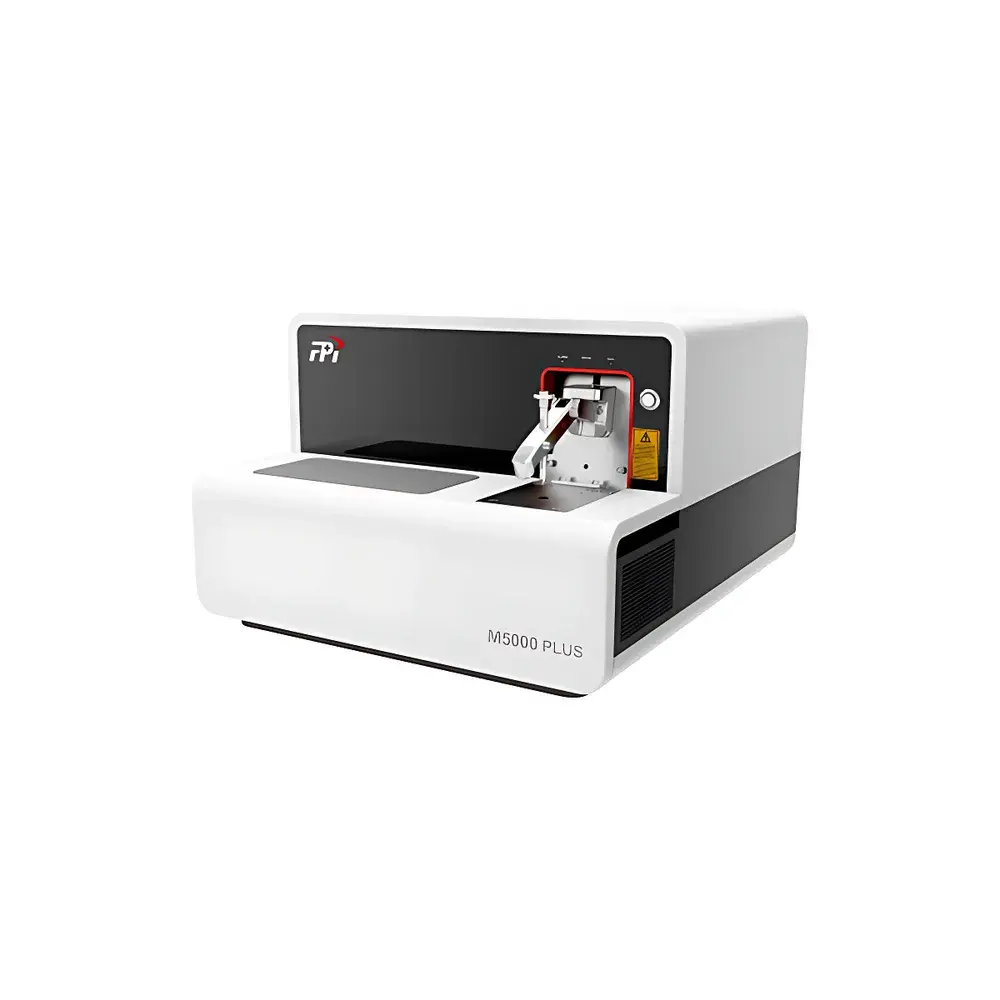
FPI M5000 PLUS F Direct-Reading Spark Optical Emission Spectrometer
| Brand | FPI |
|---|---|
| Origin | Zhejiang, China |
| Model | M5000 PLUS F |
| Instrument Type | Benchtop |
| Excitation Method | Spark |
| Detector Type | Scientific-grade CMOS |
| Focal Length | 400 mm |
| Grating Line Density | 2400 l/mm (Visible), 3600 l/mm (UV) |
| Wavelength Range | 140–680 nm |
| Spectral Acquisition Mode | Full-Spectrum Direct Reading |
Overview
The FPI M5000 PLUS F is a benchtop direct-reading spark optical emission spectrometer (OES) engineered for high-precision, routine elemental analysis of metallic alloys in industrial and research laboratories. It operates on the principle of spark-induced atomic emission spectroscopy: a controlled high-voltage spark excites atoms in a solid metal sample, causing them to emit characteristic photons across the ultraviolet–visible (UV–Vis) spectrum (140–680 nm). These emissions are dispersed by dual-grating optics—separately optimized for UV and visible regions—and simultaneously captured by a scientific-grade back-illuminated CMOS detector. Unlike traditional PMT-based systems, the CMOS architecture enables full-spectrum acquisition without mechanical scanning, delivering inherent wavelength stability, high dynamic range, and PPM-level detection limits for key metallurgical elements including C, P, S, N, Si, Mn, Cr, Ni, Al, Cu, Mo, and Ti.
Key Features
- Scientific-grade CMOS detector with ultra-low readout noise and anti-blooming (anti-halo) pixel architecture—ensuring high signal fidelity and long-term photometric stability.
- Dual optical path design: independent UV and visible spectral channels, each with dedicated gratings (3600 l/mm for UV; 2400 l/mm for visible) and optimized focal geometry—maximizing resolution for critical non-metals (C, S, P, N) while maintaining broad elemental coverage.
- Monolithic aluminum alloy optical chamber with four-stage stress-relief annealing and active temperature stabilization (±0.1 °C)—eliminating thermal drift and guaranteeing spectral peak position reproducibility over extended operation cycles.
- RTMC (Real-Time Multi-Channel) spectral optimization algorithm—dynamically calibrates intensity response per pixel during acquisition, compensating for minor source fluctuations and detector non-uniformity.
- Full-digital pulsed spark source with adaptive energy control—automatically selects optimal discharge parameters (pulse width, frequency, current) based on sample matrix and analyte volatility, ensuring robust precision and repeatability (RSD < 1.5% for major elements).
- Multi-hole purging system integrated into the spark stand—enabling rapid, complete displacement of ambient air from the optical path, especially critical for stable UV transmission below 200 nm.
Sample Compatibility & Compliance
The M5000 PLUS F accepts standard 32–40 mm diameter solid metal samples (ferrous and non-ferrous), including cast iron, stainless steel, aluminum alloys, copper alloys, titanium, and nickel-based superalloys. Sample preparation follows ISO 11577 and ASTM E407 guidelines for grinding and surface conditioning. The instrument supports GLP-compliant operation through audit-trail-enabled software, user-access-level controls, electronic signature capability, and data integrity safeguards aligned with FDA 21 CFR Part 11 requirements. All calibration and validation procedures comply with ISO/IEC 17025:2017 for testing laboratories.
Software & Data Management
The proprietary FPI SpectraSuite software provides a fully graphical, intuitive interface with real-time spectral visualization, multi-element quantitative analysis, and intelligent curve generation. Its “Universal Calibration” module enables model-free analysis of unknown alloys via iterative least-squares fitting against a comprehensive spectral library—removing dependency on pre-defined grade libraries. Data export supports CSV, XML, and ASTM E1382-compliant formats. Remote maintenance functionality allows secure firmware updates, diagnostic log retrieval, and health monitoring via encrypted TLS connection—reducing downtime and supporting predictive service planning.
Applications
The M5000 PLUS F serves as a core analytical tool in foundry quality assurance (QA/QC), incoming raw material inspection, scrap sorting, failure analysis, and R&D for advanced metallic materials. It is widely deployed in steel mills, aerospace component manufacturers, automotive casting facilities, third-party testing labs, customs inspection bureaus, and university metallurgy departments. Typical use cases include: verification of alloy grade conformity (e.g., ASTM A36, EN 10025); low-carbon steel certification (C ≤ 0.02%); sulfur segregation mapping in bearing steels; nitrogen quantification in duplex stainless steels; and phosphorus control in high-purity aluminum conductors.
FAQ
What types of samples can be analyzed on the M5000 PLUS F?
Solid metallic samples with flat, clean, conductive surfaces—typically disks or machined coupons 32–40 mm in diameter and ≥4 mm thick.
Does the instrument require external argon gas supply?
Yes—a continuous high-purity argon purge (≥99.998%) is required for both spark chamber atmosphere and optical path protection, especially for UV-sensitive elements.
Can additional elements or base materials be added post-purchase?
Yes—new calibration models and spectral analysis ranges can be deployed via software update without hardware modification, subject to physical spectral coverage and detector sensitivity constraints.
How often is recalibration required?
Under stable environmental conditions and routine use, recalibration intervals typically extend to 8–12 weeks; automated drift correction and RTMC compensation significantly reduce frequency versus conventional OES systems.
Is the system compliant with regulatory documentation standards?
Yes—the software includes full 21 CFR Part 11 compliance features: electronic signatures, change audit trails, role-based access control, and immutable raw data storage.




