
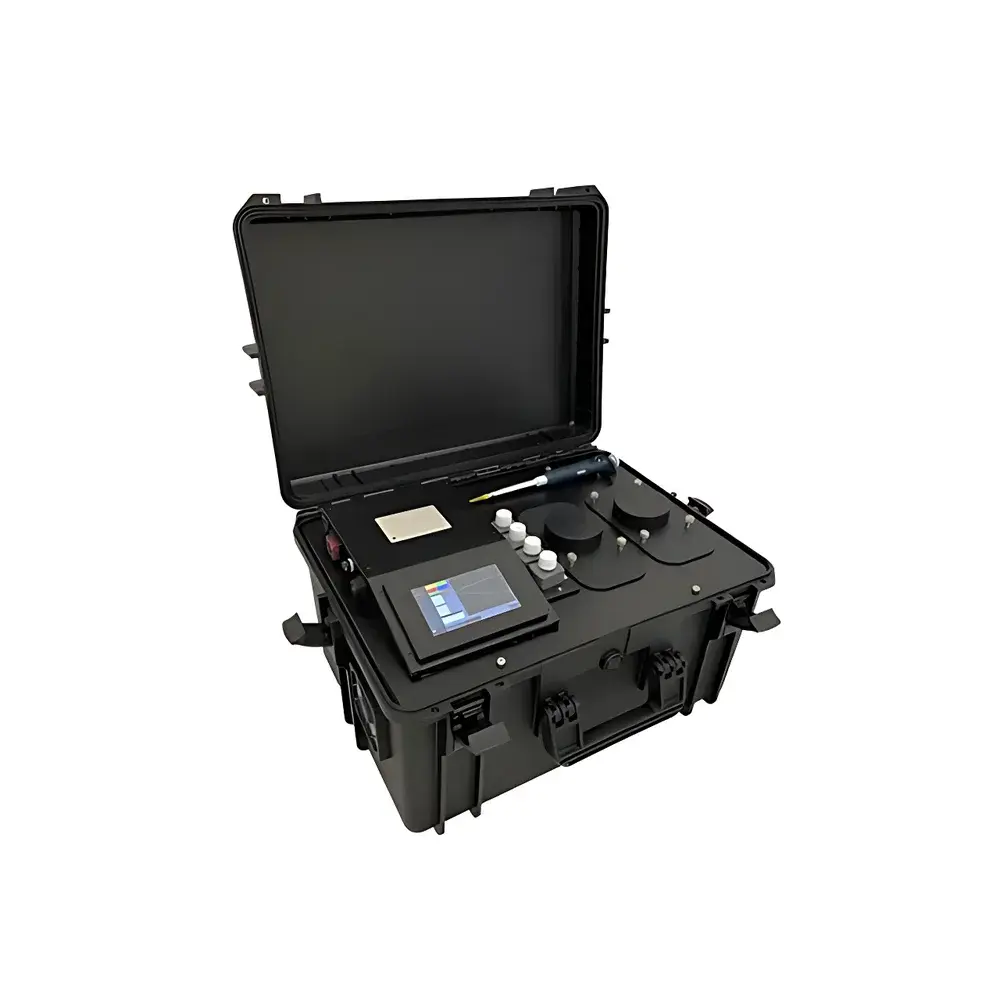
FPI Micromac SmarTox Portable Bioluminescent Toxicity Analyzer
| Brand | FPI |
|---|---|
| Origin | Italy |
| Manufacturer | FPI |
| Type | Portable |
| Model | Micromac SmarTox |
| Operating Temperature | 4–6 °C (bacterial storage), 15 °C and 25 °C (reaction chambers) |
| Assay Time | 15 min |
| Compliance | ISO 11348-3, GB/T 15441 |
| Detection Principle | Bioluminescence inhibition of non-pathogenic marine bacteria |
Overview
The FPI Micromac SmarTox Portable Bioluminescent Toxicity Analyzer is an engineered field-deployable instrument designed for rapid, quantitative assessment of acute aquatic toxicity in water samples. It operates on the principle of bioluminescence inhibition: viable, metabolically active luminescent bacteria—specifically Vibrio fischeri, Photobacterium phosphoreum, and Vibrio qinghaiensis—emit visible light as a byproduct of cellular respiration. When exposed to toxicants—including heavy metals, pesticides, organic pollutants, and industrial effluents—their metabolic activity is suppressed, resulting in measurable reduction in photon emission. The Micromac SmarTox quantifies this inhibition relative to a non-toxic control, delivering a % inhibition value or EC50 equivalent within 15 minutes. Its dual-temperature architecture enables strict adherence to ISO 11348-3 requirements for bacterial viability maintenance and assay reproducibility, making it suitable for regulatory screening, emergency response, and routine environmental monitoring under GLP-aligned workflows.
Key Features
- Dual independent temperature-controlled compartments: one at 4–6 °C for long-term storage and reactivation of lyophilized bacterial cultures; two programmable reaction chambers at 15 °C and 25 °C to support species-specific optimal growth and luminescence kinetics.
- Integrated four-compartment reagent storage module for standardized buffer solutions, positive/negative controls, and calibration standards—minimizing cross-contamination and ensuring traceable assay conditions.
- Industrial-grade 7-inch color LCD touchscreen with intuitive icon-driven interface; supports both manual initiation and fully automated assay sequences including blank normalization and multi-sample batch processing (up to three samples + one blank per run).
- Onboard high-capacity 12.6 V / 11,000 mAh rechargeable Li-ion battery enabling >8 hours of continuous operation without external power—validated for mobile deployment in vehicles, vessels, and remote sampling sites.
- Embedded thermal printer for immediate hard-copy reporting with timestamp, sample ID, inhibition %, temperature logs, and operator signature fields—supporting audit-ready documentation per ISO/IEC 17025 and EPA Method 1604 compliance frameworks.
- Local data management: stores >1,000 complete assay records with full metadata (date/time, chamber temp, bacterial strain ID, raw RLU values, inhibition calculation); exportable via USB 2.0 to CSV or PDF for LIMS integration or regulatory submission.
Sample Compatibility & Compliance
The Micromac SmarTox accepts liquid samples across a broad matrix range—including raw and treated drinking water, wastewater influent/effluent, surface water, process water from food/beverage production, and leachates from landfill or industrial sites. Sample pretreatment (e.g., filtration, pH adjustment to 6.0–8.5, dilution for highly inhibitory matrices) follows ISO 11348-3 Annex A protocols. All bacterial strains used are non-pathogenic, biosafety level 1 (BSL-1), and certified free of endotoxin contamination. Instrument validation includes daily photometric calibration using NIST-traceable luminance standards and periodic performance verification with reference toxicants (e.g., 3,5-dichlorophenol). Data integrity is maintained through electronic audit trails, user-level access control, and automatic firmware logging—fully compatible with FDA 21 CFR Part 11 requirements when deployed in regulated QA/QC environments.
Software & Data Management
The embedded firmware provides real-time luminescence acquisition at 1-second intervals over the full 15-minute assay window, with automatic baseline correction and kinetic curve fitting. Raw relative light unit (RLU) data are processed using a robust algorithm that computes inhibition (%) as: [(RLUblank − RLUsample) / RLUblank] × 100. Results are displayed alongside confidence indicators derived from intra-assay coefficient of variation (CV < 15% typical). Data export supports standard formats (CSV, XML) for downstream statistical analysis in R, Python, or commercial QC software. Optional PC-based desktop application enables method template creation, multi-instrument fleet synchronization, and automated report generation compliant with ISO/IEC 17025 clause 7.8.2.
Applications
- Rapid emergency response during chemical spills or accidental discharges—providing actionable toxicity thresholds within 15 minutes on-site.
- Drinking water safety verification at intake points, distribution nodes, and post-treatment stages.
- Wastewater treatment plant optimization—monitoring influent toxicity to protect biological treatment units and verifying effluent compliance prior to discharge.
- Food & beverage industry process water surveillance—ensuring rinse water, boiler feed, and cleaning-in-place (CIP) effluents meet internal toxicity specifications.
- Environmental impact assessments and sediment pore-water toxicity screening in ecotoxicological studies.
- Validation of advanced oxidation or membrane filtration efficacy via pre-/post-treatment toxicity profiling.
FAQ
What bacterial strains are supported, and how are they supplied?
The instrument supports Vibrio fischeri, Photobacterium phosphoreum, and Vibrio qinghaiensis in lyophilized format. Each vial contains ≥1 × 10⁸ CFU/mL after reconstitution and is stable for ≥12 months at 4–6 °C.
Is calibration required before each use?
A daily photometric check using the built-in reference standard is recommended; full calibration with certified luminance sources is performed annually or after sensor servicing.
Can the device be integrated into a laboratory LIMS?
Yes—via USB mass storage mode or optional RS-232/USB-C serial interface with ASCII-based command protocol supporting automated data ingestion.
Does the analyzer meet regulatory acceptance criteria for official reporting?
Data generated comply with ISO 11348-3 and GB/T 15441 for screening-level toxicity assessment; formal regulatory acceptance depends on local authority validation protocols and documented instrument qualification (IQ/OQ/PQ).
Related Products







