
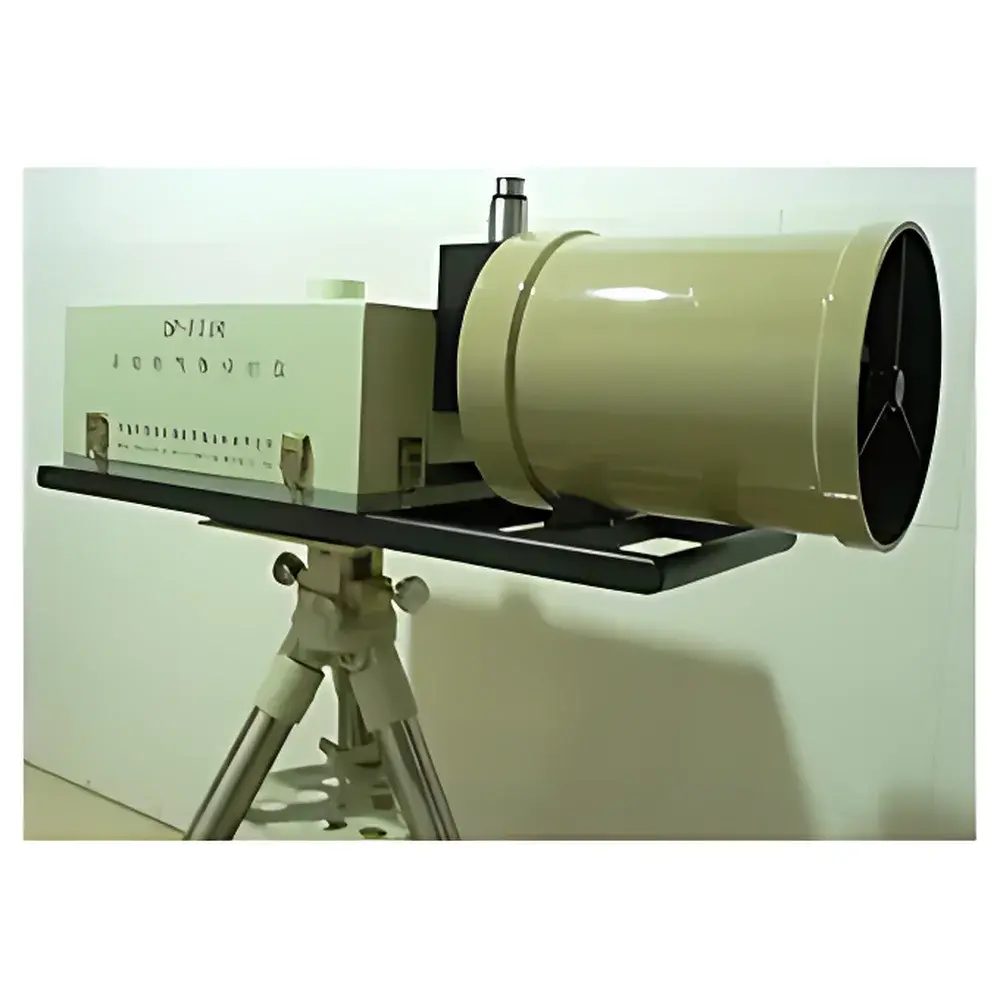
FPI Open-Path Fourier Transform Infrared Multicomponent Gas Analyzer
| Brand | FPI (Focus Photonics Inc.) |
|---|---|
| Origin | Zhejiang, China |
| Manufacturer Type | Original Equipment Manufacturer (OEM) |
| Product Type | Online Analyzer |
| Optical Configuration | Dual-Station Open-Path FTIR |
| Spectral Resolution | 1 cm⁻¹ |
| Detector Operating Temperature | −196 °C (Liquid Nitrogen Cooled MCT) |
| Detection Limit | Sub-ppb for Selected Analytes |
| Spectral Library | >300 Reference Spectra (Validated Against Bruker and Anhui Institute of Optics and Fine Mechanics Libraries) |
| Gas Coverage | ≥20 Target Species Including VOCs, CO, CO₂, NH₃, SO₂, NO, HCl, HF, CH₄ (Customizable) |
| Sample Handling | Direct Ambient Air Measurement — No Pre-concentration, No Chemical Derivatization, No Sampling Line Required |
Overview
The FPI Open-Path Fourier Transform Infrared Multicomponent Gas Analyzer is an online, real-time environmental monitoring instrument engineered for continuous, non-invasive atmospheric trace gas analysis. It operates on the fundamental principle of open-path Fourier transform infrared (OP-FTIR) spectroscopy: infrared radiation from a broadband thermal source propagates across an unenclosed atmospheric path (typically 50–500 m), interacts with target gas molecules via vibrational-rotational absorption, and is collected by a co-located or remotely positioned interferometer-equipped spectrometer. The resulting interferogram is digitized and subjected to fast Fourier transformation to yield high-fidelity mid-infrared absorbance spectra (4000–600 cm⁻¹). Quantitative concentration retrieval is performed via multivariate spectral fitting—leveraging least-squares regression against reference absorption cross-sections under defined temperature, pressure, and path-length conditions. This architecture eliminates sampling artifacts associated with extractive systems (e.g., adsorption losses, catalytic decomposition, tubing memory effects) and enables true in-situ measurement of reactive, condensable, and thermally labile species.
Key Features
- Open-path dual-station configuration supporting flexible deployment: transmitter and receiver units may be installed at fixed separation distances, enabling area-wide plume mapping and fence-line monitoring.
- High-stability liquid nitrogen-cooled mercury cadmium telluride (MCT) detector operating at −196 °C, delivering superior signal-to-noise ratio (SNR) and extended spectral response up to 18 µm (555 cm⁻¹), critical for low-concentration detection of heavy organics and acid gases.
- Spectral resolution of 1 cm⁻¹—optimized for resolving overlapping absorption features of complex gas mixtures without compromising data acquisition speed (typical scan rate: 0.5–2 spectra per second).
- Proprietary multi-point calibration and multi-spectral band fitting algorithm, developed in collaboration with the Anhui Institute of Optics and Fine Mechanics (Chinese Academy of Sciences), mitigates interferences from water vapor, CO₂, and overlapping functional group absorptions (e.g., C=O stretch vs. N–H bend).
- Comprehensive, experimentally validated spectral library containing >300 analytes—including regulated pollutants (SO₂, NO, NH₃, HCl, HF), greenhouse gases (CO₂, CH₄, N₂O), and volatile organic compounds (benzene, toluene, formaldehyde, acetaldehyde)—all referenced to Bruker’s industrial spectral database and traceable to NIST standards.
- Fully automated operation: self-calibrating optical alignment, ambient temperature/pressure compensation, and integrated diagnostics enable unattended long-term deployment (>6 months) under varying meteorological conditions.
Sample Compatibility & Compliance
The analyzer is designed for direct measurement of ambient air, stack emissions, landfill boundary air, and industrial process exhaust streams without sample conditioning. It complies with ISO 14001 environmental management system requirements for continuous emission monitoring (CEM) applications and supports audit-ready data integrity per EPA Method 320 and ASTM D6348 for open-path IR gas analysis. While not certified to EN 15267 or MCERTS for regulatory reporting in the EU, its measurement uncertainty profile (±5–10% RSD for major analytes at ppm levels, ±15–25% at sub-ppb levels) aligns with QA/QC protocols for screening-level compliance verification and fugitive emission quantification. All spectral processing adheres to GLP-compliant data handling principles, including full metadata logging (time stamp, GPS coordinates, T/P/RH, optical path length, detector voltage, laser HeNe stability metrics).
Software & Data Management
The embedded acquisition and analysis software (FPI-OPFTIR v4.x) provides real-time spectral visualization, automatic peak identification, and time-series concentration trending with configurable alarm thresholds. Raw interferograms and processed spectra are stored in HDF5 format with embedded calibration history and instrument state variables. Export modules support CSV, NetCDF, and XML for integration into SCADA, LIMS, or third-party environmental data management platforms (e.g., EQuIS, ArcGIS Environmental Monitoring). Audit trail functionality records all user actions, parameter changes, and calibration events—meeting foundational requirements for FDA 21 CFR Part 11 compliance when deployed in pharmaceutical or biotech facility perimeter monitoring contexts.
Applications
- Industrial fence-line and community air monitoring for VOCs, acid gases, and odorants near petrochemical, semiconductor, and chemical manufacturing sites.
- Landfill and wastewater treatment plant odor and methane emission quantification.
- Urban air quality research—tracking diurnal patterns of CO, NO, NH₃, and formaldehyde in traffic corridors and residential zones.
- Emergency response and leak detection: rapid identification and semi-quantitative localization of unknown gas releases using spectral residual analysis and plume dispersion modeling inputs.
- Validation of point sensors and extractive CEMS through spatially averaged path-integrated concentration measurements.
FAQ
What gases can this analyzer detect out-of-the-box?
The standard configuration supports quantitative analysis of ≥20 gases—including CO, CO₂, CH₄, NH₃, SO₂, NO, HCl, HF, and common VOCs (e.g., benzene, toluene, acetone). Additional analytes may be added via spectral library expansion and field validation.
Is calibration required before deployment?
Yes—initial calibration requires known concentration reference gases (or certified permeation tubes) at representative path lengths and environmental conditions. Multi-point calibration across concentration ranges and humidity levels is recommended for optimal accuracy in variable ambient settings.
Can the system operate in rain, fog, or snow?
Performance degrades under heavy precipitation or dense fog due to Mie scattering and beam attenuation. The system includes automatic fog detection algorithms and data quality flags; however, continuous operation is best maintained in clear-air conditions or with periodic path-clearing (e.g., heated optics, purge air curtains).
Does it meet regulatory reporting requirements?
It satisfies technical performance criteria for indicative monitoring under EPA, ISO, and national ambient air quality guidelines but is not pre-certified for legally binding compliance reporting in jurisdictions requiring MCERTS or EN 15267 certification. Site-specific validation per local regulatory protocols is required.
What maintenance is required?
Annual detector re-cooling (LN₂ refill schedule), quarterly optical alignment verification, biannual interferometer mirror cleaning, and annual spectral library update—performed by FPI-certified field service engineers or trained site personnel.
Related Products







