
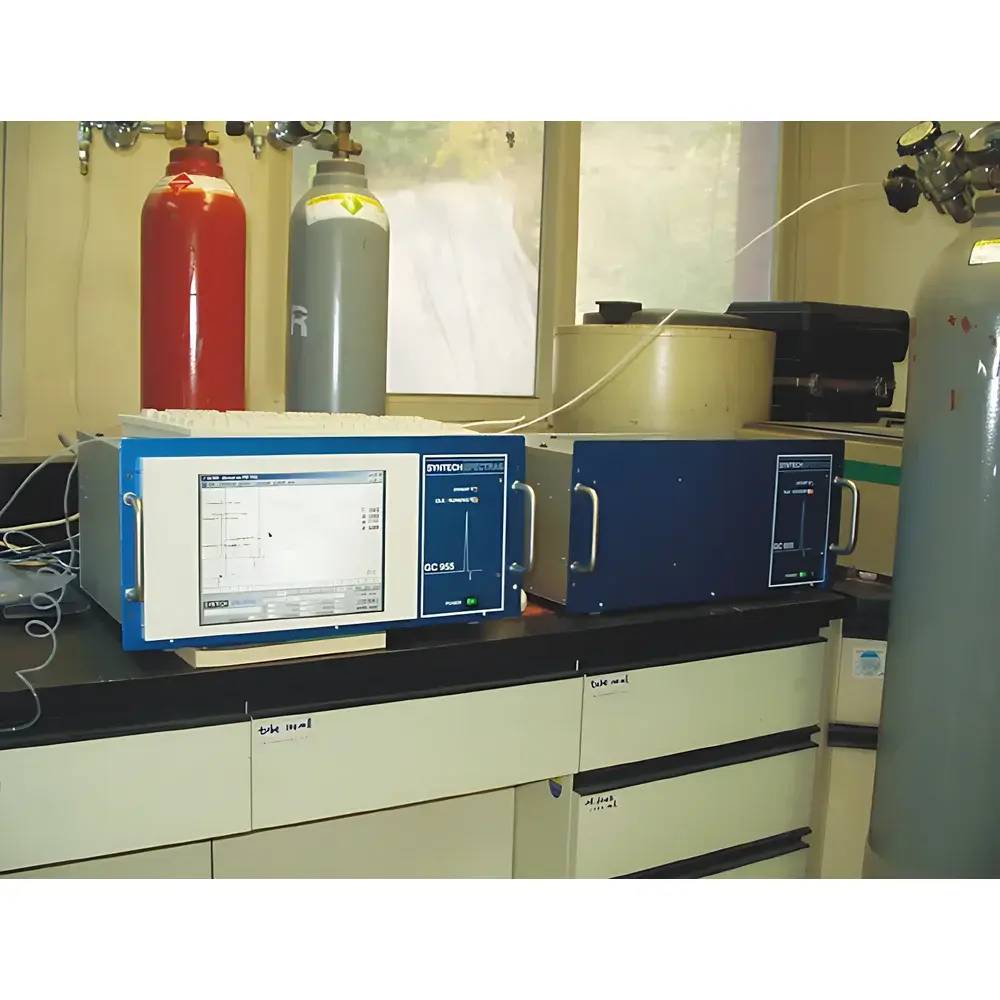
FPI Ozone Precursor Analyzer Model FPI-OPA
| Brand | FPI (Fortune Photonics Instrumentation) |
|---|---|
| Origin | Zhejiang, China |
| Manufacturer Type | Original Equipment Manufacturer (OEM) |
| Instrument Type | Online Continuous Emission Monitor |
| Detection Principle | Dual-Detector Gas Chromatography (GC-PID/GC-FID) |
| Sample Introduction | Stepper Motor-Driven Piston Sampling System with Temperature/Pressure Compensation |
| Preconcentration | Integrated Tenax TA or Cryo-Focused Trap with Thermal Desorption |
| Separation Architecture | Two-Dimensional GC (2D-GC) with Primary Pre-Separation Column and Analytical Capillary Column |
| Detector Configuration | Photoionization Detector (PID) + Flame Ionization Detector (FID) |
| Data Acquisition & Control | Embedded Industrial PC with Real-Time OS |
| Communication Interfaces | Ethernet, RS-232 (COM), USB, 4–20 mA Analog Output, Digital I/O |
| Compliance Support | Designed for EPA TO-15 / TO-17 alignment, compatible with ISO 8573-6 (hydrocarbon analysis in ambient air), supports audit-ready data logging per GLP/GMP principles |
Overview
The FPI Ozone Precursor Analyzer (Model FPI-OPA) is a dedicated online gas chromatographic system engineered for continuous, unattended monitoring of volatile organic compounds (VOCs) that serve as key ozone precursors in ambient air. It operates on the principle of two-dimensional gas chromatography (2D-GC), combining selective pre-separation with high-resolution analytical separation to resolve complex hydrocarbon mixtures across an exceptionally wide boiling point range—from ethane (bp −89 °C) to 1,2,3-trimethylbenzene (bp 176 °C). This 300 K volatility span necessitates precise thermal management and dual detection capability: the system integrates both a photoionization detector (PID) for enhanced sensitivity toward aromatic and unsaturated compounds (e.g., benzene, toluene, xylenes, 1,3-butadiene), and a flame ionization detector (FID) for robust, linear quantification of aliphatic species (e.g., ethane, propane, n-pentane, 2,2,4-trimethylpentane). The instrument is designed for regulatory-grade environmental monitoring stations, urban air quality networks, and industrial fence-line surveillance where real-time speciated VOC data informs ozone formation potential modeling and emission source attribution.
Key Features
- Dual-detector architecture (PID + FID) enabling compound-class-selective detection and cross-validated quantification
- Integrated 2D-GC platform with dedicated pre-concentration trap (Tenax TA or cryogenically cooled) and thermally programmed desorption for trace-level enrichment (sub-pptv LODs typical)
- Stepper motor-driven piston sampling module with real-time temperature and barometric pressure compensation—ensuring metrologically traceable volumetric intake independent of ambient fluctuations
- Electronically actuated multi-port valves (10-port configuration) for precise, repeatable flow path switching—eliminating hysteresis and wear-related drift common in pneumatic valve systems
- Modular column set: fused-silica pre-separation column (e.g., porous polymer PLOT) coupled with high-efficiency analytical column (e.g., 5% phenyl methylpolysiloxane), optimized for C2–C12 hydrocarbons
- Embedded industrial control computer running deterministic real-time operating system; fully automated sequence execution including calibration, zero/span checks, and maintenance alerts
- Comprehensive diagnostics logging: all critical parameters—including oven temperatures, detector baselines, valve timing, and trap desorption profiles—are timestamped and archived with millisecond resolution
Sample Compatibility & Compliance
The FPI-OPA is validated for direct analysis of ambient air without sample dilution or derivatization. Its preconcentration and separation design accommodates both low-boiling alkenes (e.g., ethylene, propene, isoprene) and higher-boiling aromatics (e.g., trimethylbenzenes, n-dodecane), covering over 40 target compounds specified in U.S. EPA Method TO-15 and European standard EN 14662. The system meets performance criteria for continuous emission monitoring under ISO 17025-accredited laboratories and supports data integrity requirements aligned with FDA 21 CFR Part 11 (electronic records/signatures) when deployed with optional audit trail and user access control modules. All hardware components comply with IEC 61000-6-2 (immunity) and IEC 61000-6-4 (emissions) for operation in electromagnetically noisy field environments.
Software & Data Management
The analyzer is operated via FPI ChromaView™, a Windows-based chromatographic workstation built on .NET Framework with native SQL Server Express database integration. The software provides full remote supervision through encrypted HTTPS web interface, allowing parameter adjustment, method scheduling, and live chromatogram viewing from any networked device. Raw chromatographic data (including analog detector outputs and digital valve status logs) are stored in vendor-neutral formats (NetCDF 4.0 and mzML-compliant metadata wrappers) to ensure long-term interoperability. Automated report generation includes EPA-compliant summary tables (e.g., hourly averaged concentrations, detection frequency, method detection limits), trend plots, and outlier flagging based on statistical process control (SPC) algorithms. Data export supports CSV, XML, and MODBUS TCP protocols for seamless ingestion into SCADA, EMS, or air quality modeling platforms such as CAMx or CMAQ.
Applications
- Urban and regional photochemical assessment—quantifying reactivity-weighted VOC emissions for ozone isopleth modeling
- Industrial fenceline monitoring—detecting fugitive emissions from petrochemical facilities, refineries, and solvent-use operations
- Mobile laboratory deployments—integrated into van-mounted air quality labs for spatial mapping of precursor gradients
- Research campaigns—supporting field studies on atmospheric oxidation mechanisms, OH radical reactivity, and secondary organic aerosol (SOA) formation potential
- Regulatory compliance reporting—generating auditable datasets for national air quality standards (e.g., China’s HJ 1019-2019, EU Directive 2008/50/EC Annex IX)
FAQ
What VOCs does the FPI-OPA quantify, and how are they selected?
The instrument targets 42+ speciated hydrocarbons defined by their photochemical reactivity and regulatory relevance—including C2–C5 alkanes/alkenes and C6–C12 mono-/poly-aromatics—selected per U.S. EPA, EEA, and MEE reference lists. Compound selection is configurable via method editor without hardware modification.
Does the system require external calibration gas standards?
Yes—certified permeation tubes or dynamic dilution calibrators (e.g., NIST-traceable VOC standards in nitrogen) are required for initial method validation and periodic recalibration. The embedded PC automates calibration sequence execution and stores certificate metadata.
Can the FPI-OPA operate unattended for extended periods?
Fully—designed for >30-day autonomous operation with scheduled self-diagnostic routines, automatic trap regeneration, and low-gas-consumption FID operation (<20 mL/min H2). Optional uninterruptible power supply (UPS) and environmental enclosure extend field deployment reliability.
Is remote firmware update supported?
Yes—secure OTA (over-the-air) updates are delivered via signed package files through authenticated HTTPS channel, preserving configuration integrity and cryptographic signature verification.
Related Products







