
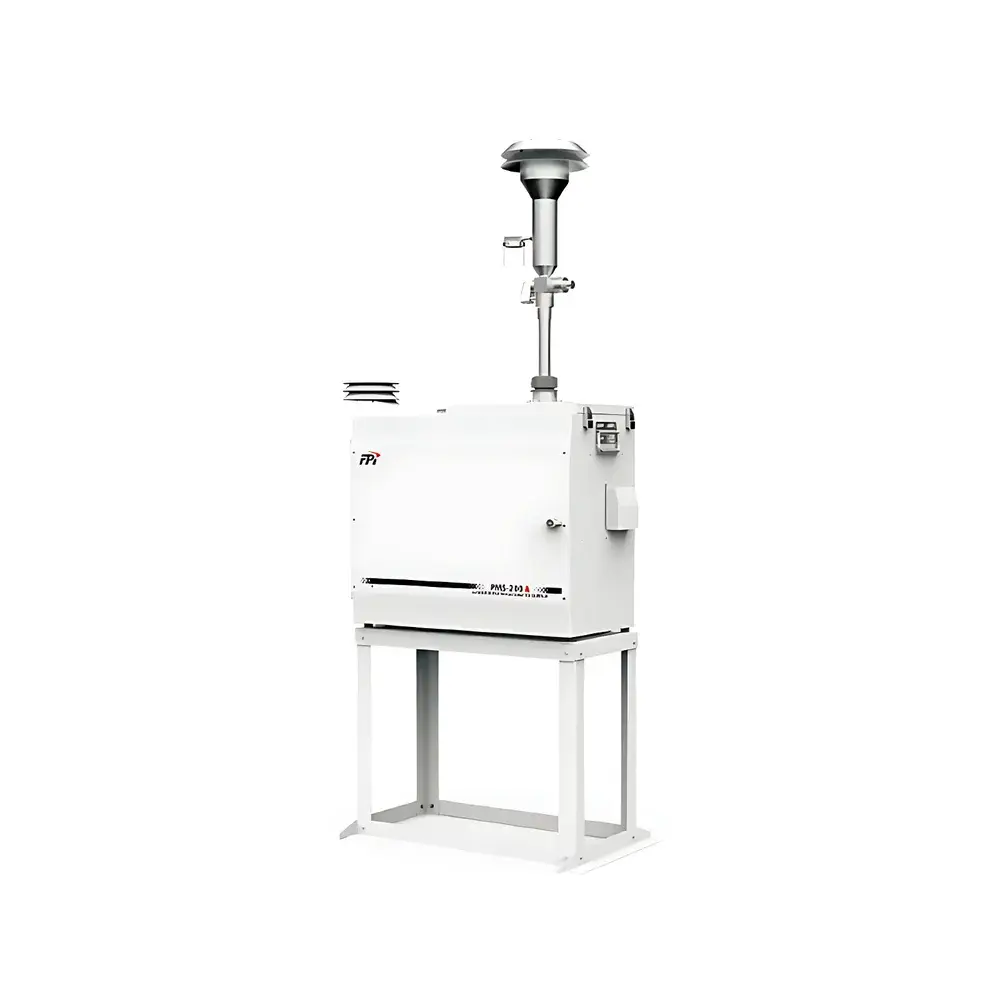
FPI PMS-200A Automated Filter-Changing Low-Flow Particulate Matter Sampler
| Brand | FPI |
|---|---|
| Origin | Zhejiang, China |
| Manufacturer Type | Direct Manufacturer |
| Country of Origin | China |
| Model | PMS-200A |
| Configuration | Integrated Low-Flow PM Sampler |
| Nominal Flow Rate | 16.67 L/min |
| PM10 & PM2.5 Fractionation | Equipped with ISO/EPA-compliant impactor or cyclonic PM2.5 separator |
| Filter Capacity | 16 pre-loaded filters per cassette |
| Automation | Pneumatically actuated filter exchange |
| Environmental Operating Range | -30 °C to +50 °C with active thermal regulation |
| Data Interface | RS-232, USB, and GPRS telemetry |
| Compliance | Designed to meet EPA Reference Method EQPM-0899-004, ISO 23270:2023 (Ambient air — Measurement of mass concentration of PM2.5 and PM10), and Chinese HJ 93-2013 technical specifications |
Overview
The FPI PMS-200A Automated Filter-Changing Low-Flow Particulate Matter Sampler is a field-deployable, regulatory-grade ambient air monitoring instrument engineered for unattended, long-term gravimetric measurement of PM2.5 and PM10 mass concentrations. It operates on the principle of size-selective inertial separation followed by quantitative gravimetric analysis—air is drawn through certified PM10 and PM2.5 inlets (per ISO 23270 and EPA guidance), where particles exceeding the aerodynamic diameter cutoff are removed via inertial impaction or cyclonic separation, while sub-cutoff particulates are collected onto precision pre-weighed quartz or Teflon filters. The system maintains a nominal sampling flow rate of 16.67 L/min (1.0 m³/h), calibrated and stabilized via closed-loop electronic mass flow control, ensuring adherence to reference method requirements for low-flow samplers used in national air quality networks.
Key Features
- Automated pneumatic filter exchange mechanism enabling fully unattended operation for up to 16 sequential sampling periods—eliminating manual intervention and reducing operator exposure and scheduling dependency.
- Dual-cutpoint inlet configuration supporting interchangeable, traceably certified PM2.5 separators: optional EPA-equivalent sharp-cut impactors or ISO-compliant cyclonic designs, each validated against wind tunnel and wind tunnel–calibrated transfer functions.
- Integrated thermal management system with PID-controlled heating/cooling elements, maintaining internal chamber temperature within ±2 °C across ambient conditions from −30 °C to +50 °C—critical for humidity-sensitive gravimetric accuracy and filter integrity.
- Real-time flow monitoring with digital feedback compensation; flow stability maintained within ±2% of setpoint under variable backpressure conditions typical of loaded filters and seasonal atmospheric resistance.
- Multi-protocol communication architecture: native RS-232 serial interface for local diagnostics, USB host mode for firmware updates and data dump, and embedded GPRS module supporting remote status polling, alarm notifications (SMS/email), and scheduled data upload to central servers.
Sample Compatibility & Compliance
The PMS-200A is compatible with standard 47-mm circular filters including quartz fiber (for OC/EC analysis), polytetrafluoroethylene (PTFE), and cellulose ester membranes. Its mechanical design and airflow path geometry conform to ISO 23270:2023 Annex B requirements for low-flow samplers, and its PM2.5 separation performance aligns with the test criteria specified in EPA EQPM-0899-004 for equivalent methods. All firmware logic and data logging routines support audit-ready timestamping, sensor calibration traceability, and metadata tagging (e.g., inlet type, filter ID, ambient T/RH, barometric pressure). The device supports GLP-aligned operation when paired with certified balance workflows and chain-of-custody documentation protocols.
Software & Data Management
The embedded firmware implements a deterministic real-time operating system (RTOS) with non-volatile event logging—including flow deviations, temperature excursions, filter change timestamps, and power interruption records. Local data storage retains ≥30 days of 1-minute averaged diagnostic parameters. The companion PC application (Windows/Linux) enables configuration export/import, calibration coefficient management, and QC flagging per EN 14902:2022 Annex C. Remote access via GPRS allows secure TLS-encrypted command-and-control sessions compliant with IEC 62443-3-3 cybersecurity profiles. Audit trails include user login history, parameter modification logs, and firmware version stamps—all exportable in CSV/JSON for integration into LIMS or EPA AirNow-compatible platforms.
Applications
- Long-term trend monitoring in national and regional air quality surveillance networks (e.g., China’s CNEMC network, EU Air Quality Directive reporting).
- Source apportionment studies requiring high-temporal-resolution filter archives for subsequent ion chromatography, XRF, or thermal-optical carbon analysis.
- Validation and co-location testing of optical particle counters (OPCs) and beta attenuation monitors (BAMs) under diverse meteorological conditions.
- Indoor/outdoor comparative exposure assessments in urban, rural, and industrial boundary zones where low-power, low-maintenance deployment is essential.
- Regulatory compliance monitoring for PM2.5/PM10 in occupational health settings where NIOSH/OSHA-gravimetric equivalence is required.
FAQ
What filtration standards does the PMS-200A support for regulatory reporting?
It accepts 47-mm filters certified to ISO 9001 and ASTM D2974 for gravimetric analysis, and its inlet performance is validated against ISO 23270 and EPA Reference Method equivalency criteria.
Can the instrument operate continuously during winter conditions below freezing?
Yes—the integrated thermal regulation system actively maintains internal thermal stability down to −30 °C ambient, preventing condensation, filter icing, and flow sensor drift.
How is flow calibration traceability ensured?
Each unit ships with a NIST-traceable calibration certificate; field recalibration is supported via primary-standard dry calibrators (e.g., Roots meter or critical orifice) with automated correction factor upload.
Is the GPRS telemetry module compatible with international cellular networks?
The embedded module supports quad-band GSM (850/900/1800/1900 MHz) and is configurable for APN-based authentication across ETSI, FCC, and MIC-certified carrier infrastructures.
Does the system comply with FDA 21 CFR Part 11 for electronic records?
While not a pharmaceutical device, its audit trail architecture—including electronic signatures, role-based access, and immutable log files—meets core ALCOA+ principles and is deployable in GLP environments requiring Part 11–aligned data governance.







