
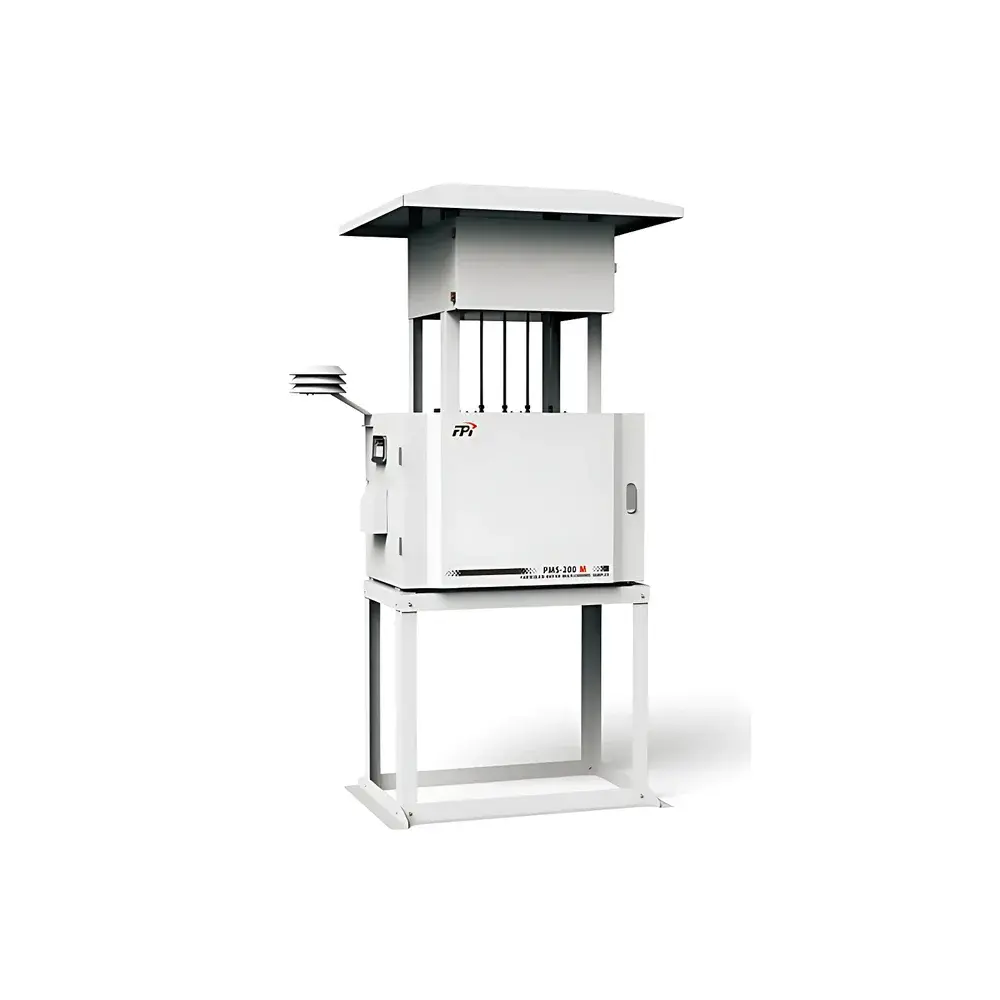
FPI PMS-200M Multi-Channel PM₂.₅ Aerosol Sampler
| Brand | FPI |
|---|---|
| Origin | Zhejiang, China |
| Manufacturer Type | Original Equipment Manufacturer (OEM) |
| Product Category | Domestic |
| Model | PMS-200M |
| Instrument Type | 24-Hour Temperature- and Flow-Controlled Ambient Air Sampler |
| Instrument Architecture | Multi-Channel Sequential Gas & Aerosol Sampler |
| Flow Range | Customizable (Typical Standard Range: 16.7–100 L/min per Channel) |
| Pressure Drop Handling | Up to 25 kPa (at max flow) |
| Flow Stability | ±2% over 24 h (with active feedback control) |
| Flowmeter Accuracy | ±1.5% of reading (NIST-traceable thermal mass flow sensors) |
| Rated Service Life at Max Load | ≥12,000 operating hours |
| Continuous Operation Duration at Max Flow & Backpressure | ≥24 h per cycle |
Overview
The FPI PMS-200M Multi-Channel PM₂.₅ Aerosol Sampler is an engineered ambient air monitoring platform designed for simultaneous, time-synchronized collection of size-fractionated particulate matter (PM₂.₅) and co-located gaseous pollutants across multiple independent sampling streams. Based on the principle of inertial separation combined with precision-controlled volumetric aspiration, the system integrates cyclonic cut-point selection (TSP → PM₁₀ → PM₂.₅) with thermally stabilized mass flow regulation to meet ISO 7708, EN 12341, and US EPA Method IO-3.1 requirements for respirable aerosol fractionation. Its modular architecture enables deployment in regulatory-grade air quality monitoring stations, source apportionment studies, and long-term epidemiological exposure assessments where parallel sampling of trace metals, water-soluble ions, organic carbon, and reactive gases (e.g., SO₂, NOₓ, O₃) is required under identical meteorological conditions.
Key Features
- Configurable multi-channel operation: Standard 4-channel layout expandable to 8 channels via time-multiplexed flow routing—enabling concurrent sampling of PM₂.₅ on quartz fiber filters, denuded and non-denuded Teflon filters for gas-particle partitioning, and impingers for volatile acidic species.
- Integrated sampling canister design: Compact cyclone-based size-selective inlet (D₅₀ = 2.5 µm ± 0.2 µm @ 16.7 L/min) housed within a single stainless-steel canister; accommodates up to three filter stages (e.g., backup, primary, backup) and two mist eliminators or scrubber cartridges in series.
- Closed-loop thermal mass flow control: Each channel employs individually calibrated, temperature-compensated MEMS-based flow sensors with real-time PID adjustment—achieving ±2% flow stability over 24-hour unattended operation, even under variable ambient pressure and humidity.
- Onboard environmental sensing: Integrated PTU (Pressure-Temperature-Humidity) module records ambient conditions at 1-minute resolution; optional RS-485 interface supports third-party anemometer and wind vane integration for directional plume tracking.
- Remote telemetry and alarm management: Embedded GPRS modem with TLS-secured data upload to cloud-hosted LIMS; SMS alerts triggered by flow deviation >5%, power interruption, door open event, or filter saturation timeout.
Sample Compatibility & Compliance
The PMS-200M is validated for use with standard 47-mm and 90-mm diameter substrates including quartz fiber (Pallflex® QAT-UP), Teflon® membrane (Gelman Type A/E), nylon, polycarbonate, and coated glass fiber filters. It supports gravimetric analysis per ISO 12103-1 and chemical speciation workflows aligned with EPA TO-13A, EN 14902, and IMPROVE_A protocols. All firmware and data logging modules comply with GLP audit trails (user login, parameter change history, calibration logs) and support 21 CFR Part 11–compliant electronic signatures when deployed with validated server infrastructure.
Software & Data Management
The instrument operates under FPI’s AirSight™ Control Suite (v3.2+), a Windows-based configuration and diagnostics application that enables full setup of sampling sequences—including programmable start/stop times, conditional triggers (e.g., PM₁₀ > 50 µg/m³ initiates 2-hour intensive sampling), and duty-cycle modulation. Raw sensor data (flow, T, P, RH, battery voltage) and event logs are stored locally on industrial-grade microSD card (encrypted FAT32) and transmitted via MQTT or HTTP(S) to central databases. Export formats include CSV (time-series), NetCDF (CF-compliant metadata), and XML (for integration with national AQMS platforms such as China’s CNEMC or EU’s EEA AirBase).
Applications
- Regulatory compliance monitoring at national reference sites and urban background stations
- Source receptor modeling requiring synchronized multi-species datasets (e.g., sulfate/nitrate/ammonium + VOCs + PM mass)
- Indoor-outdoor penetration studies using paired indoor/outdoor channel configurations
- Mobile monitoring campaigns (vehicle-mounted or trailer-deployed) with GPS-synchronized timestamping
- Calibration verification of low-cost sensor networks through collocated high-precision reference sampling
FAQ
What particle size fractions can the PMS-200M collect simultaneously?
It is configured by default for PM₂.₅ (D₅₀ = 2.5 µm), but interchangeable cyclone inserts allow field-swappable cut-points for PM₁₀ or TSP collection—each channel independently configurable.
Does the system support automated filter exchange?
No—it is a manual filter-change platform optimized for high-reliability 24-hr batch sampling; robotic auto-changers are available as an external add-on module (PMS-AutoX v2.0).
Is NIST-traceable calibration documentation provided?
Yes—each unit ships with a factory calibration certificate referencing NIST SRM 2890 (gas flow standards) and includes annual recalibration service options with documented uncertainty budgets.
Can the GPRS module operate in low-coverage rural areas?
It supports fallback to SMS-based status reporting and local SD-card buffering with automatic retransmission upon network recovery—no data loss during intermittent connectivity.
What maintenance intervals are recommended for field deployment?
Primary maintenance includes quarterly inspection of cyclone wear, biannual replacement of desiccant in humidity sensors, and annual full flow sensor recalibration—detailed in the IEC 61508–aligned Maintenance Manual (Doc. FPI-PMS200M-MNT-EN-Rev4).







