
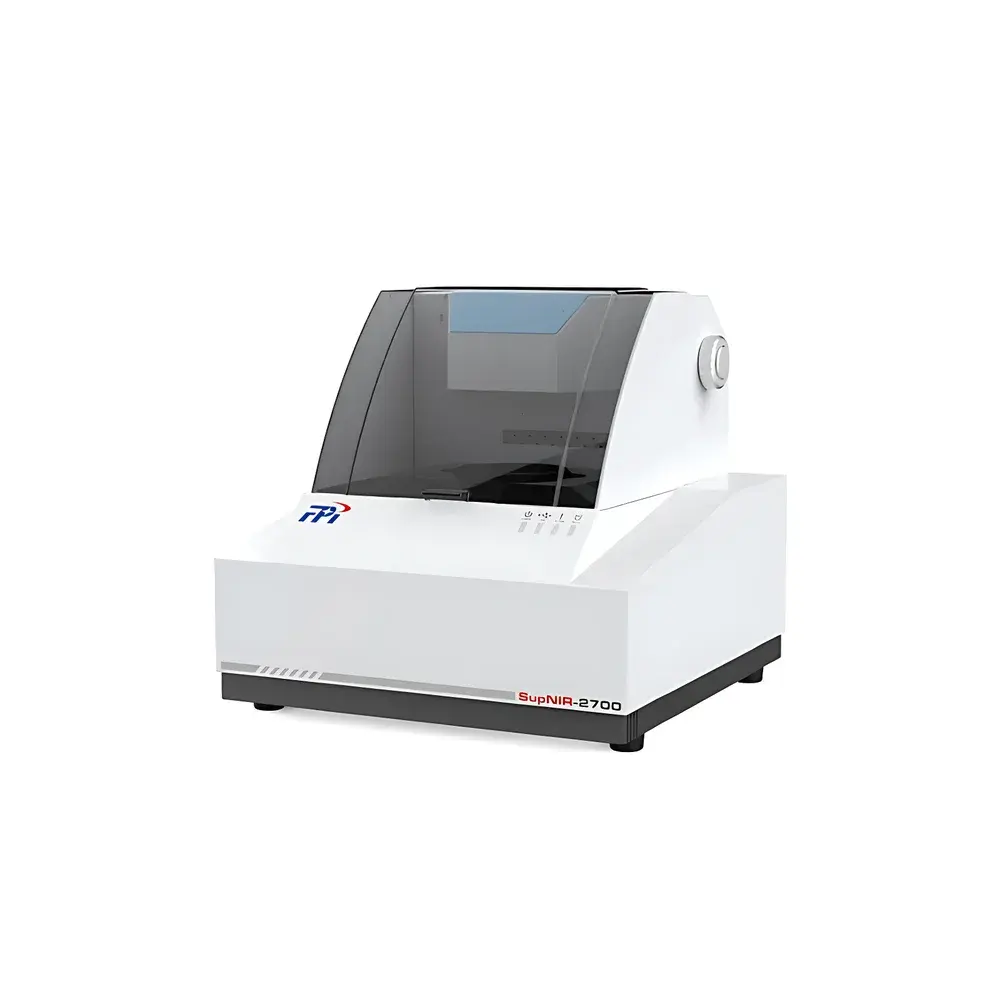
FPI SupNIR-2700 Series Near Infrared Spectrometer
| Brand | FPI |
|---|---|
| Origin | Zhejiang, China |
| Manufacturer Type | Original Equipment Manufacturer (OEM) |
| Instrument Type | Laboratory Benchtop NIR Spectrometer |
| Optical Principle | Holographic Grating Scanning |
| Wavelength Range | 1000–2500 nm |
| Spectral Acquisition Speed | 0.2 s per spectrum |
| Spectral Resolution | 1 nm data sampling interval |
| Measurement Mode | Diffuse Reflectance |
| Chemometrics Software | RIMP |
| Detector | Thermoelectrically Cooled (TEC) InGaAs Array |
| Sample Handling | Motorized Rotating Sample Tray |
| Built-in Reference Standards | Yes |
| Network Connectivity | Ethernet & USB |
Overview
The FPI SupNIR-2700 Series Near Infrared Spectrometer is a laboratory-grade, grating-scanning dispersive spectrometer engineered for robust, non-destructive quantitative and qualitative analysis of organic materials in solid form. Operating on the principle of diffuse reflectance spectroscopy in the short-wave near-infrared region (1000–2500 nm), it captures molecular overtone and combination vibrations—primarily from C–H, N–H, and O–H bonds—to enable rapid prediction of compositional and physical properties. Its optical architecture integrates a holographic digital grating with a thermoelectrically cooled (TEC) indium gallium arsenide (InGaAs) photodiode array detector, delivering high signal stability, low dark current drift, and superior signal-to-noise ratio (SNR) under ambient lab conditions. Designed for routine use in quality control and research environments, the SupNIR-2700 requires no sample preparation, generates full-spectrum data in 0.2 seconds, and supports real-time spectral acquisition at 1 nm data point intervals across its entire operational range.
Key Features
- Motorized rotating sample tray ensures representative measurement of heterogeneous solids—including granules, flakes, and powders—by averaging spatial variance across multiple angular positions.
- Self-aligned light source module eliminates manual collimation; lamp replacement is tool-free and maintains optical path consistency without recalibration.
- Built-in certified reference standards enable automated system diagnostics, wavelength validation, and intensity drift monitoring—critical for long-term instrument qualification and GLP-compliant operation.
- Integrated TEC cooling stabilizes the InGaAs detector at –10 °C ± 0.5 °C, minimizing thermal noise and ensuring spectral reproducibility over extended acquisition sessions.
- Multi-instrument model transfer capability allows calibration models developed on one SupNIR-2700 unit to be deployed directly on others within the same batch, supporting centralized method development and distributed deployment across production sites.
- Embedded firmware supports remote firmware updates and diagnostic logging via standard Ethernet or USB interfaces—facilitating preventive maintenance scheduling and audit-ready traceability.
Sample Compatibility & Compliance
The SupNIR-2700 accepts bulk solid samples ranging from coarse grains (e.g., corn, soybeans) to fine pharmaceutical excipients and feed pellets, with minimal geometric constraints due to its large-diameter sample port and adjustable height stage. It complies with ISO 12099:2017 (Animal feeding stuffs — Guidance on the application of near infrared spectroscopy) and aligns with ASTM E1655-22 (Standard Practices for Infrared Multivariate Quantitative Analysis) for method validation workflows. While not FDA 21 CFR Part 11–certified out-of-the-box, the RIMP software architecture supports configurable user access controls, electronic signatures, and audit trail generation—enabling customization to meet GMP/GLP documentation requirements when deployed in regulated environments.
Software & Data Management
RIMP (Real-time Intelligent Modeling Platform) is a Windows-based chemometrics suite fully integrated with the SupNIR-2700 hardware. It provides end-to-end workflow support—from raw spectral acquisition and preprocessing (Savitzky-Golay smoothing, multiplicative scatter correction, first/second derivative) to PLS, PCR, and SVM regression modeling. All models are stored in encrypted binary format with metadata tagging (operator ID, timestamp, instrument serial number, versioned calibration parameters). The software supports batch reporting in CSV, PDF, and XML formats, and exports spectra in JCAMP-DX v5.01 for third-party interoperability. Network-enabled RIMP clients can synchronize calibration libraries and instrument logs with central servers using secure HTTPS-based APIs, enabling enterprise-level method governance.
Applications
The SupNIR-2700 delivers validated performance across agricultural and industrial sectors where rapid, non-invasive composition screening is essential. In animal feed manufacturing, it quantifies moisture, crude protein, ether extract, acid detergent fiber (ADF), neutral detergent fiber (NDF), and ash content per AOAC-approved NIR protocols. For grain trading and storage facilities, it enables on-site verification of wheat protein content, rice amylose levels, and oilseed moisture—reducing reliance on off-site wet chemistry labs. In plant breeding programs, it accelerates phenotyping by correlating spectral fingerprints with traits such as amino acid profiles, starch branching patterns, and drought-resistance biomarkers. Additional use cases include quality release testing of malt, flour, and botanical extracts in food processing, and raw material identity verification in nutraceutical production.
FAQ
What sample forms are compatible with the SupNIR-2700?
Solid samples including granules, flakes, pellets, and free-flowing powders—no grinding, drying, or pressing required.
Does the instrument support regulatory compliance for QC laboratories?
Yes—when configured with RIMP’s optional audit trail and user role modules, it meets foundational requirements for GLP and GMP environments; formal 21 CFR Part 11 validation packages are available upon request.
Can calibration models be shared across multiple SupNIR-2700 units?
Yes—model transfer functionality ensures consistent prediction performance across instruments without retraining, provided they share identical optical configuration and firmware version.
Is spectral data export compatible with third-party chemometrics tools?
Yes—raw and preprocessed spectra export in JCAMP-DX format; model coefficients and metadata are accessible via RIMP’s open API for integration with MATLAB, Python (scikit-learn), or Unscrambler.
What maintenance is required for long-term stability?
Annual verification using built-in standards is recommended; detector cooling system and grating drive mechanism require no user-serviceable parts—only periodic dust filter inspection and cleaning.
Related Products





