
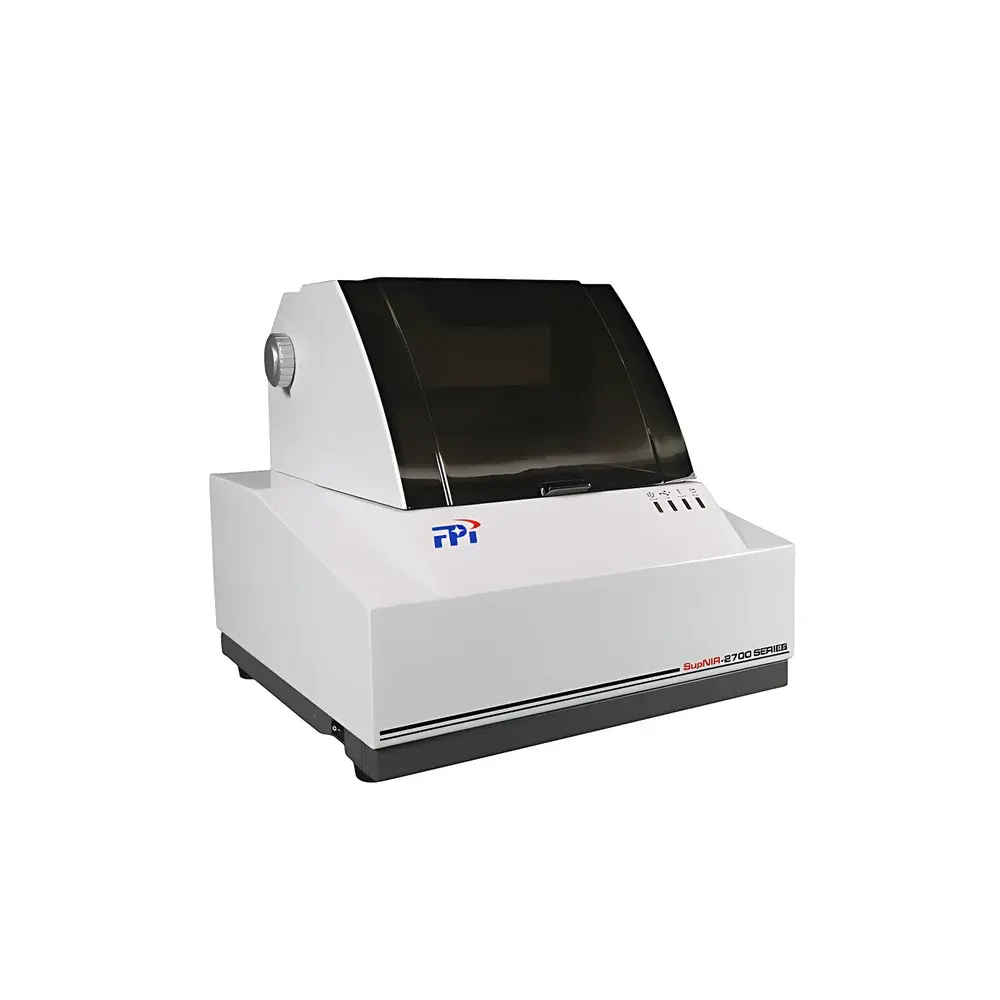
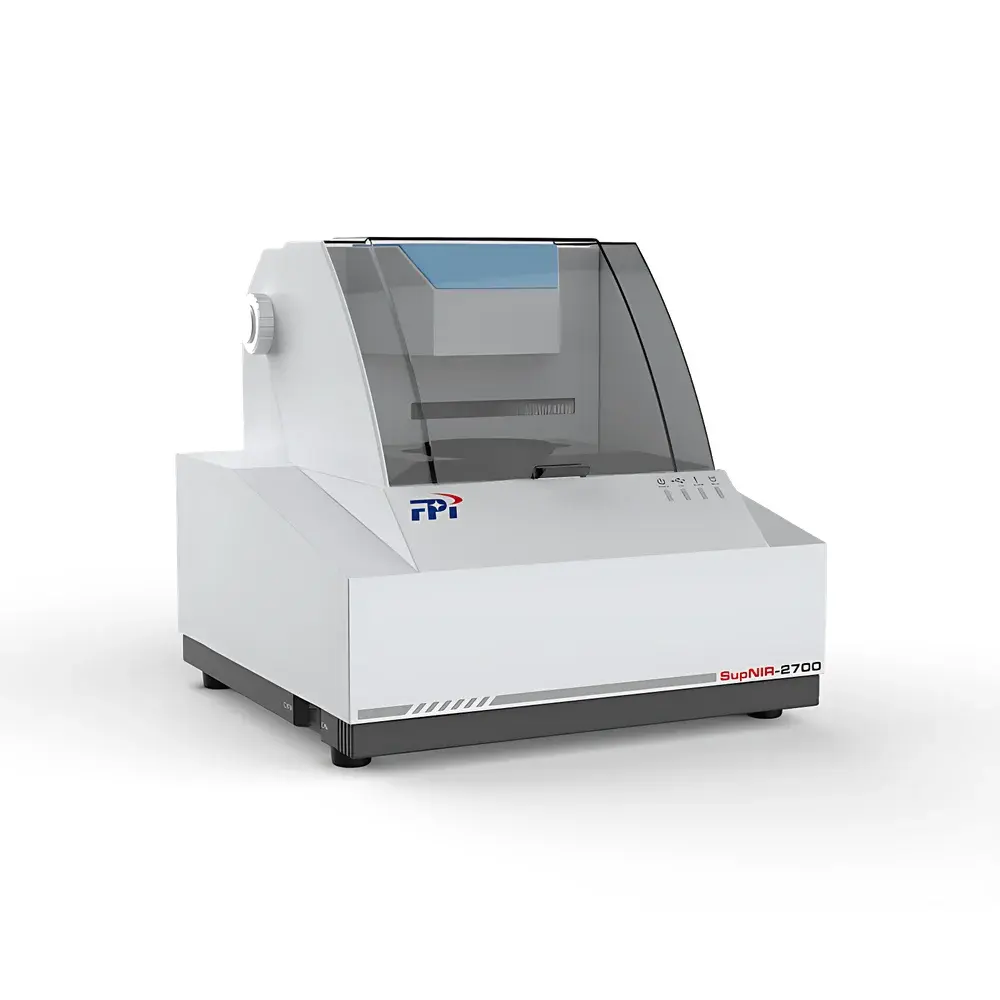
FPI SupNIR-2700 Series Laboratory Near-Infrared Spectrometer
| Brand | FPI |
|---|---|
| Origin | Zhejiang, China |
| Manufacturer Type | Authorized Distributor |
| Instrument Type | Laboratory |
| Principle | Grating Scanning |
| Wavelength Range | 1000–2500 nm |
| Scan Speed | 0.2 s per spectrum |
| Spectral Sampling Interval | 1 nm |
| Measurement Mode | Diffuse Reflectance |
| Chemometrics Software | RIMP |
Overview
The FPI SupNIR-2700 Series Laboratory Near-Infrared Spectrometer is a robust, grating-scanning dispersive spectrometer engineered for high-fidelity quantitative and qualitative analysis in controlled laboratory environments. Operating on the physical principle of diffuse reflectance spectroscopy in the short-wave to near-infrared (SW-NIR) region, it captures molecular vibrational overtones and combination bands—primarily from C–H, N–H, and O–H functional groups—enabling non-destructive, reagent-free characterization of organic matrices. With a full spectral coverage of 1000–2500 nm and 1 nm data sampling resolution, the instrument delivers high spectral fidelity suitable for building predictive calibration models compliant with ISO 12099:2017 (Animal feeding stuffs — Guidance on the application of near infrared spectroscopy) and ASTM E1655–22 (Standard Practices for Infrared Multivariate Quantitative Analysis). Its optical architecture features an optimized tungsten-halogen light source, precision fused-silica collimating optics, and a thermoelectrically stabilized InGaAs detector array (1000–1700 nm) supplemented by an extended-range InSb or MCT detector (1700–2500 nm), ensuring stable photometric response across the full range.
Key Features
- Grating-scanning monochromator design ensures high wavelength accuracy (< ±0.5 nm) and long-term spectral stability—critical for multi-year calibration model maintenance.
- Top-illuminated diffuse reflectance probe geometry minimizes sample preparation artifacts and enables reproducible measurements of heterogeneous solids including granules, milled powders, pellets, and semi-solid pastes.
- Sub-second spectral acquisition (0.2 s per full-spectrum scan) supports high-throughput batch screening without compromising signal-to-noise ratio (SNR > 10,000:1 at 1550 nm, RMS).
- Integrated thermal stabilization and real-time dark-current correction suppress baseline drift, meeting GLP-compliant instrument qualification requirements (IQ/OQ/PQ).
- Modular hardware architecture allows optional integration of fiber-optic sampling accessories, temperature-controlled sample holders, or automated sample changers for unattended operation.
Sample Compatibility & Compliance
The SupNIR-2700 is validated for direct analysis of intact, unprocessed samples across diverse material classes: cereal grains (wheat, corn, rice), oilseeds (soybean, rapeseed), animal feed formulations, dairy powders, pharmaceutical excipients, and polymer blends. Sample presentation follows standardized protocols aligned with AOAC 984.27 (Moisture in Grain by NIR) and USP (Near-Infrared Spectroscopy). All measurement workflows support audit-trail-enabled data capture per FDA 21 CFR Part 11 when used with validated RIMP software configurations. Instrument performance verification includes daily standard reference material (SRM) checks using NIST-traceable ceramic tiles (e.g., NIST SRM 2036), satisfying ISO/IEC 17025:2017 clause 7.7 on equipment verification.
Software & Data Management
Controlled via the RIMP chemometrics software platform (v4.3+), the system provides end-to-end analytical workflow management—from raw spectral acquisition and preprocessing (Savitzky-Golay smoothing, multiplicative scatter correction, first/second derivative transformation) to PLS, PCR, and SVM regression modeling. RIMP supports cross-validation (leave-one-out, k-fold), outlier detection (Mahalanobis distance), and model transfer between instruments using piecewise direct standardization (PDS). All spectral datasets are stored in HDF5 format with embedded metadata (operator ID, timestamp, instrument serial, calibration version), enabling traceability and facilitating LIMS integration via OPC UA or CSV export. Software validation documentation—including IQ/OQ test scripts and risk assessment reports—is provided for GMP-regulated laboratories.
Applications
- Agricultural breeding programs: Rapid phenotyping of protein, starch, oil, and moisture content in single-kernel maize or wheat samples.
- Grain storage quality monitoring: Detection of mycotoxin contamination markers (e.g., deoxynivalenol spectral signatures) and early-stage spoilage indicators.
- Feed formulation QA/QC: Real-time verification of amino acid profiles (lysine, methionine) and fiber fractions (NDF, ADF) in compound feeds.
- Food processing: Inline monitoring of moisture migration during drying, crystallinity assessment in chocolate, and authenticity screening of botanical extracts.
- Chemical R&D: Quantification of functional group concentrations (e.g., hydroxyl number in polyols, epoxy equivalent weight) without derivatization.
FAQ
Is the SupNIR-2700 compliant with FDA 21 CFR Part 11 for electronic records and signatures?
Yes—when deployed with validated RIMP software v4.3 or later, the system supports role-based access control, electronic signatures, and immutable audit trails required for regulated environments.
Can calibration models developed on other NIR platforms be transferred to the SupNIR-2700?
Yes—RIMP includes robust model standardization tools (PDS, SHS) to align spectral responses across different grating-scanning instruments, minimizing re-calibration effort.
What sample throughput can be achieved in routine QC testing?
With automated sample presentation and batch processing, up to 120 samples per hour can be analyzed with full-spectrum acquisition and PLS prediction, assuming 10-second total cycle time per sample.
Does the system require annual recalibration by the manufacturer?
No—users perform daily performance verification using certified SRMs; factory recalibration is recommended only every 24 months or after major optical component replacement.
Is remote diagnostics and software update support available?
Yes—FPI provides secure remote connectivity via TLS-encrypted VNC sessions for technical support, with quarterly software updates delivered through authenticated download portals.



