
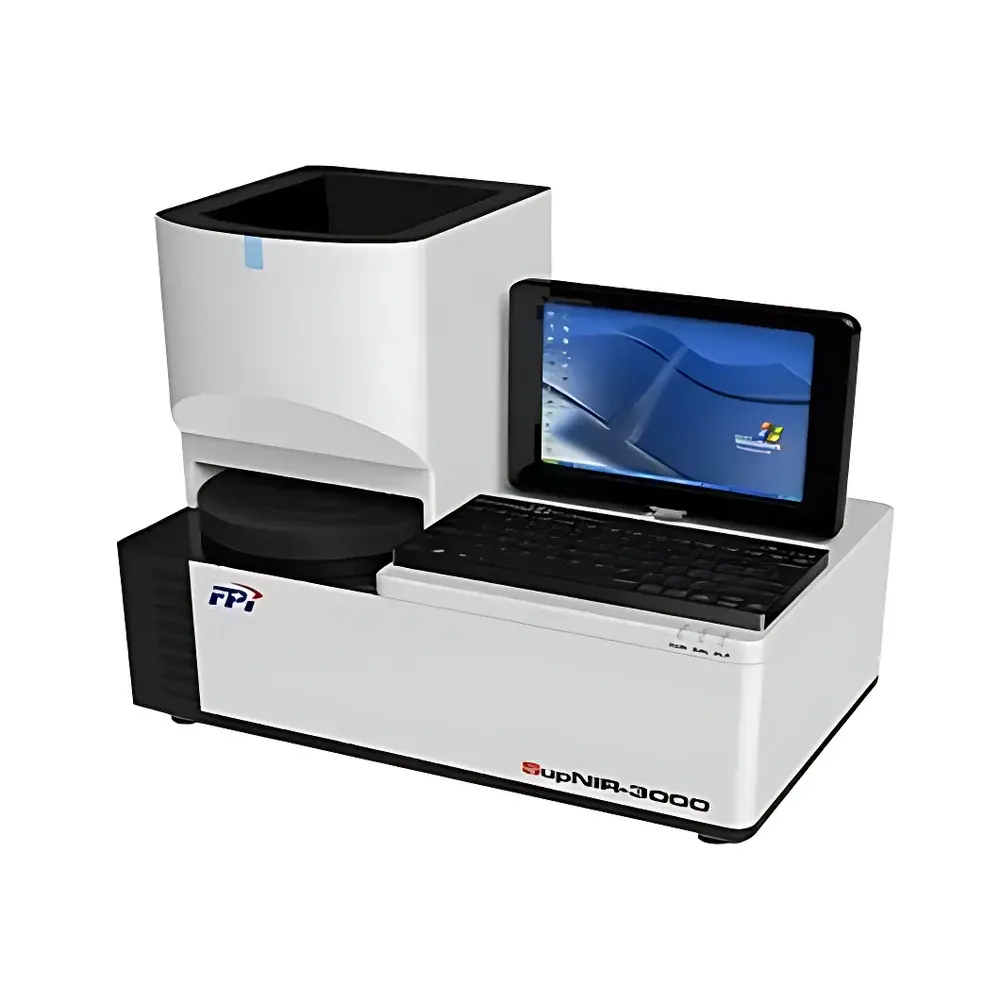
FPI SupNIR-3000 Series Laboratory Near-Infrared Spectrometer
| Brand | FPI |
|---|---|
| Origin | Zhejiang, China |
| Model | SupNIR-3000 |
| Instrument Type | Laboratory |
| Operating Principle | Grating Scanning |
| Wavelength Range | 1000–1800 nm |
| Scan Speed | >1 scan/s |
| Data Sampling Interval | 1 nm |
| Measurement Mode | Diffuse Reflectance |
| Chemometrics Software | RIMP |
Overview
The FPI SupNIR-3000 Series Laboratory Near-Infrared Spectrometer is a grating-scanning dispersive spectrometer engineered for precise, non-destructive compositional and physical property analysis of solid samples in regulated laboratory environments. Operating across the short-wave near-infrared (SW-NIR) spectral region from 1000 to 1800 nm, the instrument leverages diffuse reflectance optical geometry with a top-illuminating (downward-facing) probe configuration—optimized for homogeneous sampling of granular, powdered, and tablet-form materials without preparation or extraction. Its optical architecture incorporates a thermally stabilized diffraction grating, high-sensitivity InGaAs detector array, and precision wavelength calibration traceable to NIST-traceable standards. Designed for routine QC/QA workflows and method development, the SupNIR-3000 delivers high spectral reproducibility (<0.1 nm wavelength repeatability) and photometric stability (<0.5% RSD over 8 hours), enabling robust calibration transfer between instruments and laboratories.
Key Features
- Grating-scanning monochromator with 1 nm data sampling interval, ensuring sufficient resolution for multivariate modeling of overlapping absorption bands (e.g., C–H, O–H, N–H overtones and combinations).
- Real-time acquisition capability at >1 full-spectrum scan per second, supporting high-throughput batch analysis and dynamic process monitoring readiness.
- Integrated industrial-grade embedded computer running the RIMP chemometrics platform—eliminating external PC dependency and reducing electromagnetic interference risks.
- Downward-facing diffuse reflectance optical head with adjustable sample height compensation and integrated halogen illumination—designed for consistent pathlength control across heterogeneous particulate matrices.
- Optional bulk density (bulk specific gravity) module—mechanically and software-synchronized with NIR acquisition to enable simultaneous physical and chemical characterization within a single measurement cycle.
- Rugged aluminum alloy chassis with EMI-shielded enclosure, compliant with IEC 61326-1 for electromagnetic compatibility in shared laboratory infrastructure.
Sample Compatibility & Compliance
The SupNIR-3000 accommodates a broad range of dry, non-liquid solid forms including cereal grains, milled flour, feed pellets, pharmaceutical tablets, polymer granules, and chemical catalysts. Sample presentation requires no solvent, grinding, or dilution—preserving native structure and minimizing analyst exposure to hazardous materials. The system supports ASTM E1655-22 (Standard Practices for Infrared Multivariate Quantitative Analysis) and ISO 12099:2017 (Animal feeding stuffs, cereals and milled cereal products — Guidelines on the application of near infrared spectroscopy). While not pre-certified for FDA 21 CFR Part 11, the RIMP software architecture permits audit trail configuration, electronic signature implementation, and user access controls—enabling validation under GLP or GMP frameworks when deployed with documented SOPs and IQ/OQ/PQ protocols.
Software & Data Management
RIMP (Robust Intelligent Modeling Platform) is a Windows-based chemometrics suite developed specifically for FPI’s NIR instrumentation. It provides complete workflow support—from raw spectrum preprocessing (Savitzky-Golay smoothing, multiplicative scatter correction, standard normal variate) to PLS, PCR, and SVM regression modeling, plus PCA-based outlier detection and model performance validation (RMSEC, RMSEP, R², bias, slope). All models are stored in encrypted binary format with metadata logging (operator ID, timestamp, instrument serial, calibration version). Raw spectral data export is supported in ASTM E131-compliant JCAMP-DX format (.jdx) and CSV, facilitating third-party integration with LIMS (e.g., Thermo Fisher SampleManager, LabVantage) or enterprise analytics platforms (e.g., Tableau, Power BI) via API or scheduled file drop.
Applications
- Grain & Feed Industry: Rapid quantification of moisture, protein, starch, oil, and fiber in wheat, corn, soybean meal, and compound feed—aligned with USDA FGIS and AACC International Method 46–13A.
- Food Quality Control: Detection of adulteration (e.g., melamine in milk powder), authenticity screening (geographic origin of olive oil), and shelf-life prediction via oxidation marker tracking (e.g., carbonyl band shifts).
- Pharmaceutical Development: Blend uniformity assessment of active pharmaceutical ingredients (APIs) in powder blends, tablet hardness correlation, and excipient identification per USP <1119>.
- Chemical & Polymer R&D: Monitoring of reaction endpoints in polycondensation processes, quantification of residual monomers (e.g., caprolactam), and classification of polymer grades by crystallinity index.
- Agricultural Research: High-throughput phenotyping of crop breeding lines for nitrogen use efficiency, drought tolerance biomarkers, and grain quality traits.
FAQ
Is the SupNIR-3000 compliant with 21 CFR Part 11 for regulated pharmaceutical environments?
The base RIMP software does not ship with out-of-the-box Part 11 compliance, but its modular architecture supports configuration of audit trails, role-based permissions, and electronic signatures—subject to site-specific validation per internal SOPs.
Can calibration models developed on other NIR platforms be imported into RIMP?
RIMP accepts PLS models in .csv or .txt formats containing regression coefficients and preprocessing parameters; however, spectral format alignment (wavelength grid, resolution, SNR) must be verified prior to deployment.
What maintenance is required for long-term spectral stability?
Annual wavelength and photometric calibration using certified reference standards (e.g., NIST SRM 2036) is recommended; the grating drive mechanism and detector require no routine consumables.
Does the system support fiber-optic probe extension for remote sampling?
The standard configuration uses fixed optics; optional fiber-coupled versions (with SMA 905 connectors) are available upon request for integration into gloveboxes or reactor manifolds.
How is temperature drift managed during extended acquisitions?
The InGaAs detector and grating stage are housed in a thermally buffered compartment with active ambient temperature monitoring; spectral baseline drift is corrected in real time via internal reference channel normalization.




