
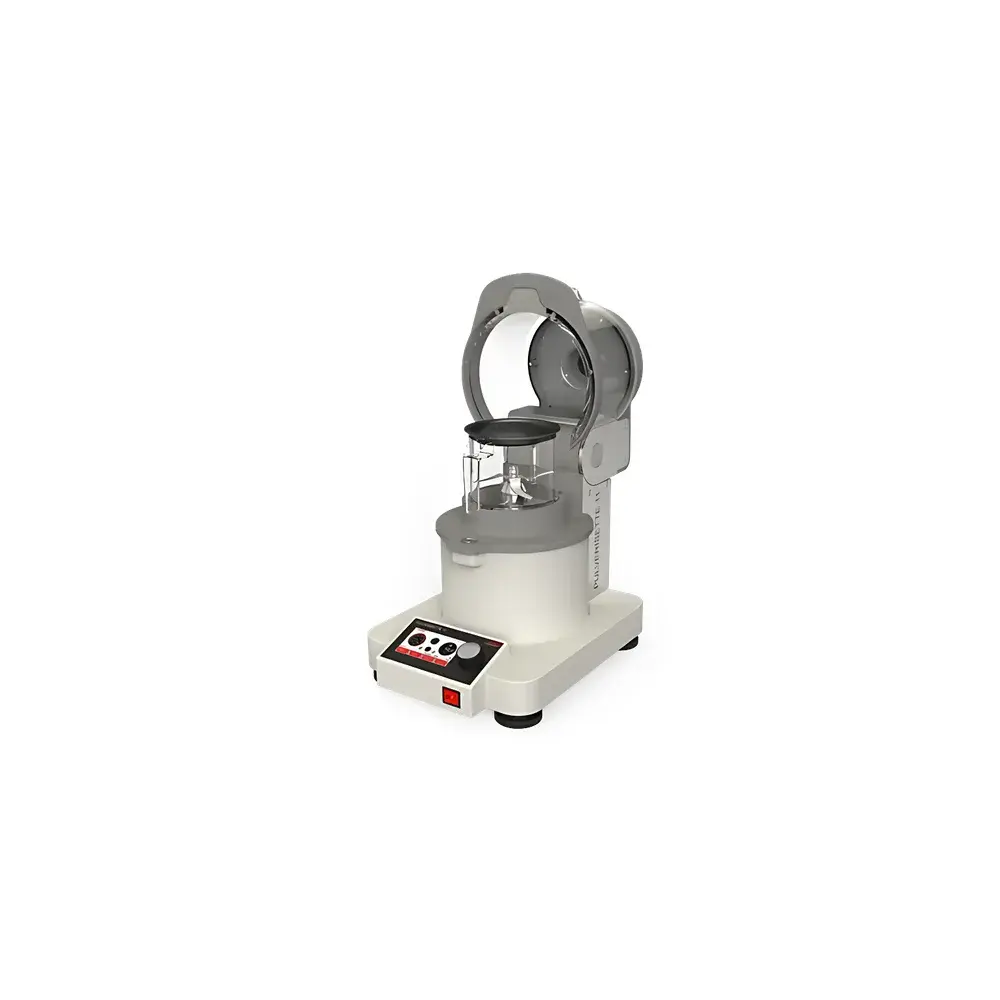
FRITSCH PULVERISETTE 11 Knife Mill
| Brand | FRITSCH |
|---|---|
| Origin | Germany |
| Model | PULVERISETTE 11 |
| Batch Grinding Capacity | 1.3 L |
| Feed Particle Size | < 40 mm |
| Final Particle Size | 0.01–0.5 mm |
| Sample Compatibility | Ambient & Cryogenic (Freeze-Milling Capable) |
| Grinding Time Range | 0.5–360 s (adjustable in 0.5-s increments) |
| Blade Diameter | 128 mm |
| Peripheral Blade Speed | 67 m/s |
| Control Interface | 4.3″ Color Touchscreen + Multifunction Rotary Knob |
| Motor Protection | Thermal Power Reduction |
| Safety Features | Interlocked Lid with Pneumatic Gas Spring, Integrated Start/Stop Monitoring, Blade & Bowl Locking System |
| Connectivity | USB Port for SOP Storage & Transfer |
| Programmability | Adjustable Intervals, Reverse Rotation Mode, Microprocessor-Controlled Speed Regulation |
Overview
The FRITSCH PULVERISETTE 11 Knife Mill is a high-performance, laboratory-scale cutting mill engineered for rapid, reproducible size reduction of soft to medium-hard, fibrous, and brittle materials. Operating on the principle of high-speed impact and shear between a rotating knife rotor and stationary counter-cutting elements, it delivers consistent particle size distributions without excessive heat generation—critical for thermolabile or moisture-sensitive samples. Designed and manufactured in Germany under strict DIN EN ISO 9001 quality management standards, the PULVERISETTE 11 integrates precision mechanics with digital process control to support method transfer, routine QC, and R&D workflows across pharmaceuticals, food science, environmental analysis, and polymer research.
Key Features
- Microprocessor-controlled motor with variable speed regulation ensures precise energy input per grinding cycle, enabling method optimization for diverse sample matrices.
- Programmable grinding duration from 0.5 to 360 seconds in 0.5-second increments—ideal for developing standardized operating procedures (SOPs) with documented repeatability.
- Reversible rotation mode and programmable intermittent grinding intervals mitigate thermal buildup and improve homogeneity in heterogeneous or temperature-sensitive samples—including cryogenic milling applications down to –196 °C when used with liquid nitrogen-cooled accessories.
- 4.3-inch full-color touchscreen interface, paired with a tactile multifunction rotary knob, provides intuitive navigation through settings, real-time status monitoring, and quick access to stored protocols.
- Integrated USB port allows secure export and import of grinding programs, calibration logs, and audit trails—supporting compliance with FDA 21 CFR Part 11 requirements when implemented within validated laboratory information management systems (LIMS).
- Robust safety architecture includes lid interlock with pneumatic gas spring assistance, automatic start/stop monitoring, and mechanical locking of the grinding bowl, rotor, and protective hood—meeting EN 61000-6-2 (EMC) and EN 61000-6-4 (Emission) directives.
Sample Compatibility & Compliance
The PULVERISETTE 11 accepts feed particles up to 40 mm in maximum dimension and reduces them to a final particle size range of 0.01–0.5 mm, depending on material properties, knife geometry, and process parameters. It accommodates dry, moist, and frozen samples—including plant tissues, grains, plastics, rubber, pharmaceutical tablets, and composite materials. Optional stainless steel, hardened steel, or tungsten carbide grinding components extend service life and minimize contamination risk for trace-level analysis. The instrument complies with ISO 17025 requirements for equipment qualification and supports GLP/GMP documentation through its integrated parameter logging and user-accessible event history.
Software & Data Management
No external software installation is required—the onboard firmware enables full protocol management directly via the touchscreen interface. Each grinding program stores time, speed, direction, interval pattern, and user ID (with optional password protection). All settings are exportable as CSV files via USB for integration into electronic lab notebooks (ELN) or quality management systems. Timestamped operation logs—including motor temperature events, lid-open cycles, and emergency stops—are retained for internal audits and regulatory review.
Applications
- Pharmaceutical pre-formulation: uniform particle size reduction of active pharmaceutical ingredients (APIs) and excipients prior to dissolution testing or tablet compression studies.
- Food & agriculture: homogenization of cereal grains, spices, herbs, and animal feed for proximate analysis (e.g., moisture, protein, fiber) per AOAC and ISO 6496 standards.
- Environmental testing: preparation of soil, sediment, and sludge samples for heavy metal extraction (EPA Method 3050B) or organic contaminant analysis (e.g., PAHs, PCBs).
- Polymer & materials science: controlled fragmentation of thermoplastics, composites, and elastomers for rheological characterization or SEM sample mounting.
- Biological research: cryo-milling of frozen tissue specimens for RNA/DNA preservation prior to nucleic acid isolation or proteomic profiling.
FAQ
Can the PULVERISETTE 11 be used for cryogenic grinding?
Yes—when equipped with optional liquid nitrogen cooling accessories and appropriate cryo-rated grinding bowls and knives, it supports freeze-milling of biological, polymeric, and thermally unstable samples.
Is the instrument compliant with FDA 21 CFR Part 11?
Its USB-based protocol storage, user authentication options, and tamper-evident operation logs provide foundational capabilities for Part 11 compliance; full validation requires site-specific IQ/OQ/PQ and integration with a compliant LIMS or ELN.
What maintenance is required for long-term reliability?
Routine cleaning after each use, periodic inspection of blade sharpness and counter-cutting edges, and annual verification of speed calibration and thermal cutoff thresholds are recommended per FRITSCH’s maintenance schedule.
Does the mill support automated feeding or integration with robotic sample handling systems?
The PULVERISETTE 11 is a benchtop manual-feed instrument; however, its digital I/O interface (optional) permits external trigger signals for semi-automated batch processing in custom laboratory automation setups.



