
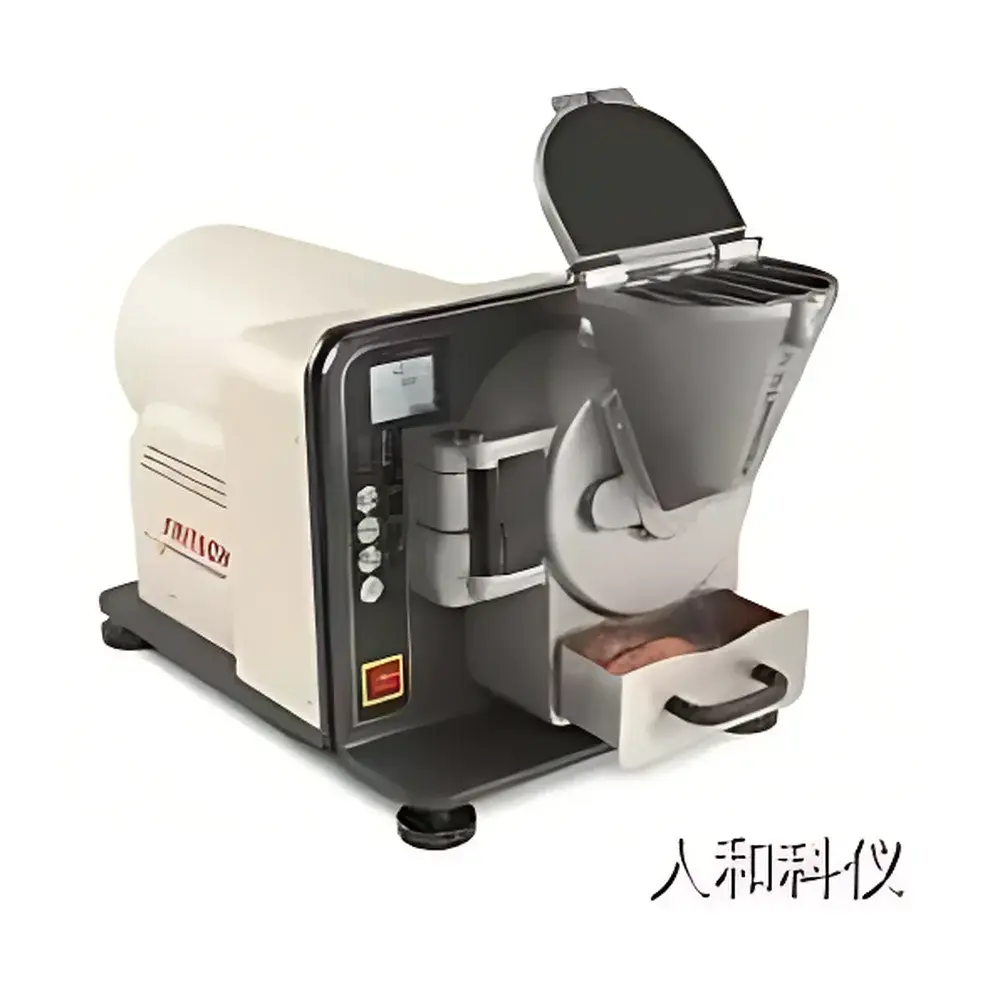
FRITSCH Pulverisette 13 Universal Cutting Mill
| Brand | FRITSCH |
|---|---|
| Origin | Germany |
| Model | Pulverisette 13 |
| Sample Hardness | Hard to Very Hard |
| Max. Feed Size | 20 mm |
| Final Particle Size Range | 0.1–12 mm |
| Adjustable Grinding Gap | Yes |
| Throughput Capacity | Up to 150 kg/h |
| Grinding Disc Materials | Cast Iron (11–12% Cr), Manganese Steel (12–13% Mn), Tungsten Carbide (90.3% WC + 9.5% Co), Zirconia (94.8% ZrO₂) |
| Motor | 3-phase, 400 V, 50–60 Hz, 1830 W |
| Rotational Speed | 439 rpm |
| Net Weight | 140 kg |
| Dimensions (L×W×H) | 44 × 87 × 40 cm |
| Collection Container Volume | 1.8 L |
Overview
The FRITSCH Pulverisette 13 Universal Cutting Mill is a high-capacity, precision-engineered laboratory cutting mill designed for the reliable size reduction of hard and brittle materials under controlled conditions. Operating on the principle of compressive and shear force generation between two counter-rotating, radially grooved grinding discs—one stationary and one motor-driven—the instrument delivers consistent particle size distribution through mechanical attrition. Unlike impact or ball-milling methods, the Pulverisette 13 employs a continuous, gravity-fed cutting mechanism that minimizes thermal degradation and preserves sample integrity during high-throughput processing. Its robust cast-iron housing, sealed grinding chamber, and adjustable disc gap enable reproducible batch or continuous operation—making it suitable for pre-treatment prior to XRF, XRD, ICP-OES, or sieve analysis in regulated environments.
Key Features
- Adjustable grinding gap with external micrometer-scale calibration for precise control over final particle size (0.1–12 mm)
- Four interchangeable grinding disc materials—cast iron, manganese steel, tungsten carbide, and zirconia—to match sample abrasiveness and contamination sensitivity
- Integrated hinge-mounted grinding chamber with quick-release clamping system for rapid disc access, cleaning, and maintenance
- Direct connection port for industrial vacuum systems (e.g., HEPA-filtered dust extractors) to ensure operator safety and compliance with OSHA 1910.94 and EU Directive 2004/37/EC (carcinogens and mutagens)
- Reversible motor rotation to extend grinding disc service life by distributing wear evenly across both disc faces
- Transparent polycarbonate viewing window for real-time visual monitoring of disc clearance and material flow
- Three-phase asynchronous motor (1830 W, 439 rpm) delivering stable torque output without speed fluctuation under variable load conditions
Sample Compatibility & Compliance
The Pulverisette 13 is validated for use with mineralogical samples (e.g., quartz, feldspar, basalt), metallurgical slags, ceramic bodies, sintered oxides, tempered glass, and hardened steel fragments. It complies with ISO 13320:2020 (laser diffraction particle sizing—sample preparation requirements), ASTM C117 (material testing—sieving procedures), and GLP-aligned documentation workflows when paired with FRITSCH’s optional digital logging module. The sealed grinding chamber and vacuum interface support adherence to laboratory containment protocols required under USP particulate matter testing and EPA Method 6010D (ICP analysis of solid waste). All disc materials are certified non-leaching per DIN EN ISO 10993-12 for incidental contact with analytical reference standards.
Software & Data Management
While the Pulverisette 13 operates as a standalone mechanical unit, its operational parameters—including runtime, motor current draw, and vacuum pressure (when interfaced)—can be logged via optional analog/digital signal outputs compatible with LabArchives ELN, Thermo Fisher SampleManager LIMS, or custom SCADA integration. FRITSCH’s optional “GrindControl” add-on module provides timestamped gap-setting records, motor duty cycle tracking, and disc usage counters—enabling audit-ready traceability per FDA 21 CFR Part 11 Annex 11 requirements. All firmware updates are delivered via encrypted USB interface with SHA-256 checksum verification.
Applications
- Preparation of homogenized feedstock for geochemical assay (e.g., rock powders for ICP-MS quantification of REEs)
- Size reduction of sintered catalyst supports prior to BET surface area analysis
- Batch comminution of refractory ceramics for phase composition validation via Rietveld refinement
- Continuous milling of metallurgical slag for leachability testing (TCLP, SPLP)
- Standardized grinding of construction aggregates in accordance with EN 933-1 and ASTM D4791
- Primary crushing stage upstream of FRITSCH P1 jaw crushers for multi-stage liberation protocols
FAQ
What is the recommended maintenance interval for the grinding discs?
Disc inspection is advised after every 200 operating hours or following processing of 15 tonnes of abrasive material—whichever occurs first. Visual wear assessment should include groove depth measurement using FRITSCH’s supplied depth gauge (Order No. 02.7001).
Can the Pulverisette 13 be integrated into an automated sample prep line?
Yes—via 0–10 V analog input for feed rate modulation and dry-contact relay outputs for interlock signaling with upstream vibratory feeders or downstream sieving stations.
Is the 1.8 L collection container suitable for hazardous dust classes?
The container is rated for ATEX Zone 22 (dust explosion group IIIA) when used with grounded FRITSCH-approved vacuum systems and conductive liners (optional accessory kit #02.8120).
Does the instrument meet noise emission limits for ISO 15744-compliant laboratories?
At 1 m distance under full-load operation, sound pressure level is ≤78 dB(A), conforming to ISO 7779 and EU Machinery Directive 2006/42/EC acoustic requirements.
How is trace metal contamination minimized during grinding?
Zirconia and tungsten carbide disc options eliminate Fe/Ni/Cr leaching; all disc surfaces undergo passivation per ASTM A967 and are certified with CoA for elemental impurity content (ICP-MS tested, LOD <0.1 ppb for Pb, Cd, As).



