
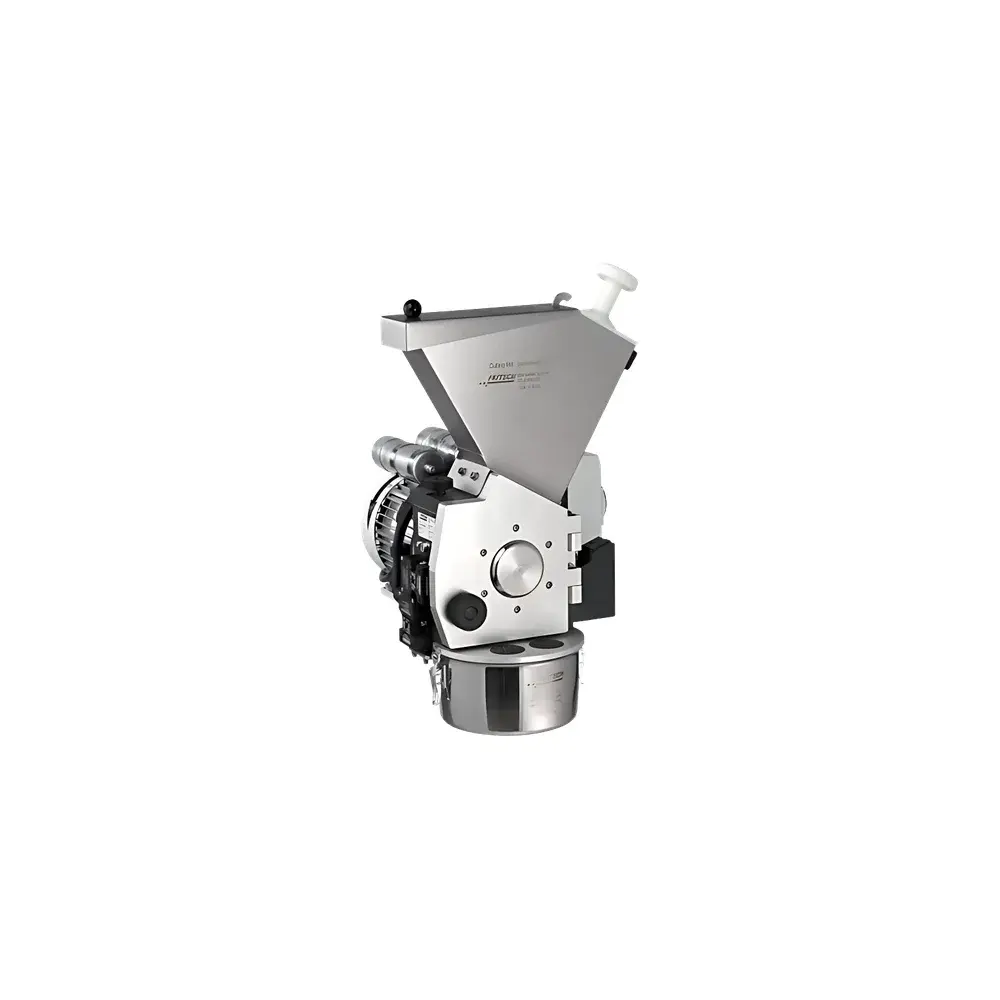
FRITSCH PULVERISETTE 15 Cutting Mill
| Brand | FRITSCH |
|---|---|
| Origin | Germany |
| Model | PULVERISETTE 15 |
| Maximum Feed Size | 70 × 70 mm |
| Throughput | up to 50 L/h |
| Final Particle Size | 0.25–6.00 mm |
| Rotor Speed | 2800–3400 rpm (voltage- and frequency-dependent) |
| Net Weight | 42 kg |
| Gross Weight | 72 kg |
| Dimensions (W × D × H) | 42 × 48 × 69 cm |
| Construction | Stainless steel cutting blades & interchangeable stainless steel insert sieves |
Overview
The FRITSCH PULVERISETTE 15 Cutting Mill is a high-performance, laboratory-scale mechanical size reduction instrument engineered for reproducible coarse to medium grinding of soft to medium-hard, fibrous, or brittle materials. Operating on the principle of high-speed rotary shearing—where a dynamically balanced cutting rotor engages material against fixed counter-blades and adjustable gap geometry—the PULVERISETTE 15 delivers controlled particle size distribution through precise mechanical interaction rather than impact or compression. Its design emphasizes operational safety, accessibility, and regulatory adaptability, making it suitable for routine sample preparation in quality control laboratories, environmental testing facilities, food safety labs, and academic research settings where trace-metal-free analysis (e.g., ICP-MS, AAS) or GLP-compliant documentation is required.
Key Features
- Quick-access grinding chamber secured by only two knurled screws—enabling full disassembly in under 60 seconds without tools
- Motor-driven hinged lid with push-button actuation for hands-free opening and closing, minimizing operator exposure during loading/unloading
- Durable, hardened stainless steel cutting knives with reversible edges and regrindable geometry—extending service life and reducing consumable cost per batch
- Externally adjustable cutting gap—allowing real-time optimization of particle size without chamber disassembly
- Interchangeable stainless steel insert sieves (mesh sizes corresponding to 0.25–6.00 mm final output)—providing deterministic control over top-cut particle size
- Integrated dust extraction port compatible with standard laboratory vacuum systems—maintaining continuous airflow across the grinding zone to suppress temperature rise and prevent static buildup
- Modular mounting options: benchtop fixation via integrated threaded inserts or freestanding configuration using optional support frame (sold separately)
- Cr-free blade and sieve variants available upon request—certified for heavy-metal-free grinding per ISO 17025-accredited protocols and compliant with USP / elemental impurities requirements
Sample Compatibility & Compliance
The PULVERISETTE 15 accommodates heterogeneous, moisture-sensitive, or temperature-sensitive samples including plant tissues, polymers, pharmaceutical tablets, feedstuffs, soil aggregates, and recycled composites. It is not intended for hard metals, ceramics, or abrasive minerals exceeding Mohs 5 hardness. All wetted parts are constructed from AISI 304 or 316 stainless steel; optional Cr-free components meet EN 15552:2017 and DIN 50900-3 corrosion resistance standards. The instrument conforms to CE machinery directive 2006/42/EC, EMC directive 2014/30/EU, and carries IP20 ingress protection rating. When operated with documented SOPs and maintained per FRITSCH’s service schedule, it supports audit readiness for ISO/IEC 17025, FDA 21 CFR Part 11 (when paired with validated data capture software), and GMP Annex 11 environments.
Software & Data Management
While the PULVERISETTE 15 operates as a stand-alone electromechanical unit with manual parameter selection, its architecture supports integration into digital lab ecosystems. Optional analog/digital I/O modules enable connection to LIMS or ELN platforms via RS-232 or 0–10 V signal outputs (e.g., for runtime logging, motor status, or interlock verification). FRITSCH’s optional GRANUCLAST® LabControl software (v4.2+) provides audit-trail-enabled operation logging—including date/time stamps, operator ID, sieve ID, rotor speed setpoint, and total operating hours—meeting ALCOA+ data integrity principles. All electronic records comply with 21 CFR Part 11 when deployed with appropriate access controls and electronic signature workflows.
Applications
- Preparation of homogenized feedstock for XRF, NIR, or elemental analysis—especially where Cr/Ni leaching must be excluded
- Routine comminution of herbal matrices prior to solvent extraction or enzymatic digestion
- Size reduction of polymer pellets and recyclate streams for melt flow index (MFI) or rheological characterization
- Standardized grinding of agricultural commodities (e.g., grains, forage) in accordance with ISO 6497 and AOAC 995.12
- Production of representative sub-samples from bulk environmental solids (sediments, sludges) prior to TCLP or SPLP leaching tests
- Fragmentation of composite materials for microstructural analysis (SEM/EDS) without thermal degradation or phase segregation
FAQ
What materials are incompatible with the PULVERISETTE 15?
Materials harder than Mohs 5 (e.g., quartz, alumina, tungsten carbide), highly elastic polymers (e.g., silicone rubber), or samples containing >15% free moisture require pre-drying or alternative milling strategies.
Can the instrument be validated for GMP use?
Yes—when configured with Cr-free components, equipped with GRANUCLAST® LabControl, and operated under documented IQ/OQ/PQ protocols, it supports GMP Annex 15 validation frameworks.
Is cleaning validation supported?
The fully accessible chamber and tool-free sieve exchange enable swab-based residue recovery studies; FRITSCH provides cleaning procedure templates aligned with ICH Q5C and EU GMP Annex 15.
What maintenance intervals are recommended?
Blade inspection every 200 operating hours; full lubrication and torque verification annually or after 1,000 hours—per FRITSCH Service Bulletin SB-P15-2023.
Does the mill generate electrostatic charge during operation?
Continuous dust extraction mitigates static accumulation; grounding kits and conductive sieve inserts are available for Class I, Division 2 hazardous locations.



