
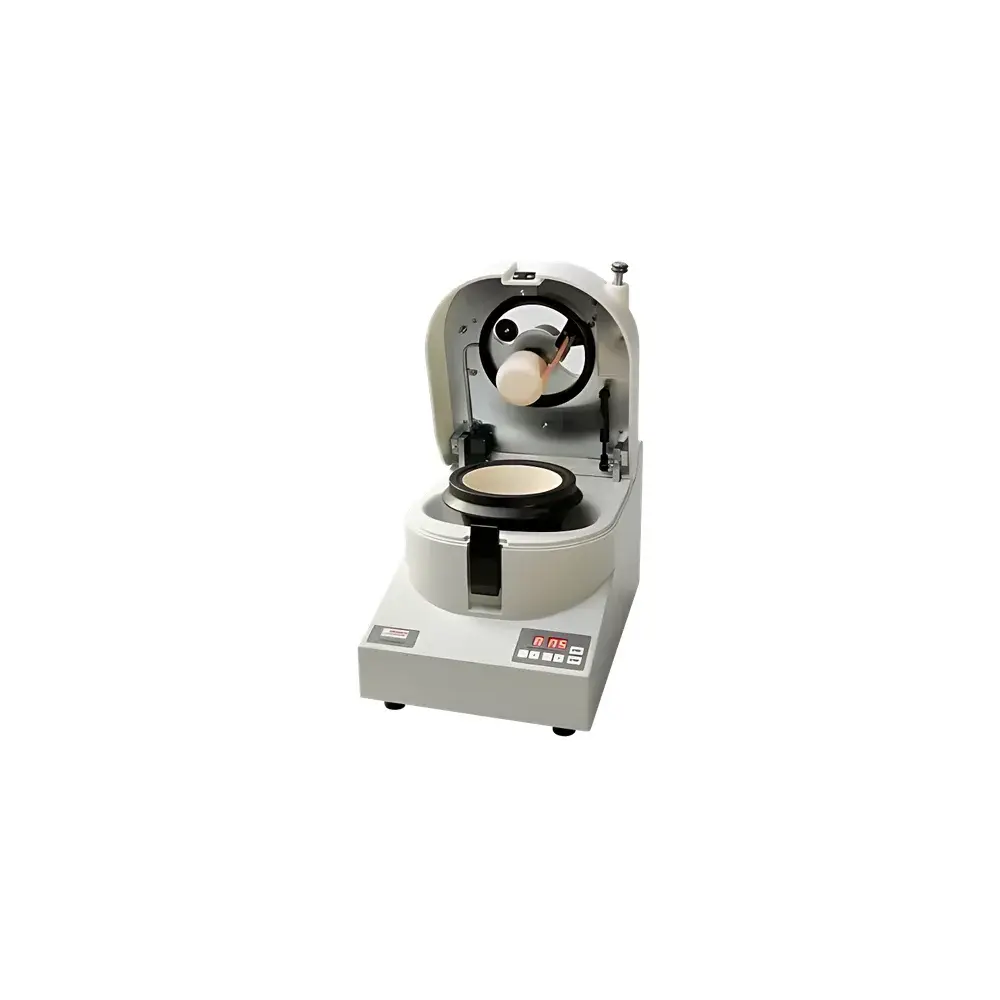
FRITSCH PULVERISETTE 2 Planetary Micro Mill
| Brand | FRITSCH |
|---|---|
| Origin | Germany |
| Model | PULVERISETTE 2 |
| Maximum Feed Size | 8 mm |
| Sample Volume Range | 10–190 mL |
| Final Fineness | 10–20 µm |
| Motor Speed | ~70 rpm (50 Hz) / ~80 rpm (60 Hz) |
| Grinding Bowl Inner Diameter | 130 mm, Outer Diameter: 200 mm |
| Electrical Supply | 200–240 V, 1~ , 50–60 Hz, 250 W |
| Net Weight | 24 kg |
| Gross Weight | 34 kg |
| Dimensions (L×W×H) | 31×46×41 cm |
| Grinding Bowl Materials | Agate, Alumina, Zirconia, Stainless Steel, Tempered Steel, Tungsten Carbide, Hard Ceramic |
Overview
The FRITSCH PULVERISETTE 2 Planetary Micro Mill is a high-precision laboratory-scale planetary ball mill engineered for reproducible, contamination-free size reduction of dry, wet, or cryogenic samples. Operating on the principle of planetary motion—where grinding bowls rotate eccentrically around a sun wheel while simultaneously rotating on their own axes—the instrument generates high-energy impact and shear forces essential for efficient comminution. This dual-motion mechanism ensures uniform energy input across the entire sample volume, enabling consistent particle size distribution down to 10–20 µm. Designed for routine use in analytical laboratories, materials science research, geochemistry, pharmaceutical development, and quality control environments, the PULVERISETTE 2 delivers reliable performance under GLP-compliant workflows and supports method validation per ISO 13320 (particle size analysis) and ASTM E11 (specifications for test sieves).
Key Features
- Planetary drive system with precisely controlled rotational speed (~70 rpm at 50 Hz; ~80 rpm at 60 Hz), ensuring repeatable kinetic energy transfer.
- Digital display interface with intuitive operation and real-time parameter monitoring.
- Transparent glass observation window integrated into the grinding chamber lid, allowing visual verification of grinding progress without interrupting operation.
- Tool-free grinding bowl mounting and disassembly—enabling rapid changeover between samples and materials.
- Dust-tight sealing mechanism on all grinding bowls to prevent sample loss, cross-contamination, and operator exposure during handling.
- Cryogenic compatibility: grinding bowls can be pre-cooled or charged with liquid nitrogen to suppress thermal degradation of heat-sensitive compounds (e.g., polymers, APIs, biological matrices).
- Seven certified grinding media options—including agate (for ultra-low trace metal contamination), zirconia (high wear resistance), tungsten carbide (for extreme hardness applications), and stainless steel (for general-purpose milling)—each validated for chemical inertness and mechanical stability under prolonged high-energy conditions.
Sample Compatibility & Compliance
The PULVERISETTE 2 accommodates diverse sample types: brittle solids (e.g., minerals, ceramics), fibrous materials (e.g., plant tissues), soft clays, pastes, and suspensions. Its sealed grinding configuration meets requirements for hazardous or regulated substances under OSHA HAZCOM and EU CLP guidelines. All grinding bowls comply with DIN EN ISO 17025 calibration traceability standards when used with certified reference materials. The instrument’s electrical design conforms to IEC 61010-1 for laboratory equipment safety, and its construction supports audit readiness for FDA 21 CFR Part 11–aligned data integrity protocols when paired with optional FRITSCH LabSoft software.
Software & Data Management
While the base PULVERISETTE 2 operates via standalone digital controls, it is fully compatible with FRITSCH LabSoft v5.x—a validated software platform supporting electronic batch records, user access levels, audit trail generation, and export of grinding parameters (time, speed, bowl ID, material type) in CSV or PDF formats. LabSoft enables integration into LIMS environments and satisfies documentation requirements for GMP, ISO 9001, and ISO/IEC 17025 accreditation. Optional RFID-enabled bowl identification ensures automatic logging of material-specific grinding histories.
Applications
- Preparation of homogenized powders for X-ray fluorescence (XRF) and X-ray diffraction (XRD) analysis.
- Particle size reduction prior to laser diffraction or dynamic image analysis (ISO 13322-2).
- Homogenization of clay-rich soils and sediment samples for geochemical testing (ASTM D422, ISO 14688).
- Cryomilling of thermolabile pharmaceutical actives to preserve crystallinity and bioavailability profiles.
- Dispersion of nanocomposites and pigment masterbatches in R&D formulation labs.
- Standardized sample preparation for inter-laboratory proficiency testing programs accredited by ILAC-MRA signatories.
FAQ
What is the maximum feed particle size the PULVERISETTE 2 can accept?
Up to 8 mm—though optimal throughput and final fineness are achieved when feed material is pre-crushed to ≤3 mm.
Can the instrument operate under inert atmosphere?
Yes—optional gas-tight grinding bowls with purge ports support operation under N₂ or Ar for oxidation-sensitive samples.
Is maintenance required beyond routine cleaning?
No scheduled preventive maintenance is mandated; however, periodic inspection of bowl clamping mechanisms and motor coupling integrity is recommended per FRITSCH Service Bulletin SB-PM2-2023.
How does the PULVERISETTE 2 ensure reproducibility across operators?
Through fixed-speed planetary kinematics, standardized bowl geometry, and digital parameter locking—eliminating manual variability inherent in analog mills.
Are grinding bowls supplied with certification of material composition?
Yes—each bowl includes a material test certificate (EN 10204 3.1) verifying alloy grade, density, and hardness specifications.



