
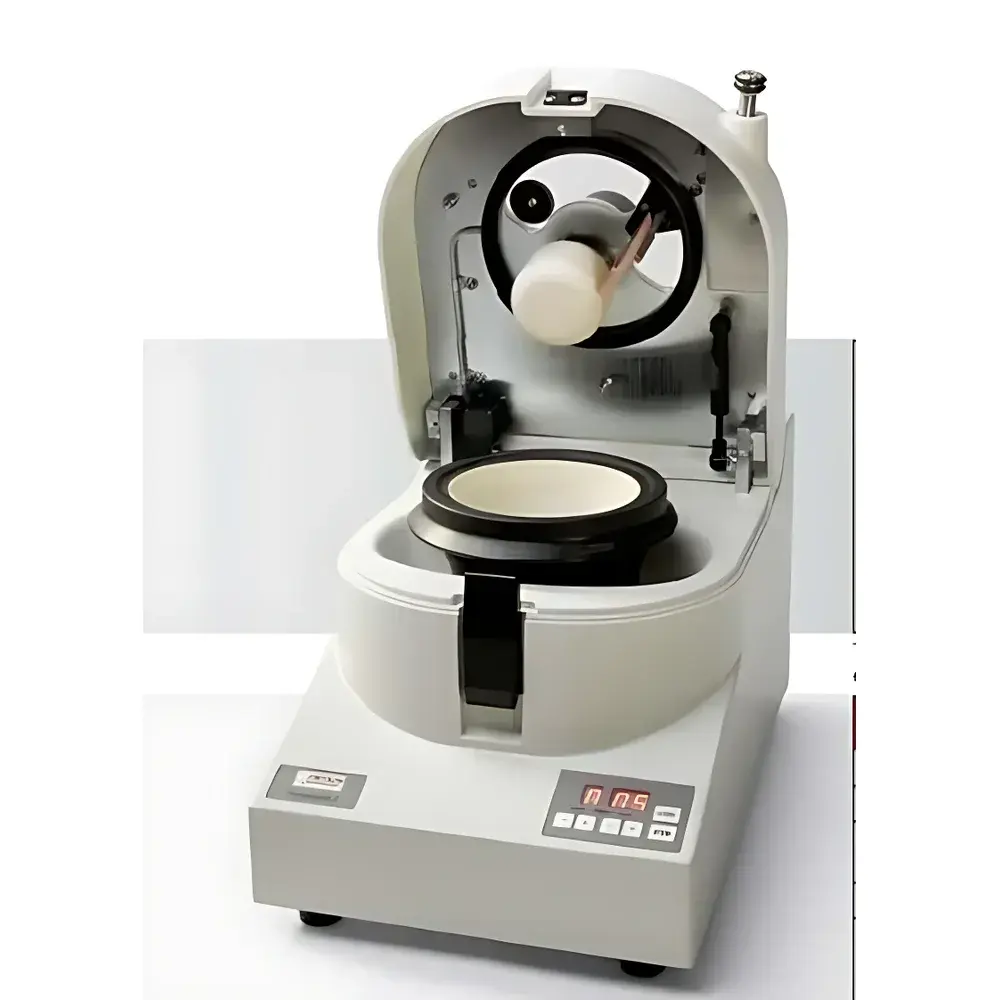
FRITSCH Pulverisette 2 Planetary Micro Mill
| Brand | FRITSCH |
|---|---|
| Origin | Germany |
| Model | Pulverisette 2 |
| Final Particle Size | 10–20 µm |
| Max. Batch Volume | 150 mL |
| Max. Feed Size | 8 mm |
| Motor Speed | 70–80 rpm |
| Input Power | 180 W |
| Voltage | 100–120 / 200–240 V, 50–60 Hz |
| Net Weight | 24 kg |
| Gross Weight | 34 kg |
| Dimensions (W×D×H) | 31 × 46 × 41 cm |
| Grinding Principle | Friction-based planetary motion |
| Grinding Bowl & Pestle Materials | Agate, Sintered Alumina, Zirconia, Stainless Steel, Hardened Steel, Tungsten Carbide, Technical Ceramics |
| Safety Certification | CE |
| Warranty | 1 Year |
Overview
The FRITSCH Pulverisette 2 Planetary Micro Mill is a precision-engineered laboratory grinding instrument designed for reproducible size reduction of dry, brittle, soft, fibrous, temperature-sensitive, or slightly moist samples to analytical fineness. Operating on the principle of friction-driven planetary motion—where a stationary pestle is pressed against a rotating grinding bowl—the system generates high shear and compressive forces without mechanical coupling between drive and pestle. This architecture eliminates backlash and ensures consistent force application across batches. Unlike conventional jaw or rotor mills, the Pulverisette 2 avoids heat accumulation through low-speed operation (70–80 rpm), making it especially suitable for thermolabile materials such as pharmaceutical actives, botanical extracts, or polymer additives. Its compact footprint (31 × 46 × 41 cm) and modular design allow seamless integration into ISO 17025-accredited laboratories, QC environments, and R&D facilities requiring GLP-compliant sample preparation workflows.
Key Features
- Adjustable, calibrated pestle pressure with direct digital readout—enabling method transfer and inter-laboratory comparability
- Tool-free, rapid assembly and disassembly of grinding bowls and pestles—reducing cross-contamination risk and downtime between sample runs
- Seven certified grinding material options (agate, sintered alumina, zirconia, stainless steel, hardened steel, tungsten carbide, technical ceramics) selected per sample reactivity, hardness, and contamination sensitivity
- CE-certified safety architecture with integrated overload protection, emergency stop, and lid-interlocked motor cutoff
- Single-batch capacity up to 150 mL with final particle size distribution consistently reaching 10–20 µm (D90) under optimized parameters
- Low-power consumption (180 W) and wide voltage compatibility (100–120 V / 200–240 V, 50–60 Hz) for global deployment without transformer dependency
Sample Compatibility & Compliance
The Pulverisette 2 accommodates heterogeneous feed materials including ores, clays, pharmaceutical tablets, food powders, ceramic precursors, electronic scrap, and agricultural biomass. It complies with ASTM D2490 (standard test method for particle size analysis of mineral aggregates), ISO 13320 (laser diffraction particle sizing—requiring representative sub-sampling), and USP (particle size distribution for drug substances). For regulated environments, its mechanical repeatability supports audit-ready documentation when paired with traceable calibration records and SOP-controlled parameter logging. The absence of lubricants in the grinding chamber and non-porous surface finishes of agate/zirconia bowls meet FDA 21 CFR Part 11 requirements for electronic record integrity when used with validated data acquisition systems.
Software & Data Management
While the Pulverisette 2 operates as a stand-alone mechanical unit, its parameter stability (fixed rpm, repeatable pressure setting, defined bowl geometry) enables full integration into LIMS- or ELN-managed workflows. Users assign unique batch IDs to each grinding cycle; pressure settings, run duration, and bowl/pestle identification are manually logged or entered via barcode-scanned consumables. For automated traceability, third-party I/O modules can interface with programmable logic controllers (PLCs) to capture start/stop timestamps and motor current signatures—supporting root cause analysis during deviation investigations. All grinding components carry laser-engraved serial numbers aligned with FRITSCH’s component lifecycle tracking database.
Applications
- Mineralogical sample homogenization prior to XRF or ICP-OES analysis
- Pharmaceutical blend uniformity testing (USP ) via geometric dilution and subsequent sieve analysis
- Preparation of reference materials for certified particle size standards (e.g., NIST SRM 1980)
- Reduction of ceramic green bodies to sub-micron suspensions for rheological characterization
- Grinding of food matrices (spices, grains, dairy powders) for moisture content and fat extraction protocols
- Size reduction of recycled electronic components for elemental leaching studies (RoHS/WEEE compliance screening)
FAQ
Is the Pulverisette 2 suitable for cryogenic grinding?
No—it lacks integrated cooling channels or LN₂ ports. For cryo-applications, FRITSCH recommends the Pulverisette 9 or variable-speed planetary ball mills with chilled jackets.
Can the same grinding bowl be reused across different sample types without cleaning validation?
No. Cross-contamination risk mandates documented cleaning procedures (e.g., ultrasonic bath + solvent rinse + blank run verification) per ISO/IEC 17025 Clause 7.5.2.
Does FRITSCH provide material compatibility charts for aggressive samples (e.g., HF-containing minerals)?
Yes—certified chemical resistance data sheets are available for all seven bowl/pestle material variants, including pH stability ranges and corrosion rates under static immersion conditions.
What maintenance intervals are recommended for long-term accuracy?
Annual recalibration of the pressure transducer and visual inspection of gear train wear are advised; FRITSCH offers certified service contracts with metrology-grade torque verification.
How does the Pulverisette 2 compare to mortar-and-pestle manual grinding in terms of reproducibility?
Inter-operator CV% for D50 drops from >15% (manual) to <3.5% (Pulverisette 2) under identical feed conditions, per internal FRITSCH validation report #FRT-PM2-REP-2023-089.



