
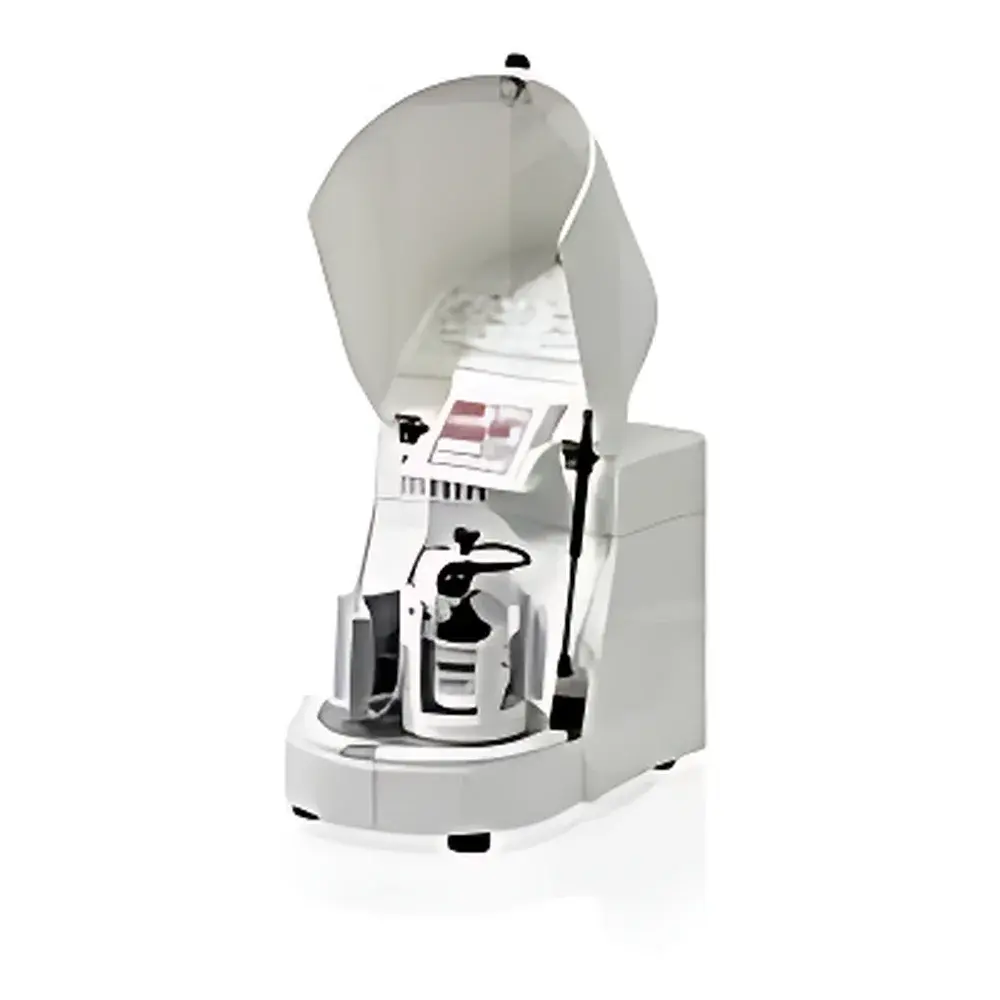
Fritsch Pulverisette 6 Planetary Micro Mill
| Brand | Fritsch |
|---|---|
| Origin | Germany |
| Model | Pulverisette 6 |
| Instrument Type | Planetary Ball Mill |
| Sample Suitability | Hard and brittle materials |
| Feed Size | ≤ 10 mm |
| Final Particle Size | < 1 µm |
| Batch Capacity | 225 mL |
| Operating Speed | Up to 600 rpm (sun wheel), planetary ratio 1:2 |
| Power Supply | 100–240 V, 50–60 Hz, 1100 W |
| Noise Level | ~70 dB(A) (250 mL bowl, 10 mm balls) |
| Net Weight | 63 kg |
| Dimensions (L×W×H) | 37 × 53 × 50 cm |
| Compliance | EN 61010, CE Marked |
| Optional Accessories | GTM Gas Temperature & Pressure Monitoring System, inert gas-compatible lids, 8 bowl/ball material options, 3 bowl volumes (80/250/500 mL), 6 ball diameters (5–40 mm) |
Overview
The Fritsch Pulverisette 6 Planetary Micro Mill is a high-energy laboratory ball mill engineered for reproducible, ultra-fine comminution of hard, brittle, and fibrous materials. It operates on the principle of planetary motion: the grinding bowl rotates on its own axis (rotation) while simultaneously revolving around a central sun wheel (revolution), generating centrifugal accelerations up to 95 g. This dual-motion geometry ensures optimal impact energy transfer from grinding balls to sample particles—enabling efficient size reduction through combined impact, shear, and friction forces. Designed for analytical and R&D applications requiring sub-micron particle distributions, the Pulverisette 6 delivers consistent results across repeated batches, making it suitable for XRD sample preparation, catalyst synthesis, nanomaterial dispersion, and mechanochemical reaction studies.
Key Features
- Programmable microprocessor control with membrane-touch keypad for precise time setting (down to 1 second), speed ramping, cooling intervals, and reversible rotation direction
- Adjustable counterbalance system for dynamic load compensation during high-speed operation (up to 600 rpm sun wheel speed)
- Acoustically insulated grinding chamber with active ventilation to manage thermal buildup and reduce operational noise (~70 dB(A))
- Energy-saving standby mode with automatic overload protection and real-time motor current monitoring
- Dual-sample capability: simultaneous processing of two independent grinding bowls under identical parameters
- Integrated safety interlocks compliant with EN 61010-1 and CE directives, including lid-sensor shutdown and emergency stop circuitry
- Optional GTM (Gas Temperature & Pressure) system for in-situ monitoring of internal bowl conditions during milling—wirelessly transmitting temperature and pressure data to PC in real time (Excel/graph export)
Sample Compatibility & Compliance
The Pulverisette 6 accommodates dry powders, suspensions, and emulsions. Its robust mechanical design supports processing of materials with Mohs hardness up to 10—including ceramics, metals, minerals, alloys, and pharmaceutical actives. For oxygen- or moisture-sensitive samples, inert gas purging (N₂, Ar) is enabled via Fritsch’s proprietary gas-tight bowl lids equipped with rapid-connect purge valves and glovebox-compatible locking mechanisms. All grinding components conform to ISO 8502-3 for surface cleanliness validation. The instrument meets IEC 61000-4 electromagnetic compatibility standards and supports GLP-compliant workflows through audit-trail-capable software logging (when paired with optional Fritsch LabSoft Suite).
Software & Data Management
While the base unit features embedded firmware with non-volatile parameter storage, full traceability is achieved when integrated with Fritsch LabSoft software (Windows-based). LabSoft enables method creation, execution scheduling, digital signature support, and electronic record generation compliant with FDA 21 CFR Part 11 requirements. Raw GTM sensor data—including time-stamped temperature/pressure profiles—is logged automatically and exportable in CSV/Excel format for statistical process analysis (e.g., ANOVA of milling kinetics). All user actions—including parameter changes, start/stop events, and error codes—are timestamped and stored locally for regulatory review.
Applications
- Preparation of homogeneous, submicron powders for X-ray diffraction (XRD), SEM/TEM imaging, and laser diffraction particle size analysis
- Mechanochemical synthesis of metal–organic frameworks (MOFs), solid-state battery cathodes, and amorphous pharmaceutical intermediates
- Homogenization of composite precursors (e.g., polymer–nanofiller blends) prior to rheological or thermal characterization
- Disaggregation of agglomerated catalysts or spent battery electrode materials for elemental leaching assays
- Routine QC grinding of geological core samples, cement clinker, and refractory oxides per ASTM C114 and ISO 679 protocols
FAQ
What grinding media materials are available for the Pulverisette 6?
Fritsch offers eight certified grinding bowl and ball material combinations: agate, silicon nitride, high-purity alumina (99.7%), technical alumina (85–90%), zirconia, stainless steel, hardened steel, and tungsten carbide—each selected to minimize contamination and maximize wear resistance for specific sample chemistries.
Can the mill operate under inert atmosphere without modification?
Yes—using Fritsch’s gas-tight bowl lids with integrated purge valves and optional inert-gas manifold kits, users can maintain controlled N₂ or Ar environments throughout milling, preventing oxidation or hydrolysis of reactive samples.
Is the GTM system compatible with all bowl sizes?
The GTM sensor module is validated for use with 250 mL and 500 mL bowls; calibration files are preloaded per bowl geometry to ensure pressure/temperature accuracy within ±0.5 °C and ±5 mbar.
How does the instrument ensure batch-to-batch reproducibility?
Reproducibility is ensured by closed-loop speed control, thermally stabilized drive electronics, mechanical backlash compensation, and programmable pause-cooling cycles—all synchronized via the embedded real-time operating system (RTOS) with microsecond-level timing resolution.
What maintenance is required for long-term performance stability?
Routine maintenance includes periodic inspection of drive belt tension, cleaning of ventilation filters, verification of bowl lid sealing integrity, and recalibration of the GTM sensor every 12 months using NIST-traceable reference gases and thermal standards.



