
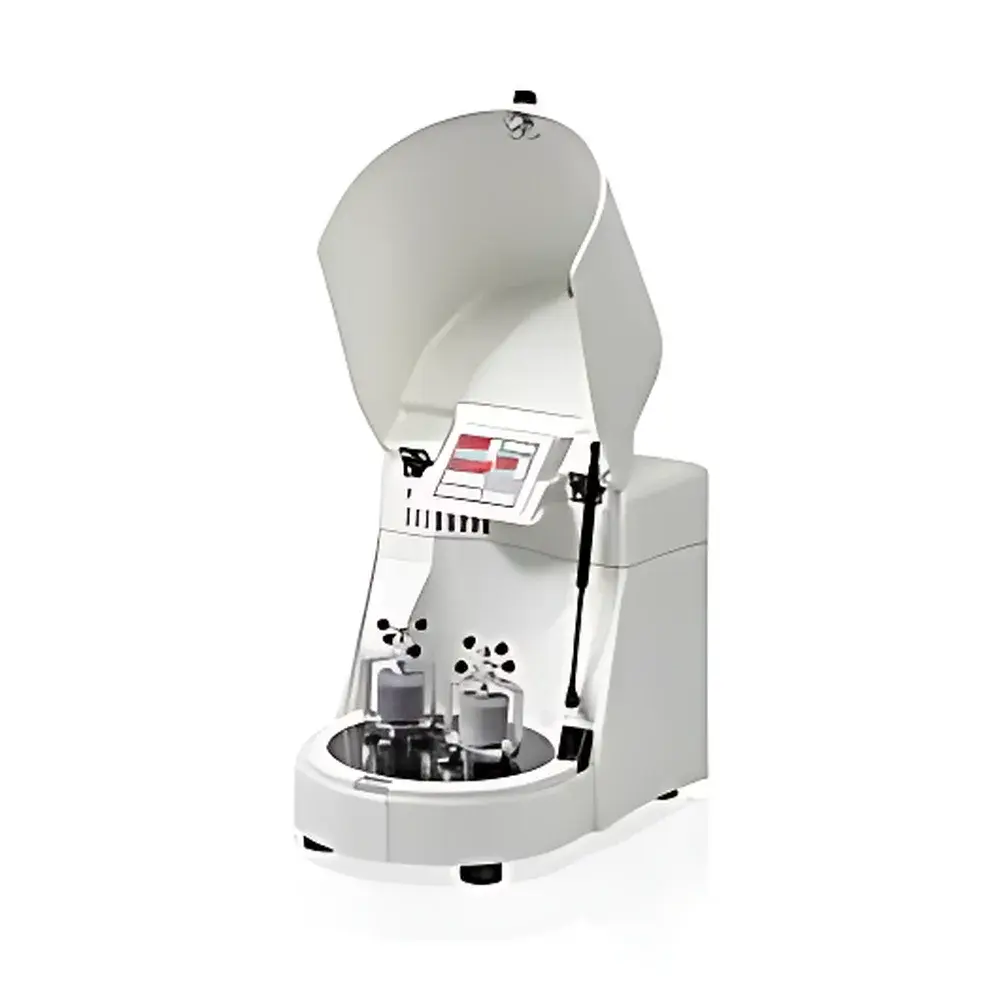
Fritsch Pulverisette 7 Classic Planetary Micro Mill
| Brand | Fritsch |
|---|---|
| Origin | Germany |
| Model | Pulverisette 7 Classic |
| Grinding Principle | Planetary Ball Milling |
| Maximum Jar Rotation Speed | 800 rpm |
| Jar-to-Sun-Disk Speed Ratio | 1:2 |
| Feed Size | < 5 mm |
| Final Particle Size | < 1 µm |
| Batch Capacity | 2 × 20 mL (max) |
| Grinding Modes | Dry & Wet |
| Power Supply | 100–240 V, 50–60 Hz, 880 W |
| Motor Output | 0.37 kW |
| Net Weight | 35 kg |
| Dimensions (L×W×H) | 82 × 52 × 71 cm |
| Compliance | EN 61010, CE Marked |
Overview
The Fritsch Pulverisette 7 Classic is a high-energy planetary micro mill engineered for reproducible, ultra-fine comminution of hard, brittle, fibrous, or temperature-sensitive materials in laboratory environments. Operating on the principle of planetary ball milling, it subjects samples to intense mechanical energy through combined rotational and orbital motion: grinding jars rotate on their own axes while simultaneously revolving around a central sun disk. This dual-motion geometry generates high-frequency impact, shear, and friction forces—enabling rapid size reduction to sub-micron particle distributions (<1 µm) with exceptional batch-to-batch consistency. Designed for analytical sample preparation in materials science, geochemistry, pharmaceutical development, and advanced ceramics research, the instrument delivers precision grinding without compromising structural integrity or chemical composition—particularly critical when processing nanomaterials, catalysts, or polymorphic drug substances.
Key Features
- Programmable microprocessor control with membrane-touch keypad for precise setting of grinding time (down to the second), pause intervals, cooling durations, and directional reversal sequences.
- High-speed planetary drive system with jar rotation speeds up to 800 rpm and a fixed 1:2 ratio between jar rotation and sun-disk revolution—ensuring optimal kinetic energy transfer and impact frequency.
- Acoustically insulated grinding chamber with active ventilation management to suppress noise and dissipate heat during extended operation.
- Overload protection and energy-saving standby mode to extend motor service life and reduce operational costs.
- Dual-jar configuration supports parallel processing of two independent samples under identical parameters—enhancing throughput and statistical reliability in comparative studies.
- Gas-tight grinding jars compatible with inert atmosphere purging (e.g., Ar, N₂) to prevent oxidation or hydration of air-sensitive compounds.
- Modular grinding media system offering eight material options—including agate, silicon nitride, alumina (85–90% & 99.7%), zirconia, stainless steel, hardened steel, and tungsten carbide—to minimize contamination and optimize wear resistance for specific sample chemistries.
Sample Compatibility & Compliance
The Pulverisette 7 Classic accommodates dry powders, suspensions, emulsions, and pastes across diverse material classes: oxides, metals, alloys, polymers, biological tissues, and pharmaceutical excipients. Its ability to achieve final particle sizes below 1 µm makes it suitable for XRD sample preparation, SEM/TEM dispersion, dissolution testing, and homogenization prior to ICP-MS or HPLC analysis. All electrical and mechanical design conforms to EN 61010-1 (Safety Requirements for Electrical Equipment for Measurement, Control, and Laboratory Use) and carries full CE marking. The instrument’s programmable audit trail—when used with optional software—is structured to support GLP/GMP-aligned workflows, including timestamped parameter logging and user-access controls consistent with FDA 21 CFR Part 11 expectations for electronic records.
Software & Data Management
While the base model operates via standalone front-panel programming, optional Fritsch LabSoft software enables remote configuration, real-time monitoring, and automated report generation. Data export supports CSV and PDF formats for integration into LIMS environments. Critical process variables—including speed profiles, cycle counts, thermal history, and jar identification—are logged with ISO/IEC 17025-compliant traceability. Software updates maintain alignment with evolving regulatory guidance on instrument qualification (IQ/OQ/PQ) and data integrity standards.
Applications
- Preparation of homogeneous reference materials for elemental analysis (XRF, ICP-OES).
- Crystallinity modification and amorphization of APIs in solid-state pharmaceutical development.
- Nanoparticle synthesis via top-down mechanical alloying or mechanochemical reactions.
- Homogenization of heterogeneous geological or environmental samples prior to geochemical fingerprinting.
- Rapid disintegration of composite electrodes for battery material R&D.
- Dispersion stabilization of pigment suspensions and ceramic slurries.
FAQ
What is the maximum recommended feed size for the Pulverisette 7 Classic?
Samples should be pre-crushed to ≤5 mm before loading into the grinding jar to ensure uniform energy distribution and avoid mechanical strain on the drive system.
Can wet grinding be performed, and what solvent compatibility considerations apply?
Yes—wet grinding is fully supported using Fritsch’s sealed, PTFE-lined or stainless-steel jars; solvent selection must account for chemical resistance of jar and ball materials (e.g., avoid HF with silica-based media).
How does the 1:2 speed ratio between jar rotation and revolution affect grinding efficiency?
This kinematic relationship maximizes centrifugal acceleration within the jar, increasing collision velocity between balls and sample—thereby accelerating particle fracture kinetics without requiring excessive run times.
Is calibration required, and how is performance verification conducted?
No routine calibration is needed; however, users perform periodic verification using certified reference materials (e.g., NIST SRM 1976b) and laser diffraction particle size analyzers to confirm reproducibility against historical baselines.
What safety interlocks are integrated into the instrument?
The mill features automatic shutdown upon lid opening, motor overtemperature detection, and torque-limiting circuitry to prevent jamming-induced damage—fully compliant with EN 61010 risk assessment requirements.



