
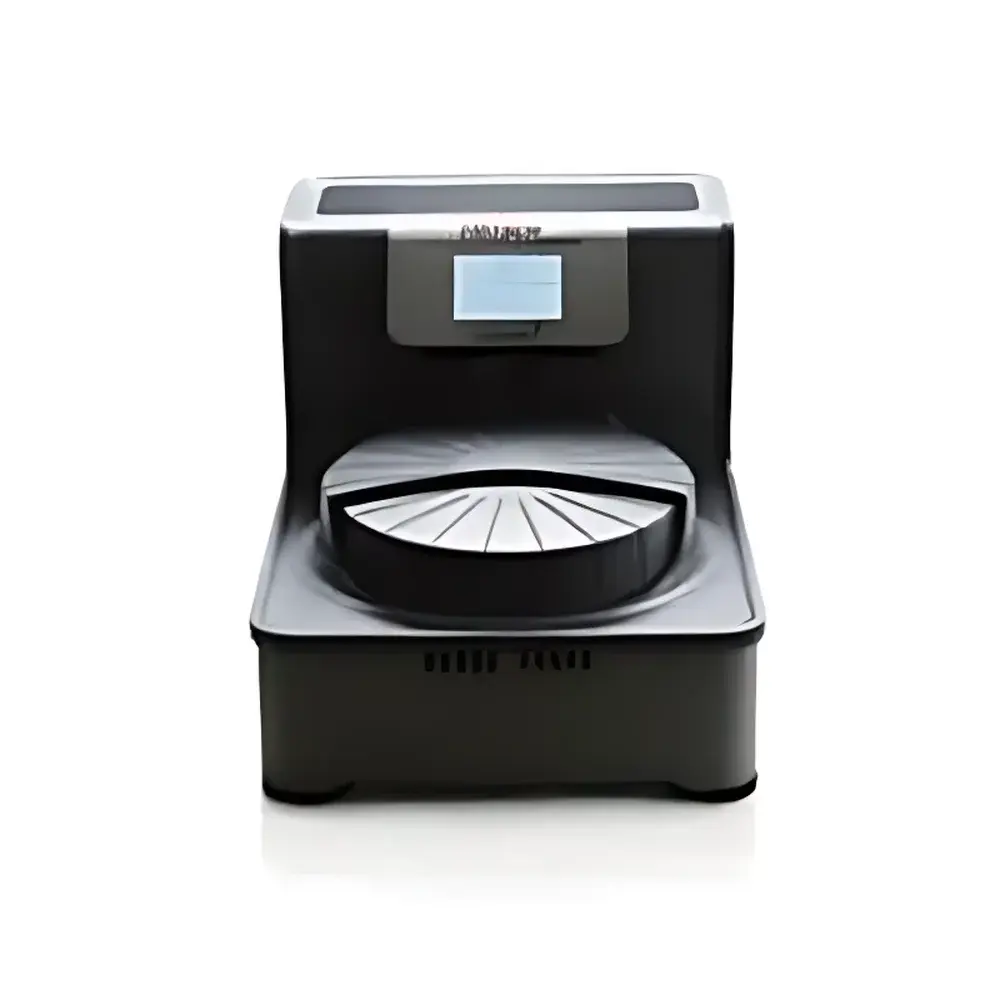
FRITSCH Pulverisette 7 Premium Line Planetary Micro Mill
| Brand | FRITSCH |
|---|---|
| Origin | Germany |
| Model | Pulverisette 7 Premium Line |
| Maximum Feed Size | 5 mm |
| Batch Capacity | 70 mL |
| Final Particle Size | < 0.1 µm |
| Grinding Modes | Dry and Wet |
| Main Drive Speed | 100–1100 rpm |
| Application Scope | Hard, brittle, medium-hard, and fibrous materials |
| Compliance | CE, ISO 9001-certified manufacturing |
Overview
The FRITSCH Pulverisette 7 Premium Line Planetary Micro Mill is a high-energy laboratory grinding instrument engineered for reproducible, ultra-fine comminution of solid materials down to the nanoscale. Operating on the principle of planetary ball milling, it generates intense mechanical energy through centrifugal acceleration, where grinding bowls rotate in the opposite direction to the sun wheel at precisely controlled speeds—up to 1100 rpm—producing combined impact, shear, and friction forces between grinding balls and sample material. This kinematic configuration enables rapid particle size reduction while preserving sample integrity under controlled thermal conditions. Designed and manufactured in Germany to stringent DIN/ISO quality standards, the Pulverisette 7 Premium Line serves as a critical tool in materials science R&D, geochemical sample preparation, pharmaceutical pre-formulation studies, and advanced ceramic synthesis—where consistent sub-100 nm particle distributions are required prior to XRD, SEM, or BET analysis.
Key Features
- High-speed planetary drive system with digitally adjustable main disc rotation (100–1100 rpm), enabling tunable energy input for optimized comminution kinetics.
- Premium-grade stainless steel grinding bowls (e.g., zirconia, tungsten carbide, or hardened steel) compatible with dry and wet grinding protocols—minimizing cross-contamination and wear-induced sample dilution.
- Integrated safety interlock system with lid position monitoring, automatic motor shutdown upon bowl disengagement, and real-time temperature sensing to prevent thermal degradation during extended milling cycles.
- Compact footprint (ideal for benchtop integration in regulated lab environments) with vibration-damped base and precision-balanced rotating assembly ensuring long-term mechanical stability and low operational noise.
- Modular design supporting interchangeable bowl volumes (15–70 mL) and multiple grinding media options—including 0.1–10 mm diameter balls—to accommodate diverse hardness and brittleness profiles across mineralogical, metallurgical, and polymeric samples.
Sample Compatibility & Compliance
The Pulverisette 7 Premium Line is validated for processing hard, brittle, medium-hard, and fibrous materials—including oxides, alloys, ores, polymers, and biological composites—without requiring cryogenic assistance in most applications. Its ability to achieve final particle sizes below 0.1 µm makes it suitable for preparing homogenized reference materials compliant with ASTM E2904 (Standard Guide for Preparation of Powder Reference Materials) and ISO 13320 (Laser diffraction particle size analysis). All mechanical components meet EU Machinery Directive 2006/42/EC requirements; electrical systems conform to IEC 61000-6-3 (EMC emissions) and IEC 61000-6-2 (immunity). Documentation packages support GLP/GMP audit readiness, including factory calibration certificates traceable to PTB (Physikalisch-Technische Bundesanstalt).
Software & Data Management
While the base unit operates via intuitive rotary encoder interface with programmable time/speed profiles, optional FRITSCH LabSoft software (v5.2+) provides full digital control and audit-trail functionality. LabSoft supports method storage, real-time RPM/temperature logging, user access levels, electronic signature workflows, and export of CSV/Excel-compatible datasets—all aligned with FDA 21 CFR Part 11 requirements for electronic records and signatures. Raw data files include timestamps, operator ID, bowl identification, and environmental metadata—facilitating traceability across analytical workflows from sample prep to final characterization.
Applications
- Preparation of nanostructured metal oxide powders for catalyst development and battery electrode slurries.
- Homogenization of geological samples prior to ICP-MS or XRF analysis—ensuring representative subsampling and minimizing grain-boundary bias.
- Amorphization of active pharmaceutical ingredients (APIs) to enhance dissolution kinetics and bioavailability profiling per USP <1059>.
- Production of ultrafine ceramic precursors for sintering optimization and microstructural control in additive manufacturing feedstocks.
- Routine quality control grinding of cement clinker, fly ash, and slag for Blaine fineness testing and hydration modeling.
FAQ
What is the maximum recommended feed particle size for optimal performance?
For consistent nanoscale output and minimized wear, FRITSCH recommends a maximum initial particle size of 5 mm—subject to material hardness and fracture toughness.
Can the Pulverisette 7 Premium Line be used for cryogenic grinding?
Yes—when equipped with optional liquid nitrogen cooling jackets and cryo-compatible bowls (e.g., stainless steel), it supports low-temperature milling of thermolabile polymers and biological tissues.
Is wet grinding supported, and what solvents are compatible?
Wet grinding is fully supported using standard FRITSCH grinding bowls; common solvents include ethanol, isopropanol, acetone, and aqueous surfactant solutions—compatibility must be verified against bowl material specifications.
How does the 1100 rpm speed affect energy input compared to conventional planetary mills?
At 1100 rpm, kinetic energy transfer increases quadratically relative to lower speeds—enabling up to 4× faster attainment of <0.1 µm D90 values in comparative trials with certified reference materials.
What documentation is provided for regulatory compliance in pharmaceutical labs?
Each unit ships with a Factory Acceptance Test (FAT) report, IQ/OQ templates, and a full traceability dossier—including material certifications, EMC test reports, and ISO 9001 manufacturing evidence—supporting validation under EU GMP Annex 15 and USP <1058>.



