
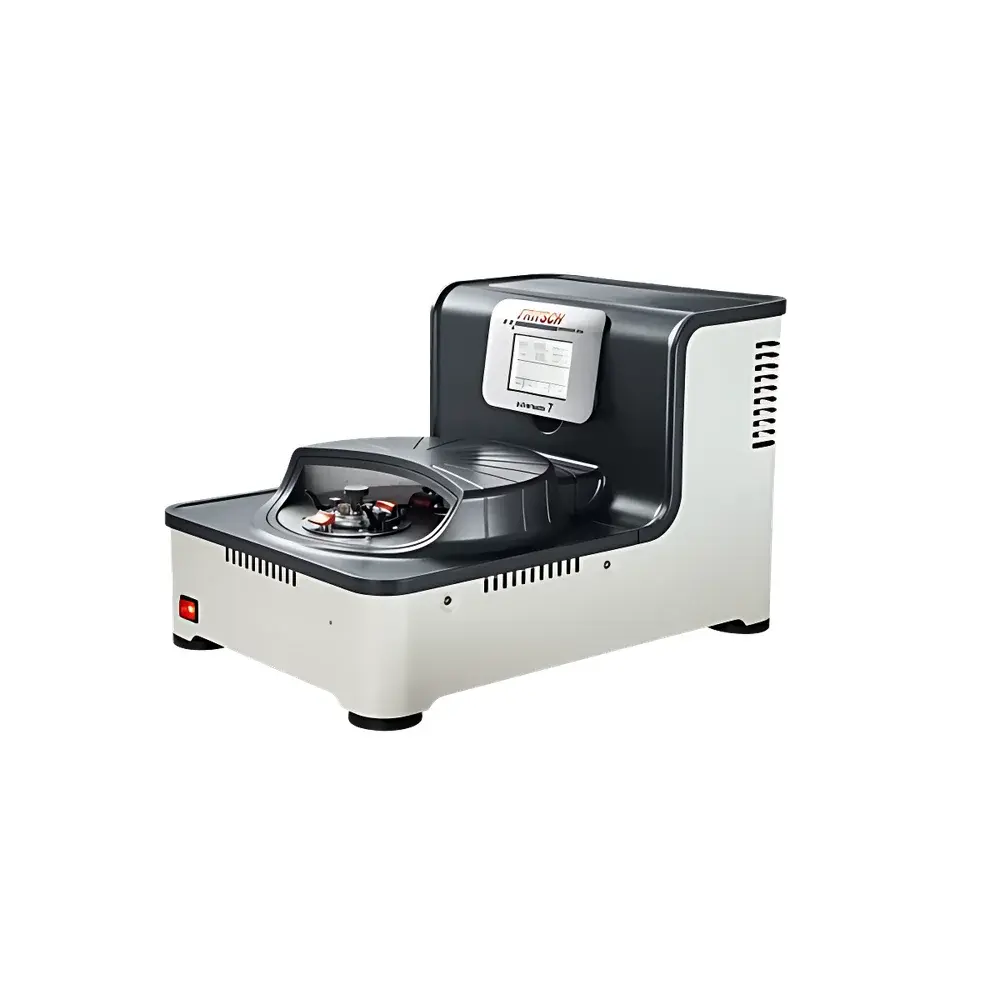
FRITSCH PULVERISETTE 7 Premium Planetary Micro Mill
| Brand | FRITSCH |
|---|---|
| Origin | Germany |
| Model | PULVERISETTE 7 Premium |
| Max. Feed Size | < 5 mm |
| Jar Capacity | 20 / 45 / 80 mL |
| Grinding Ball Diameters | 3 / 5 / 10 / 15 / 20 mm |
| Final Fineness | < 0.1 µm |
| Main Disc Speed | up to 1100 rpm |
| Simultaneous Samples | 2 |
| Power Supply | 100–240 V, 1–, 50–60 Hz |
| Power Consumption | 1100 W |
| Net Weight | 44 kg |
| Gross Weight | 61 kg |
| Dimensions (W × H × D) | 40 × 58 × 36 cm |
| Grinding Modes | Dry & Wet |
| Optional Inert Gas Purging | Yes |
| Material Options | Agate, Silicon Nitride, Alumina, Zirconia, Stainless Steel, Tempered Steel, Tungsten Carbide |
| Interface | USB, Bluetooth, Wideband Network Connectivity |
| Programmable Time & Cooling Intervals | Down to 1-second Resolution |
Overview
The FRITSCH PULVERISETTE 7 Premium Planetary Micro Mill is a high-precision laboratory instrument engineered for reproducible, contamination-free size reduction of solid materials down to the sub-micron range. Based on planetary ball milling principles, it subjects samples to intense mechanical energy through centrifugal acceleration—generated by the simultaneous rotation of grinding jars around their own axis and revolution around a central sun wheel. This dual-axis motion produces high impact and shear forces ideal for brittle, fibrous, or crystalline substances requiring ultra-fine comminution. Designed and manufactured in Germany, the Premium variant incorporates structural enhancements—including reinforced drive mechanics, improved thermal management, and an upgraded sealing system—to support extended operation cycles and stringent process control. It is widely deployed in materials science research, pharmaceutical development, geochemical analysis, and advanced ceramics R&D where particle size distribution, phase integrity, and elemental purity are critical analytical prerequisites.
Key Features
- Final fineness reliably achievable below 0.1 µm under optimized dry or wet grinding conditions
- Dual-jar configuration enables parallel processing of two independent samples with identical or differentiated parameters
- Seven certified grinding material options—including agate, silicon nitride, zirconia, and tungsten carbide—selected for chemical inertness, hardness, and low wear debris generation
- Programmable time intervals with 1-second resolution for both grinding and active cooling phases, minimizing thermal degradation of heat-sensitive compounds
- Integrated inert gas purging port compatible with nitrogen or argon atmospheres, essential for air-sensitive or pyrophoric materials
- Self-locking jar clamping mechanism ensures secure containment during high-speed operation (up to 1100 rpm) and eliminates manual torque calibration errors
- Digital connectivity via USB, Bluetooth, and wideband network interfaces supports remote monitoring, parameter synchronization, and audit-compliant data logging
Sample Compatibility & Compliance
The PULVERISETTE 7 Premium accommodates diverse sample types—including oxides, metals, polymers, plant tissues, and pharmaceutical actives—with feed sizes up to 5 mm. Its modular jar system (20 mL, 45 mL, and 80 mL volumes) and five standardized grinding ball diameters (3–20 mm) allow precise energy input tuning per application. All wet grinding configurations comply with ISO 13320:2020 for laser diffraction particle sizing preparation, while dry grinding protocols align with ASTM E11-22 for test sieve specifications. The instrument’s construction meets CE, RoHS, and IEC 61000-6-2/6-3 electromagnetic compatibility standards. Optional GLP/GMP-ready software modules provide electronic signatures, user access levels, and 21 CFR Part 11–compliant audit trails for regulated environments.
Software & Data Management
Control and documentation are managed via the FRITSCH MillSuite™ software platform—installed locally or accessed remotely—supporting full parameter definition, real-time status visualization, and automated report generation in PDF or CSV formats. Each grinding cycle stores timestamped metadata including rotational speed, duration, pause intervals, temperature trends (via optional IR sensor), and operator ID. Data export conforms to LIMS-compatible structures, enabling seamless integration into enterprise laboratory informatics systems. Firmware updates are delivered over-the-air, ensuring continuous alignment with evolving regulatory expectations and method validation requirements.
Applications
- Preparation of nanoscale precursors for battery cathode materials (e.g., LiCoO₂, NMC)
- Homogenization of geological core samples prior to XRF or ICP-MS analysis
- Cell disruption and protein extraction from microbial biomass using cryo-assisted milling
- Production of amorphous drug formulations via mechanochemical activation
- Recycling research: liberation of rare earth elements from end-of-life magnets and electronics
- Standard reference material certification workflows requiring traceable particle size reduction
FAQ
What is the maximum recommended continuous operating time per cycle?
Continuous operation is supported for up to 99 hours and 59 minutes per program; however, thermal load management requires inclusion of programmable cooling intervals for cycles exceeding 60 minutes.
Can the instrument be validated for GMP manufacturing environments?
Yes—when equipped with FRITSCH’s IQ/OQ/PQ documentation package and connected to MillSuite™ with 21 CFR Part 11 modules, it fulfills qualification requirements for pharmaceutical primary packaging and API intermediate processing.
Is there a vacuum option for oxygen-sensitive milling?
While inert gas purging is standard, vacuum pre-evacuation is not natively supported; users may integrate external vacuum pumps via the sealed gas inlet port using custom adapters compliant with DIN 28178.
How does jar material selection affect analytical accuracy in trace metal analysis?
For sub-ppb elemental detection (e.g., ICP-MS), agate or silicon nitride jars are strongly recommended to avoid Fe, Cr, or Ni leaching; stainless steel variants require rigorous acid-washing validation prior to use.
Are replacement jars and balls supplied with batch-specific certificates of conformance?
All certified grinding components ship with CoC documentation listing lot number, material grade, dimensional tolerance, and residual element assay results per EN 10204 3.1.



