
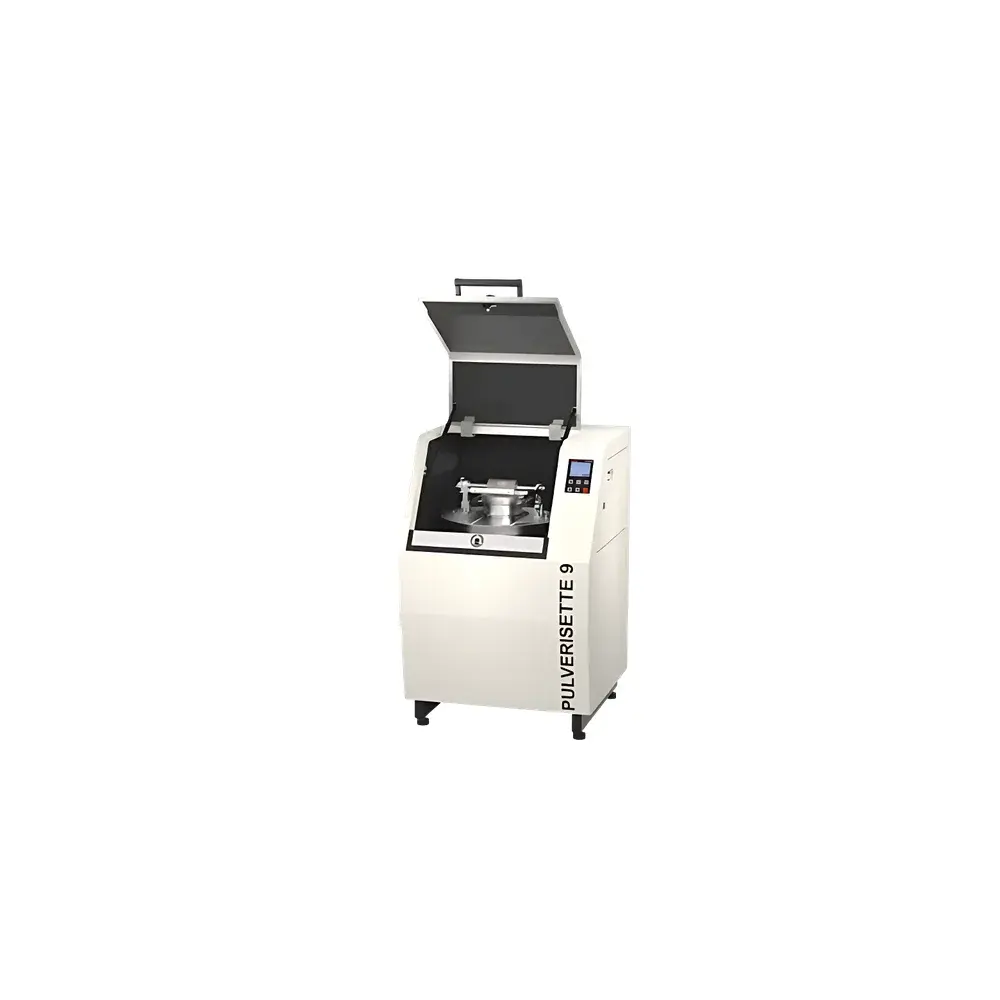
FRITSCH PULVERISETTE 9 Vibratory Cup Mill
| Brand | FRITSCH |
|---|---|
| Origin | Germany |
| Model | PULVERISETTE 9 |
| Max. Feed Size | 12 mm |
| Effective Sample Volume | 50 / 100 / 250 mL |
| Max. Batch Capacity | 250 mL |
| Final Particle Size | 10–20 µm |
| Motor Speed | up to 1500 rpm |
| Electrical Supply | 230–240 V, 1~ , 50–60 Hz, 1200 W |
| Motor Output (VDE 0530 / EN 60034) | 1.1 kW |
| Net Weight | 267 kg |
| Gross Weight | 330 kg |
| Dimensions (W × H × D) | 77 × 76 × 116 cm |
Overview
The FRITSCH PULVERISETTE 9 Vibratory Cup Mill is a high-energy, frequency-controlled laboratory grinding instrument engineered for rapid, reproducible size reduction of brittle, medium-hard, soft, fibrous, temperature-sensitive, and heterogeneous materials. Operating on the principle of vibrational impact grinding, it subjects samples to intense oscillatory motion within a sealed, centrifugally locked cup—generating kinetic energy sufficient to fracture particles through repeated high-frequency impacts between grinding media and sample material. Unlike planetary ball mills or rotor mills, the PULVERISETTE 9 delivers superior throughput per unit time while maintaining low thermal load and minimal cross-contamination, making it especially suitable for pre-treatment prior to XRD, SEM-EDS, ICP-MS, or laser diffraction particle size analysis.
Key Features
- Frequency-controlled vibration drive enabling precise adjustment of grinding intensity (0–100% amplitude) for optimized process repeatability across diverse material classes.
- Centrifugal locking mechanism ensures secure retention of the grinding cup during operation—eliminating risk of lid displacement even at maximum rotational speed (1500 rpm).
- Acoustically isolated grinding chamber compliant with DIN EN ISO 7779 and EU Directive 2006/42/EC for occupational noise exposure limits (measured <70 dB(A) at 1 m distance).
- Hermetically sealed grinding cups prevent sample loss, atmospheric contamination, or volatile component evaporation—critical for hygroscopic, oxidizable, or regulated substances.
- Tool-free cup exchange and smooth stainless-steel interior surfaces enable rapid cleaning with minimal residual carryover; validated for multi-sample workflows under GLP-compliant environments.
- Integrated motor protection per VDE 0530 and EN 60034 standards, with thermally stable 1.1 kW asynchronous motor delivering consistent torque across full speed range.
Sample Compatibility & Compliance
The PULVERISETTE 9 accommodates a broad spectrum of sample types—including minerals, ceramics, alloys, pharmaceutical tablets, polymers, soils, biological tissues (freeze-dried), and composite materials—provided feed particles are ≤12 mm in maximum dimension. Its sealed cup configuration supports grinding under inert gas (e.g., N₂ or Ar) for air-sensitive samples and optional cryo-grinding using liquid nitrogen-cooled cups. The system complies with ISO 13320 (laser diffraction), ASTM C136 (sieve analysis preparation), and USP (particle size distribution for drug substances). All electrical components meet CE marking requirements under the Low Voltage Directive (2014/35/EU) and EMC Directive (2014/30/EU); mechanical safety conforms to EN 61000-6-2/-6-4 for industrial environments.
Software & Data Management
While the PULVERISETTE 9 operates via an intuitive analog control panel (rotary encoder + LED display), it supports integration into centralized lab data management systems through optional digital interface modules (RS-232 or USB-to-serial adapters). Time-stamped operational logs—including duration, amplitude setting, and start/stop timestamps—can be exported for audit trails required under FDA 21 CFR Part 11 and ISO/IEC 17025 accreditation frameworks. Routine maintenance records (e.g., cup wear inspection, bearing lubrication intervals) align with manufacturer-recommended service schedules documented in the CE-certified technical file.
Applications
- Preparation of homogenized reference materials for geochemical assay (XRF, ICP-OES).
- Rapid comminution of catalyst supports and battery electrode materials prior to BET surface area measurement.
- Size reduction of pharmaceutical excipients and active ingredients for content uniformity testing (USP ).
- Production of sub-20 µm powders for additive manufacturing feedstock qualification.
- Homogenization of heterogeneous environmental samples (sediments, sludges) prior to heavy metal extraction (EPA Method 3050B).
- Grinding of brittle electronic scrap for elemental liberation in WEEE recycling R&D.
FAQ
What is the recommended maintenance interval for the PULVERISETTE 9?
Routine visual inspection of cup sealing gaskets and vibration isolators is advised after every 200 operating hours; full bearing lubrication and torque verification per FRITSCH Service Bulletin SB-09-2023 is required every 1,000 hours.
Can the PULVERISETTE 9 grind heat-sensitive organic compounds without degradation?
Yes—when operated at reduced amplitude (≤40%) and with optional cooling jackets or pre-chilled cups, temperature rise remains below 10 °C above ambient for most organics, as verified by IR thermography per ISO 18434-1.
Is method validation support available for regulatory submissions?
FRITSCH provides IQ/OQ documentation templates aligned with GMP Annex 15 and ASTM E2500-07, including protocol examples for repeatability (n=6), intermediate precision (inter-operator), and robustness testing (amplitude ±5%, time ±10%).
Related Products



