
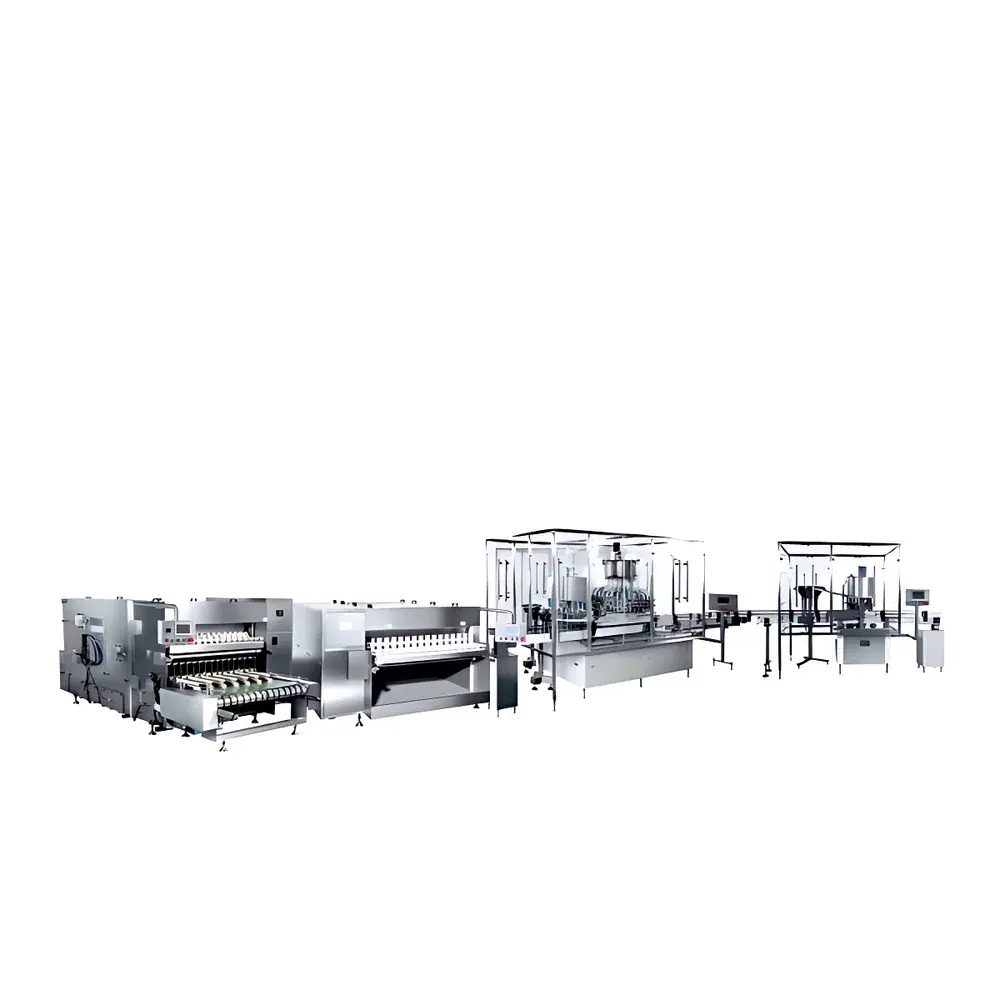
FSTAR FHJ-IF Integrated Parenteral Manufacturing Training System for GMP-Compliant Pharmaceutical Education and Process Validation
| Brand | FSTAR |
|---|---|
| Origin | Liaoning, China |
| Manufacturer Type | Authorized Distributor |
| Product Origin | Domestic (China) |
| Model | FHJ-IF |
| Price Range | USD 140,000 – 1,400,000 |
Overview
The FSTAR FHJ-IF Integrated Parenteral Manufacturing Training System is a fully functional, GMP-aligned pilot-scale production line engineered for academic institutions, regulatory training centers, and pharmaceutical R&D facilities. Designed to replicate critical unit operations of sterile large-volume parenteral (LVP) manufacturing—specifically wash, fill, stopper, crimp, depalletize, and label—the system serves as both an instructional platform and a validation-ready process model. Its architecture adheres to core principles of aseptic processing, including physical segregation of coarse and fine washing stages to eliminate cross-contamination risk, nitrogen purging capability post-filling to mitigate oxidation, and continuous in-line monitoring from final rinse through crimping. Unlike simplified demonstration units, the FHJ-IF integrates real-time control logic, programmable logic controller (PLC)-based sequencing, and human-machine interface (HMI) visualization—enabling students and trainees to observe, interrogate, and modify process parameters under instructor supervision while maintaining full traceability.
Key Features
- Dual-stage bottle washing system: Separate coarse wash and precision rinse modules with dedicated water circuits and validated spray nozzles to meet ISO 14644-1 Class C cleanroom requirements for pre-sterilization handling.
- Constant-flow volumetric filling station: Computer-controlled peristaltic or piston-based dispensing with ±0.5% volumetric repeatability; equipped with “no-bottle-no-fill” optical sensing and automatic flow compensation during line speed variation.
- Inert gas integration: On-demand nitrogen sparging module compatible with USP container closure integrity testing (CCIT) preparation protocols.
- End-to-end in-line monitoring: Vision-based cap presence detection, torque verification at crimping station, and label position/OCR validation—all logged with timestamped event records.
- GMP-compliant hardware design: 316L stainless steel contact surfaces, electropolished finishes (Ra ≤ 0.4 µm), sloped drainage, and IP65-rated enclosures conforming to IEC 60529 standards.
- Modular layout: Configurable footprint (standard 8.5 m × 2.2 m) with removable interlocks for pedagogical deconstruction of unit operations without compromising structural integrity.
Sample Compatibility & Compliance
The FHJ-IF accommodates standard glass and polymer LVP containers (50 mL–1000 mL), including vials, bottles, and flexible bags with rigid support frames. All wetted materials comply with USP Class VI biocompatibility testing and FDA 21 CFR Part 211 Subpart D (Equipment) requirements. The system supports IQ/OQ/PQ documentation packages aligned with Annex 15 of the EU GMP Guide and ASTM E2500-13 (Standard Guide for Specification, Design, and Verification of Pharmaceutical and Biopharmaceutical Manufacturing Systems). It is routinely deployed in university GMP simulation labs accredited under WHO TRS 986 Annex 5 and CNAS-CL01:2018 (equivalent to ISO/IEC 17025) for training auditors, QA personnel, and process engineers.
Software & Data Management
Control software operates on a Windows-based SCADA platform with role-based access (Operator, Technician, Administrator) and full 21 CFR Part 11 compliance—including electronic signatures, audit trail activation, and immutable data archiving. Batch records auto-generate PDF reports containing parameter setpoints, actual values, alarms, and operator actions. Historical data export supports CSV, SQL, and OPC UA protocols for integration into institutional LIMS or MES environments. Optional add-ons include digital twin simulation mode for “what-if” scenario analysis and remote instructor override via encrypted TLS 1.2 connection.
Applications
- Undergraduate and graduate pharmaceutical engineering curricula: Hands-on instruction in aseptic technique, process validation, and deviation investigation.
- GMP auditor training: Realistic simulation of routine inspections, CAPA initiation, and root cause analysis using recorded fault scenarios (e.g., misaligned stoppers, inconsistent fill volumes).
- Industry-academia collaboration: Joint development of novel container-closure systems or alternative sterilization methods under controlled pilot conditions.
- Regulatory readiness assessment: Pre-audit dry runs for FDA, NMPA, or PMDA inspections using standardized checklists mapped to ICH Q5A–Q9 guidelines.
- Process analytical technology (PAT) integration lab: Platform for deploying NIR, Raman, or laser-induced breakdown spectroscopy (LIBS) sensors at critical control points.
FAQ
Does the FHJ-IF meet international GMP training standards for academic accreditation?
Yes—it is configured to satisfy WHO Good Practice for Pharmaceutical Training (TRS 1033), EFPIA’s Academic Training Framework, and China’s “Pharmaceutical Engineering Education Certification Standards” (2022 edition).
Can the system be validated for use in student-conducted process simulations?
Yes—full IQ/OQ documentation templates, calibration logs, and PQ challenge protocols are included; all instruments carry NIST-traceable certificates.
Is nitrogen purging mandatory during operation?
No—nitrogen supply is optional and user-activated via HMI; default operation runs under ambient air with validated microbial barrier filtration.
What level of technical support is provided for curriculum integration?
FSTAR provides dedicated academic success engineers who co-develop lab manuals, grading rubrics, and competency assessments aligned with ABET Criterion 3 outcomes.
Are spare parts and consumables supplied with initial delivery?
A two-year consumables kit (nozzles, seals, tubing, filters) and OEM spare parts inventory list are included; extended service contracts cover preventive maintenance and firmware updates.





