
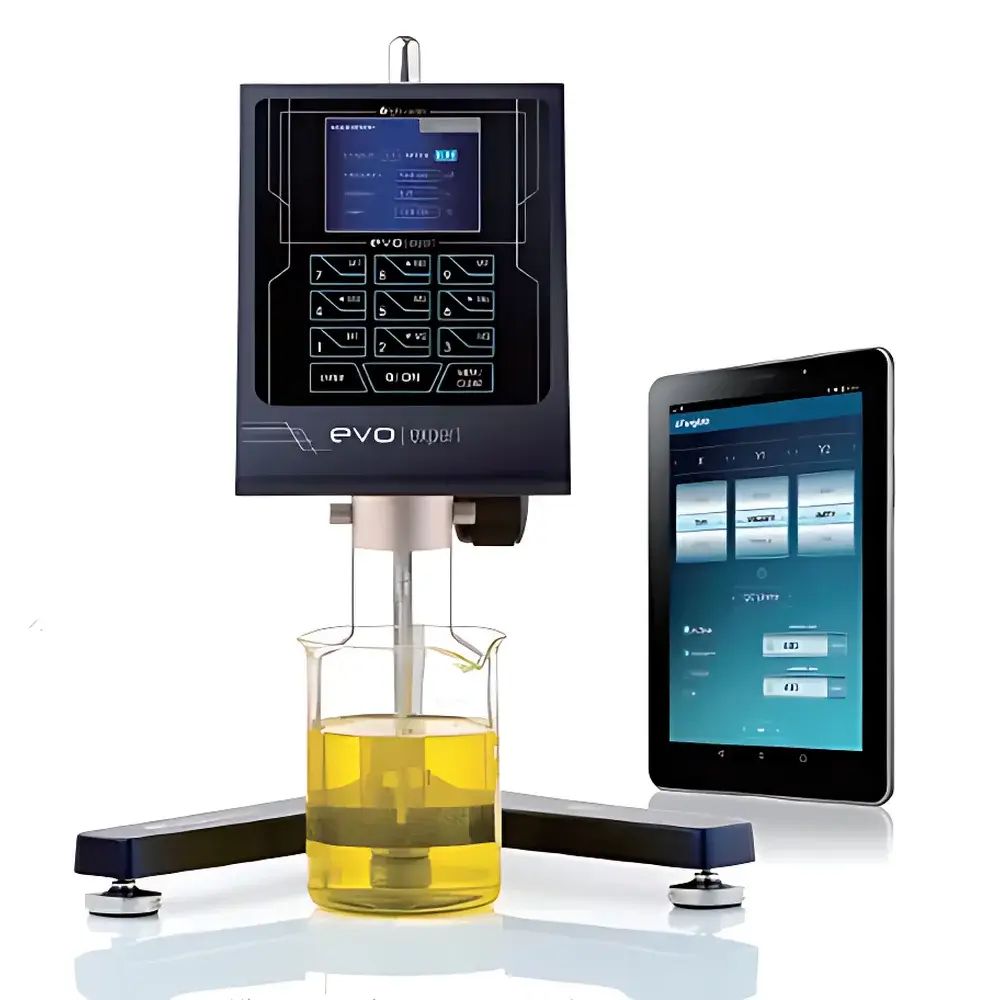
Fungilab EVO Advanced Rotational Viscometer
| Origin | Spain |
|---|---|
| Manufacturer Type | Authorized Distributor |
| Origin Category | Imported |
| Model | EVO |
| Price Range | USD 1,400 – 7,000 (FOB) |
| Instrument Type | Rotational Viscometer |
| Viscosity Range | 1–6,000,000 cP |
| Accuracy | ±1% of full scale |
| Repeatability | ±0.2% |
| Speed Range | 0.01–250 rpm (2600 programmable speeds) |
| Temperature Resolution | 0.1 °C |
| Temperature Accuracy | ±0.1 °C |
| Viscosity Resolution | 0.01 cP (with LCP adapter), 0.1 cP (<10,000 cP), 1 cP (≥10,000 cP) |
| Transducer Material | AISI 316 stainless steel rotors |
| Data Storage | Internal memory + USB export (TXT, XLSX, PDF) |
| Connectivity | Bluetooth 5.0, Wi-Fi 802.11 b/g/n, USB 2.0 |
| Compliance | ASTM D2196, ISO 2555, ISO 3219, USP <911>, GLP/GMP-ready audit trail in FDB software |
Overview
The Fungilab EVO Advanced Rotational Viscometer is a microprocessor-controlled, benchtop rheological instrument engineered for precision viscosity characterization across industrial QC laboratories, R&D facilities, and academic research environments. Based on Couette flow principle, the EVO employs concentric cylinder geometry—standard L/R/H series spindles rotating within the sample—to generate controlled shear fields. It delivers absolute dynamic viscosity (mPa·s or cP), kinematic viscosity (cSt, calculated from user-input density), shear stress (Pa), shear rate (s⁻¹), and torque (%FS) in real time. Its modular architecture supports both single-point QC checks and multi-step rheological profiling—including time-dependent thixotropy recovery, shear-rate ramping, and controlled-stress protocols—enabling comprehensive yield stress and flow curve analysis without external controllers.
Key Features
- 7-inch full-color capacitive touchscreen interface with intuitive icon-driven navigation and 10 language support (including English, German, French, Chinese, Japanese, and Spanish)
- 2600 discrete speed settings from 0.01 to 250 rpm; user-definable speed–spindle combinations stored as M1–M9 presets
- Auto-ranging display showing maximum measurable viscosity for active spindle/speed configuration
- Onboard calibration capability for both viscosity (using certified silicone oils) and temperature (via integrated PT100 RTD probe)
- Real-time calculation and display of rheological models: Bingham, Casson, Herschel-Bulkley, Power Law, IPC Paste, Thix Index, and Casson NCA/CMA
- Programmable termination logic: Torque Threshold Termination (TTT) and Time Threshold Stop (TTS)
- Three-level mechanical leveling system with integrated bubble level for gravitational alignment
- Multi-tier user access control (Admin, User1–UserN) with password-protected parameter modification and method locking
- High-resolution data acquisition: 0.01 cP resolution with Low-Capacity Probe (LCP), scalable to 1 cP at high-viscosity ranges
Sample Compatibility & Compliance
The EVO accommodates Newtonian and non-Newtonian fluids across an extended viscosity span—from thin solvents (1 cP) to highly structured pastes and polymer melts (up to 6,000,000 cP). Standard L-series (low-viscosity), R-series (medium-viscosity), and H-series (high-viscosity) spindles are manufactured from corrosion-resistant AISI 316 stainless steel and include protective legs to minimize wall effects. Optional accessories expand capability: APM micro-volume adapter (0.5–2 mL), Heldal high-torque unit (for >10⁶ cP), and Peltier-cooled jacketed vessels (sold separately) enable precise thermal control. The instrument complies with ASTM D2196 (non-Newtonian fluids), ISO 2555 (single-speed measurement), ISO 3219 (rheological classification), and USP (pharmaceutical viscosity testing). Audit-trail functionality in FDB software meets FDA 21 CFR Part 11 requirements for electronic records and signatures under GLP/GMP-regulated workflows.
Software & Data Management
The included FDB Data Analysis Software (v5.x) transforms raw sensor output into actionable rheological insight. It supports fully programmable test sequences—simple steady-state, multi-step ramps, and gradient profiles—with customizable start/stop times and sampling intervals (10 ms–60 s). All acquired parameters—time, rpm, viscosity, torque, shear rate, shear stress, temperature—are synchronized and exportable in TXT, XLSX, and PDF formats. Up to 20 independent test curves can be overlaid on a single plot for comparative analysis. Graphical tools include zoomable axes, dual-Y scaling, automatic curve fitting, and statistical summary tables (mean, SD, CV%). Data is stored in relational SQLite databases with searchable metadata tags (operator ID, batch number, material code). Bluetooth/Wi-Fi connectivity enables remote monitoring via iOS/Android mobile app, including QC pass/fail alerts based on configurable specification limits.
Applications
The EVO serves critical quality and formulation roles across regulated and industrial sectors. In coatings and inks, it quantifies sag resistance (via yield stress), spray atomization behavior (shear-thinning index), and recoat window (thixotropic recovery kinetics). For pharmaceutical suspensions and gels, it validates batch-to-batch consistency per USP , determines gelation onset temperature, and verifies pseudoplasticity required for syringeability. Food manufacturers use it to characterize sauce cling, dairy product mouthfeel, and starch gel retrogradation. Cosmetics labs apply it to assess emulsion stability (creaming rate vs. yield value) and shear-thinning response during pump dispensing. In adhesives and sealants, the EVO supports development of pressure-sensitive formulations by mapping tack build-up versus dwell time under controlled shear.
FAQ
Does the EVO require external temperature control for accurate measurements?
No—the built-in PT100 RTD probe provides direct sample temperature monitoring with ±0.1 °C accuracy. For isothermal studies, optional water baths or Peltier jackets may be connected.
Can the EVO measure yield stress directly?
Yes—via Herschel-Bulkley or Bingham model fitting using multi-point shear-rate sweeps, or through TTT mode at defined torque thresholds.
Is FDB software validated for 21 CFR Part 11 compliance?
FDB v5.3+ includes electronic signature capture, audit trail logging, and role-based access controls—fully configurable to meet Part 11 technical and procedural requirements.
What is the minimum sample volume required with standard spindles?
Standard L1–L4 spindles require ≥20 mL; APM micro-adapter reduces volume to 0.5–2 mL for precious or hazardous materials.
How does the EVO handle air bubbles or particle settling during long-duration tests?
The instrument supports automated pause/resume cycles and real-time viscosity drift alerts; optional vibration-dampening stands mitigate environmental interference.



