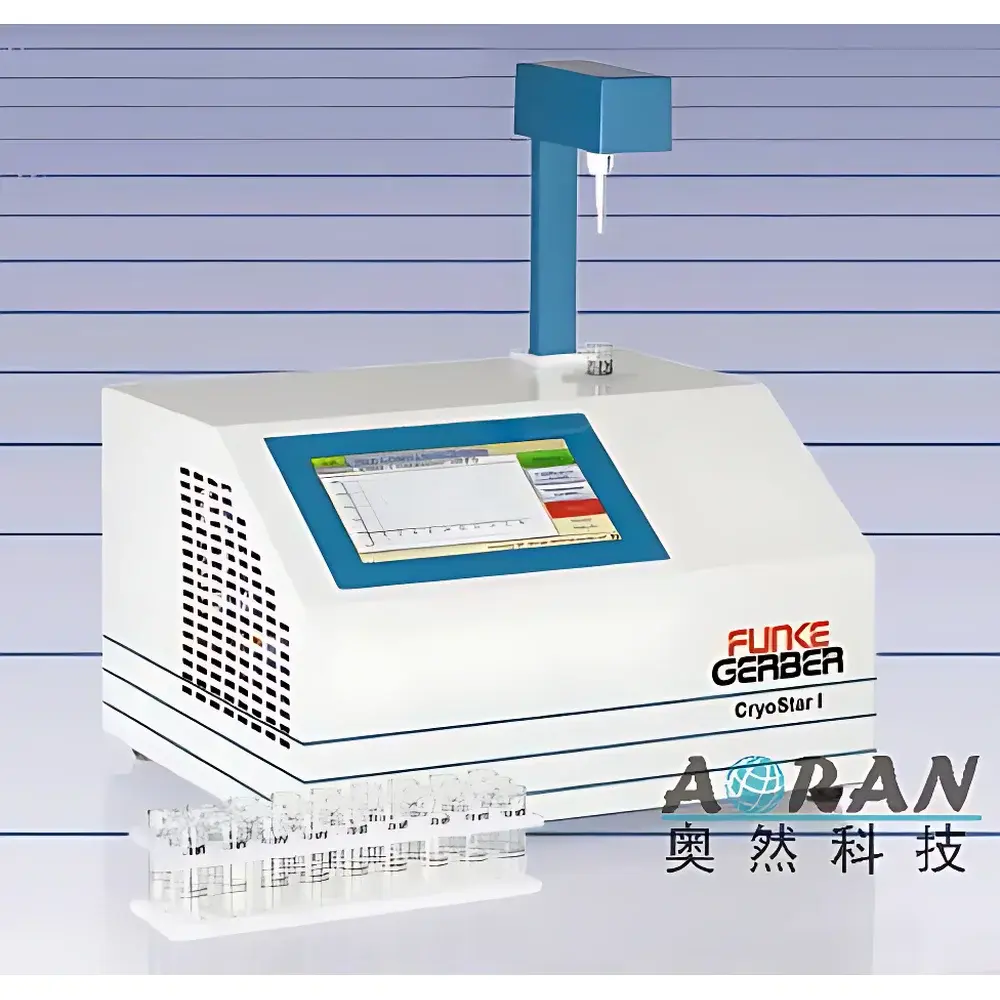
Funke Gerber CryoStar Milk Cryoscope
| Brand | Funke Gerber |
|---|---|
| Origin | Germany |
| Model | CryoStar |
| Automation | Fully Automatic |
| Analysis Speed | Up to 40 samples/h (typical 30 samples/h) |
| Measurement Range | 0.0000 °C to −1.5000 °C |
| Repeatability | ±0.0020 °C |
| Accuracy | 0.0001 °C |
| Sample Volume | 2.2 mL (recommended) |
| Power Supply | 230 V / 115 V AC, 50–60 Hz, 180 VA |
| Cooling Time | ~15 min |
| Display | 7″ color touchscreen |
| Interfaces | 2× RS-232, 2× USB, Ethernet |
| Dimensions (CryoStar 1) | 290 × 380 × 190 mm (W×D×H), 12.0 kg |
| Dimensions (CryoStar Automatic) | 440 × 440 × 200 mm (W×D×H), 14.6 kg |
Overview
The Funke Gerber CryoStar Milk Cryoscope is a precision laboratory instrument engineered for the accurate determination of milk freezing point depression—a fundamental physical parameter used globally to detect adulteration by water addition in raw and processed dairy materials. Based on the colligative property of aqueous solutions, the CryoStar measures the temperature at which milk transitions from liquid to solid phase under controlled supercooling and controlled nucleation conditions. Pure water freezes at 0.0000 °C; however, dissolved solutes—including lactose, salts, proteins, and minerals—lower the freezing point of milk to a characteristic range of approximately −0.520 °C to −0.530 °C. Any dilution with water shifts this value toward 0 °C—typically by +0.0053 °C per 1% added water. The CryoStar quantifies this shift with metrological traceability, delivering results compliant with internationally recognized reference methods.
Key Features
- Fully automated operation with integrated cooling, nucleation control, and data acquisition—eliminating manual intervention and operator-induced variability.
- High-resolution thermometry with 0.0001 °C resolution and ±0.0020 °C repeatability, ensuring compliance with stringent regulatory tolerances for dairy quality assurance.
- Two platform configurations: CryoStar 1 (single-sample mode) and CryoStar Automatic (12-position carousel), enabling flexible throughput scaling from R&D labs to high-volume QC environments.
- 7-inch color touchscreen interface with intuitive, icon-driven workflow navigation—designed for rapid operator training and minimal error risk.
- Real-time visualization of the complete freezing curve, including supercooling depth, nucleation onset, crystallization plateau, and final equilibrium temperature.
- Onboard calibration management with non-volatile memory storage for calibration constants, user-defined protocols, and audit-ready timestamps.
- Robust Peltier-based cooling system optimized for stable thermal performance across ambient temperatures up to 35 °C—ensuring consistent measurement kinetics regardless of lab climate fluctuations.
- Built-in thermal printer and dual serial/USB/Ethernet connectivity for seamless integration into LIMS, ERP, or centralized QA documentation systems.
Sample Compatibility & Compliance
The CryoStar is validated for use with raw bovine milk, standardized milk, reconstituted skim milk powder, and UHT-treated products. It accommodates standard 2.2 mL sample volumes in disposable polypropylene cryotubes (supplied as optional accessories). All measurement procedures conform to DIN EN ISO 5764 (Milk — Determination of freezing point), IDF Standard 5764, and AOAC Official Method 972.16. Instrument design and firmware support GLP-compliant operation, including electronic signature capability, full audit trail logging, and 21 CFR Part 11–ready data integrity features when paired with Gerber’s certified software suite.
Software & Data Management
Gerber CryoStar Control Software (v4.x) provides comprehensive instrument control, method programming, and result reporting. Users can define custom detection algorithms, set pass/fail limits per batch, generate PDF reports with embedded freezing curves, and export CSV/Excel-compatible datasets. Data encryption, role-based access control, and automatic backup to network drives ensure long-term data integrity. All calibration events, maintenance logs, and user actions are timestamped and stored in an immutable database—facilitating internal audits and external inspections by regulatory authorities such as EU DG SANTE, USDA-FSIS, or national dairy boards.
Applications
- Adulteration screening in dairy collection centers and receiving stations.
- Raw material verification prior to pasteurization or cheese-making processes.
- Process validation for membrane filtration, standardization, and blending operations.
- Compliance testing for national labeling regulations (e.g., EU Regulation No. 1308/2013, Indian FSSAI standards).
- Research applications involving osmolality modeling, lactose crystallization kinetics, and cryoprotectant efficacy studies.
- Inter-laboratory proficiency testing and reference material certification programs.
FAQ
What principle does the CryoStar use to determine milk freezing point?
It applies controlled supercooling followed by mechanical nucleation to initiate ice crystal formation, then records the stable plateau temperature during solid–liquid phase transition—the true freezing point depression value.
Is the CryoStar compliant with ISO 5764 and IDF standards?
Yes—the instrument implements the exact procedural sequence defined in ISO 5764:2022 and IDF 5764:2022, including specified cooling rates, nucleation timing, and plateau evaluation criteria.
How often does the system require recalibration?
Calibration is recommended before each analytical session using certified reference standards (e.g., −0.408 °C and −0.557 °C calibration fluids); the instrument supports two-point linear calibration with drift compensation.
Can the CryoStar interface with enterprise-level QA systems?
Yes—via Ethernet or RS-232, it supports ASTM E1384-compliant data exchange and integrates with major LIMS platforms through configurable OPC-UA or HL7 interfaces.
What maintenance is required for long-term accuracy?
Routine cleaning of the sample chamber and thermal sensor probe, periodic replacement of the Peltier module thermal paste (every 24 months), and annual verification using NIST-traceable reference materials.