
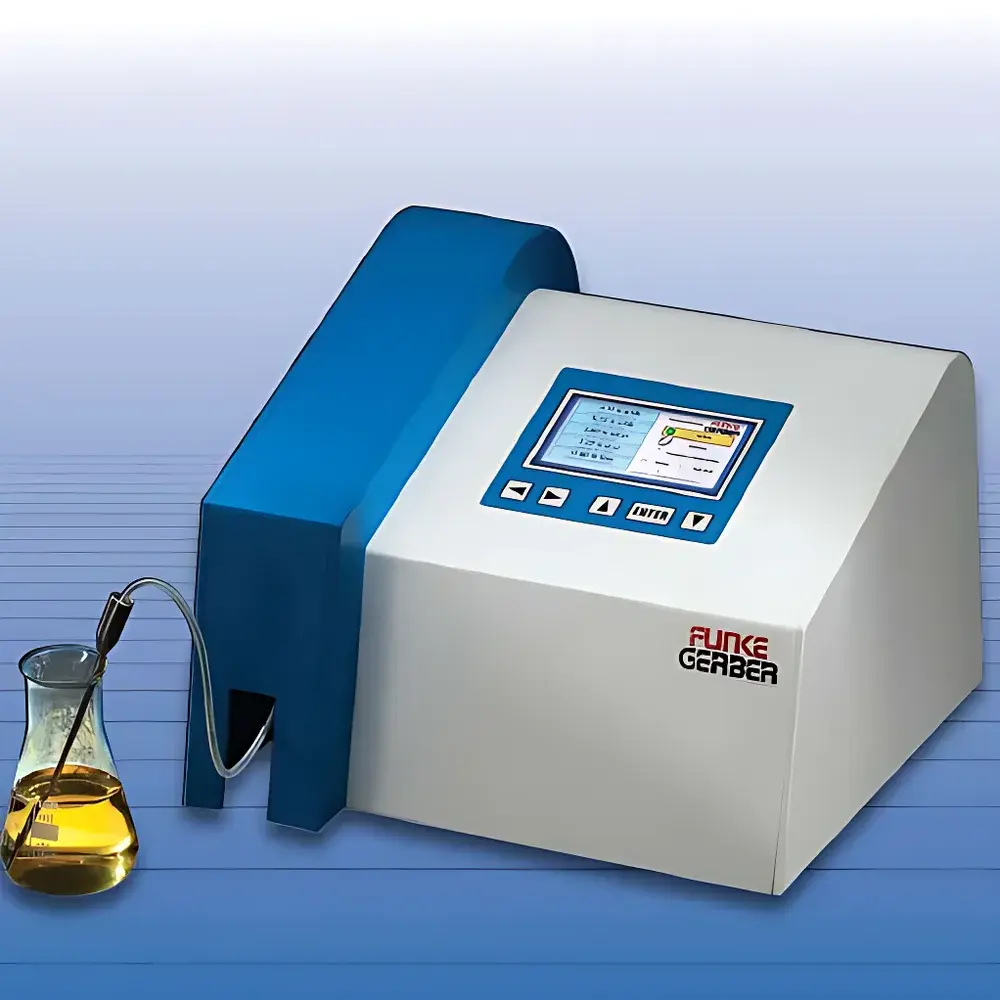
Funke Gerber FermentoFlash Beer Analyzer
| Brand | Funke Gerber |
|---|---|
| Origin | Germany |
| Model | FermentoFlash |
| Instrument Type | Dedicated Beer Analyzer |
| Application | Laboratory Use |
| Measurement Time | 1 min |
| Alcohol Content Range | 0.00–15.00 % v/v |
| pH Range | 0–14 |
| Dimensions (L × W × H) | 300 × 240 × 330 mm |
| Weight | 5 kg |
| Density Range | 0.95–1.05 g/cm³ |
| Extract Range | 0.00–10.00 % m/m |
| Apparent Extract Range | 0.00–10.00 % m/m |
| Original Wort Gravity Range | 0.00–20.00 °P |
| Density Repeatability | ±0.0002 g/cm³ |
| Alcohol Repeatability | ±0.02 % v/v |
| Extract & Apparent Extract Repeatability | ±0.04 % m/m |
| Original Wort Gravity Repeatability | ±0.02 °P |
| Calibration Memory | 18 profiles |
| Interface | USB/RS-232 for PC connectivity |
| Included Accessories | Integrated thermal printer, 100 mL conical sample vial, 5 L zero-point calibration buffer, 500 mL cleaning solution |
Overview
The Funke Gerber FermentoFlash Beer Analyzer is a fully automated, benchtop analytical instrument engineered for rapid, multi-parameter physicochemical characterization of beer and wort in quality control and research laboratories. It operates on the principle of temperature-programmed density and refractive index correlation, combined with precise thermal equilibration and flow-controlled sample introduction. A 10 mL sample is drawn via peristaltic pump into a thermostatically regulated measurement cell; sequential heating induces controlled thermal expansion, enabling simultaneous inference of alcohol content, real extract, apparent extract, original wort gravity (°P), density (g/cm³), and calculated osmotic pressure—all derived from first-principle physical relationships defined in ISO 11671, EBC Analytica, and ASBC Methods of Analysis. The system requires only a single pre-stored reference calibration using certified reference beer standards—eliminating routine recalibration and ensuring long-term metrological stability across shifts and operators.
Key Features
- Fully automated analysis cycle completed in ≤60 seconds per sample, supporting high-throughput QC workflows in breweries and contract labs.
- Integrated thermal printer provides immediate hard-copy output of full parameter sets—including date/time stamp, operator ID, and calibration profile used.
- Intuitive 5-button interface paired with a high-contrast color LCD display enables operation without prior software training or PC dependency.
- Onboard memory stores up to 18 independent calibration profiles, each traceable to specific reference materials and batch documentation—supporting audit readiness under GLP and GMP frameworks.
- Robust mechanical architecture with sealed optical path and corrosion-resistant fluidics ensures reliability in humid, CO₂-rich brewery environments.
- Pre-configured compliance with EN ISO/IEC 17025 method validation requirements, including built-in repeatability assessment and drift monitoring over time.
Sample Compatibility & Compliance
The FermentoFlash accepts standard 10 mL beer, lager, ale, stout, non-alcoholic beer, and wort samples without filtration or dilution. It accommodates carbonated and uncarbonated matrices, with automatic degassing compensation applied during thermal ramping. All reported parameters adhere to internationally recognized definitions: alcohol by volume (% v/v) per ISO 15514-1; original wort gravity (°P) per EBC Chapter 9; density at 20 °C per ISO 11671; and real/apparent extract per ASBC Beer-2B. The instrument’s measurement uncertainty budget is documented per ISO/IEC 17025 Annex A.3, and its data integrity controls—including electronic signature support, audit trail logging, and user-level access permissions—align with FDA 21 CFR Part 11 expectations for regulated environments.
Software & Data Management
The included Gerber Analytical Suite (v3.2+) provides comprehensive data management capabilities: secure database storage (SQL-based), customizable report templates (PDF/CSV/XLSX export), trend analysis with SPC charting (X-bar/R, Cpk), and batch-wise comparison against historical reference curves. Raw measurement logs include timestamps, ambient temperature/humidity metadata, and hardware diagnostic flags. Software supports role-based authentication (admin/operator/auditor), encrypted backup, and integration with LIMS via ODBC or HL7 interfaces. All calibration events, maintenance logs, and user actions are recorded in an immutable audit trail compliant with ISO 17025 clause 7.7 and EU Annex 11.
Applications
- Final product release testing per brewery internal specifications and contract brewing agreements.
- Process optimization during fermentation—tracking alcohol rise, extract depletion, and osmotic pressure shift in real time.
- Raw material verification (e.g., malt extract consistency, adjunct substitution impact).
- Regulatory submission support for labeling compliance (alcohol declaration, nutritional claims).
- Method transfer and cross-site harmonization in multinational brewing operations.
- Teaching and method validation in food science academic laboratories.
FAQ
Does the FermentoFlash require daily recalibration?
No. After initial setup with certified reference beer, no further recalibration is needed unless hardware maintenance is performed or environmental conditions exceed specified operating limits (15–30 °C ambient, <80% RH).
Can it analyze hazy or dry-hopped beers?
Yes. The optical detection system is insensitive to particulate haze; however, excessive hop debris may clog the peristaltic tubing—use of pre-filtration (≤5 µm) is recommended for heavily dry-hopped samples.
Is the osmotic pressure value measured directly or calculated?
It is calculated from density, alcohol, and extract values using the van’t Hoff equation as implemented in EBC Method 9.30, with temperature-corrected coefficients validated against cryoscopic measurements.
What validation documentation is provided with the instrument?
Each unit ships with a Factory Calibration Certificate (traceable to PTB, Germany), IQ/OQ protocol templates, and a full metrological uncertainty statement aligned with EURACHEM/CITAC Guide CG4.
How is data backup and recovery handled?
The software includes scheduled automated backups to network drives or external SSDs, with versioned archive retention (configurable up to 12 months) and point-in-time restore capability.





