
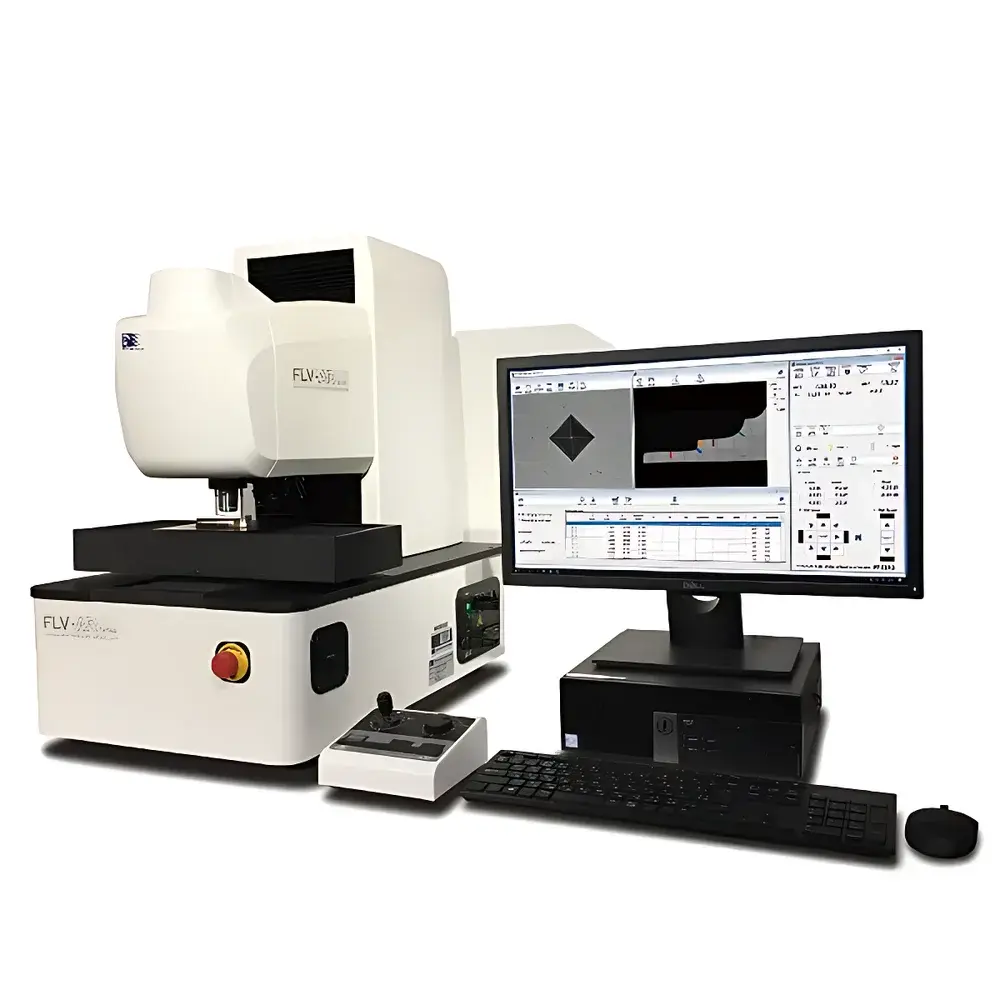
Future-Tech FLV-50ARS-F Fully Automated Vickers Hardness Tester
| Brand | Future-Tech |
|---|---|
| Origin | Japan |
| Model | FLV-50ARS-F |
| Instrument Type | Vickers Hardness Tester |
| Measurement Range | 0–3000 HV |
| Total Test Force | 50 gf to 50 kgf (16 selectable steps) |
| Specimen Stage Travel | 180 mm × 150 mm |
| Maximum Specimen Height | 210 mm |
| Maximum Specimen Depth | 180 mm |
| Optical System | Long-working-distance objective lens |
| Optional Imaging | 5 MP CMOS camera |
| Compliance | ASTM E384, ISO 6507, JIS Z 2244, GB/T 4340 |
Overview
The Future-Tech FLV-50ARS-F is a fully automated, high-precision Vickers hardness testing system engineered for metrological-grade consistency across micro- to macro-scale indentation applications. Unlike conventional Vickers testers constrained by mechanical load range limitations or dual-unit configurations, the FLV-50ARS-F integrates a dual-load-cell force application architecture—enabling seamless, traceable force delivery from 50 gf (0.49 N) to 50 kgf (490.3 N) in 16 discrete, user-selectable steps. This eliminates the need for separate micro- and macro-hardness instruments while maintaining full compliance with ASTM E384 (microhardness), ISO 6507-1 (Vickers hardness testing), and JIS Z 2244 (Japanese Industrial Standard for hardness testing). The system employs a motorized Z-axis head lift mechanism combined with a high-stability, large-travel XY stage (180 mm × 150 mm), permitting unmounted specimens up to 210 mm in height and 180 mm in depth—ideal for as-received forgings, castings, welded joints, and large-section metallurgical samples.
Key Features
- Dual-load-cell force actuation system ensures linearity, repeatability, and long-term stability across the full 50 gf–50 kgf range without mechanical weight stacks or manual recalibration.
- Motorized head-lift design with precision linear encoder feedback enables accurate, programmable indenter approach and dwell control—critical for minimizing thermal drift and surface deformation artifacts.
- Large-format XY specimen stage (180 mm × 150 mm travel) supports oversized, non-mounted samples; accommodates standard metallographic mounts as well as raw industrial components.
- Long-working-distance optical path with parfocal, infinity-corrected objectives delivers consistent image fidelity across all magnifications—optimized for both visual verification and automated image analysis.
- Optional 5-megapixel CMOS imaging module provides high-resolution, low-noise digital capture of indent impressions with real-time edge detection and sub-pixel centroid calculation.
- Intelligent specimen contour mapping uses multi-point Z-scan to reconstruct topographic profiles, enabling automatic coordinate system registration and path compensation for tilted or warped surfaces.
- Z-height correction algorithm stores localized focal plane offsets per test point, dynamically adjusting focus during automated sequences to maintain optimal depth-of-field and measurement integrity.
Sample Compatibility & Compliance
The FLV-50ARS-F is validated for use with metallic alloys, ceramics, thin films, case-hardened layers, weld zones, and composite materials. Its extended vertical clearance (210 mm) and deep specimen chamber (180 mm) allow direct testing of machined parts, turbine blades, rail sections, and heat-treated tooling without sectioning or mounting. All force calibration procedures adhere to ISO/IEC 17025-accredited methodologies, and force transducers are traceable to NMIJ (National Metrology Institute of Japan). The system meets requirements for GLP-compliant laboratories and supports audit-ready documentation per FDA 21 CFR Part 11 when paired with validated software modules.
Software & Data Management
The embedded control suite features an intuitive, role-based GUI with customizable workflows, multi-language support (English, Japanese, Chinese, German), and context-aware help. Test protocols—including load dwell time, indentation spacing, grid patterns, and conditional branching—are stored as reusable templates. The system supports automated report generation with user-defined layouts (PDF, Excel, CSV), embedded statistical summaries (mean, SD, CV%, confidence intervals), and direct export to LIMS via ODBC or RESTful API. Audit trails record operator ID, timestamp, parameter changes, and instrument status—fully compliant with ISO 17025 clause 7.7 and ASTM E2921.
Applications
- Quality assurance of aerospace nickel-based superalloys and titanium components under ASTM E92 and E384.
- Case depth profiling of carburized and nitrided steel surfaces using step-load sequences.
- Hardness gradient analysis across dissimilar metal welds (e.g., stainless-to-carbon steel).
- In-process verification of heat treatment uniformity in large-diameter shafts and pressure vessel forgings.
- Research-grade indentation mapping for phase identification in multiphase steels and intermetallic compounds.
- Calibration laboratory reference testing where traceability to national standards is mandatory.
FAQ
Does the FLV-50ARS-F support automatic load switching within a single test sequence?
Yes—users can define load transitions at specific coordinates or based on material classification tags, enabling compliant multi-force testing per ISO 6507-4.
Is the system compatible with third-party image analysis software?
Raw image data (TIFF, BMP) and coordinate metadata (XML) are exported without proprietary wrappers, supporting integration with ImageJ, MATLAB, or custom Python-based analysis pipelines.
What calibration documentation is provided with shipment?
Each unit ships with a factory calibration certificate referencing NMIJ-traceable standards, including force verification at 5 key points (100 gf, 1 kgf, 10 kgf, 30 kgf, 50 kgf) and optical magnification validation.
Can the system perform hardness testing on curved or irregular surfaces?
Yes—the intelligent contour mapping and dynamic Z-height correction functions compensate for surface tilt up to ±5°, ensuring perpendicular indenter alignment and repeatable impression geometry.
Is remote operation and monitoring supported?
The system includes Ethernet connectivity and optional VNC-compatible remote desktop access; secure HTTPS-based web interface allows real-time status viewing and queue management from authorized network endpoints.



