
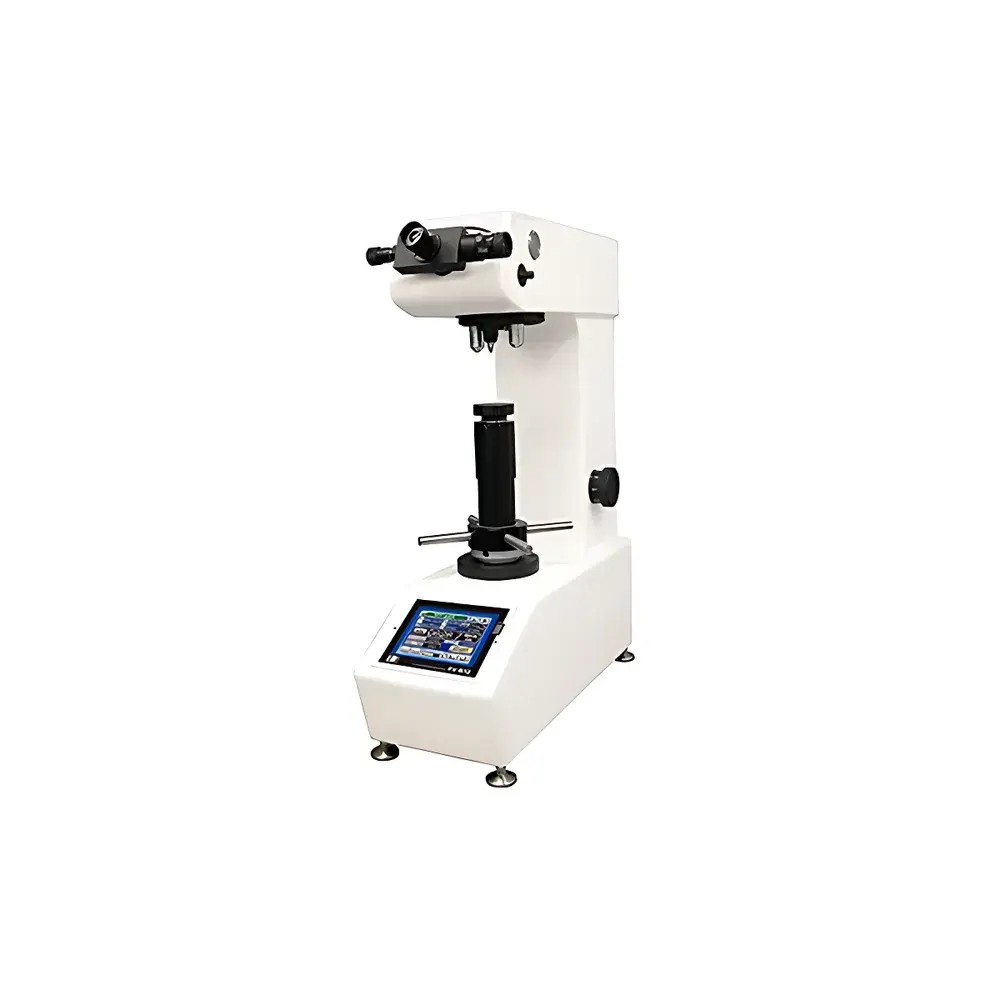
Future-Tech FV-310 Vickers Hardness Tester
| Brand | Future-Tech |
|---|---|
| Origin | Japan |
| Model | FV-310 |
| Hardness Scale | Vickers (HV) |
| Measurement Range | 0–3000 HV |
| Total Test Force | 50 kgf |
| Maximum Specimen Height | 210 mm |
| Power Supply | AC 100–240 V, 50/60 Hz |
| Weight | ~55 kg |
| Compliance | JIS R 1607 (Fracture Toughness Kc), ISO 6507, ASTM E384 |
Overview
The Future-Tech FV-310 is a fully automated Vickers hardness tester engineered for precision, repeatability, and operational flexibility in quality control laboratories, R&D facilities, and metallurgical testing environments. Based on the principle of diamond pyramid indentation under controlled static load, the FV-310 applies a precisely calibrated force—up to 50 kgf—to produce a square-based pyramidal impression on metallic, ceramic, or composite surfaces. The diagonal lengths of the resulting impression are measured optically using high-resolution digital imaging, and hardness values (HV) are calculated in strict accordance with ISO 6507-1 and ASTM E384 standards. Designed and manufactured in Japan, the FV-310 integrates a robust mechanical architecture with an intuitive color LCD touchscreen interface, enabling seamless navigation through test setup, real-time data visualization, and post-test analysis—all without external PC dependency.
Key Features
- Fully automatic loading, dwell, and unloading sequence with programmable force profiles and dwell times (5–60 s standard, configurable)
- High-contrast 7-inch color TFT touchscreen display with multi-layer PCB architecture for stable signal integrity and reduced electromagnetic interference
- Dual-indentation capability: optional dual-turret configuration supports simultaneous installation of HV and HK (Knoop) diamond indenters for comparative microhardness evaluation
- Four-objective turret support (standard two + two optional), covering magnifications from 10× to 100× for broad-spectrum microstructural observation and precise indentation measurement
- Adjustable aperture and field diaphragms, plus interchangeable color filters, enhance contrast for challenging samples—including reflective metals, coated substrates, and translucent ceramics
- Integrated X/Y stage coordinate display synchronized with optional digital micrometer head for traceable positional referencing during serial indentation mapping
- Onboard calculation modules for Brinell hardness (HBW), fracture toughness (Kc per JIS R 1607 and IF method), and sample thickness correction—enabling direct assessment of brittle materials such as fine-grained ceramics and thin-film coatings
Sample Compatibility & Compliance
The FV-310 accommodates specimens up to 210 mm in height and 165 mm in depth, making it suitable for large forgings, heat-treated components, and layered material assemblies. Its rigid C-frame construction minimizes deflection during high-load testing, ensuring measurement stability across the full 0–3000 HV range. All hardness calculations conform to international metrological requirements: ISO 6507-1 (Vickers hardness testing), ISO 6506-1 (Brinell), and JIS R 1607 (fracture toughness of advanced ceramics). The instrument supports GLP-compliant workflows via timestamped test logs, operator ID entry, and audit-ready result export (CSV/Excel via USB port). While not inherently 21 CFR Part 11 compliant, its data output structure facilitates integration into validated LIMS or ELN systems meeting FDA-regulated documentation standards.
Software & Data Management
The embedded firmware provides real-time display of test parameters—including applied load, dwell time, indentation diagonals, calculated HV value, statistical deviation (±σ), and environmental temperature. Results are stored internally with metadata (date/time, operator ID, sample ID, test location coordinates) and exported via USB 2.0 to standard storage devices. No proprietary software license is required; exported files are natively readable in Excel, MATLAB, or statistical process control (SPC) platforms. Optional PC connectivity enables remote monitoring and batch reporting, though all core functionality—including Brinell conversion, Kc derivation, and cylindrical/spherical surface correction—is executed autonomously on-device.
Applications
The FV-310 serves critical roles in failure analysis, heat treatment validation, coating adhesion assessment, and ceramic component qualification. It is routinely deployed for hardness profiling across case-hardened gears, turbine blade bond coats, sintered carbide inserts, and biomedical Ti-6Al-4V implants. Its low-force microhardness capability (down to 10 gf, when equipped with optional micro-load module) supports grain-level characterization in duplex stainless steels and intermetallic phases. In academic research, the integrated Kc calculation function supports mechanistic studies of crack initiation in silicon nitride and alumina-based composites per JIS R 1607 Annex B.
FAQ
Does the FV-310 support automatic indentation measurement?
Yes—the system performs fully automated image capture and diagonal length detection after indentation, with manual override available for edge-case verification.
Can the FV-310 test curved or inclined surfaces?
Yes—onboard geometric correction algorithms compensate for cylindrical and spherical specimen geometry, applying standard curvature corrections per ISO 6507-2.
Is calibration traceable to national standards?
All factory calibration certificates reference JCSS-accredited hardness reference blocks (NMIJ/JCSS certified), with optional annual recalibration services available through authorized Future-Tech service centers.
What power configurations are supported for global deployment?
The unit ships pre-configured for universal input (AC 100–240 V, 50/60 Hz) and includes region-specific IEC C13 inlet cables.
Is fracture toughness (Kc) calculation limited to specific materials?
Kc computation follows JIS R 1607 and is validated for monolithic ceramics (e.g., Al₂O₃, Si₃N₄); results for heterogeneous or porous systems require supplementary SEM-based crack-length verification.



