
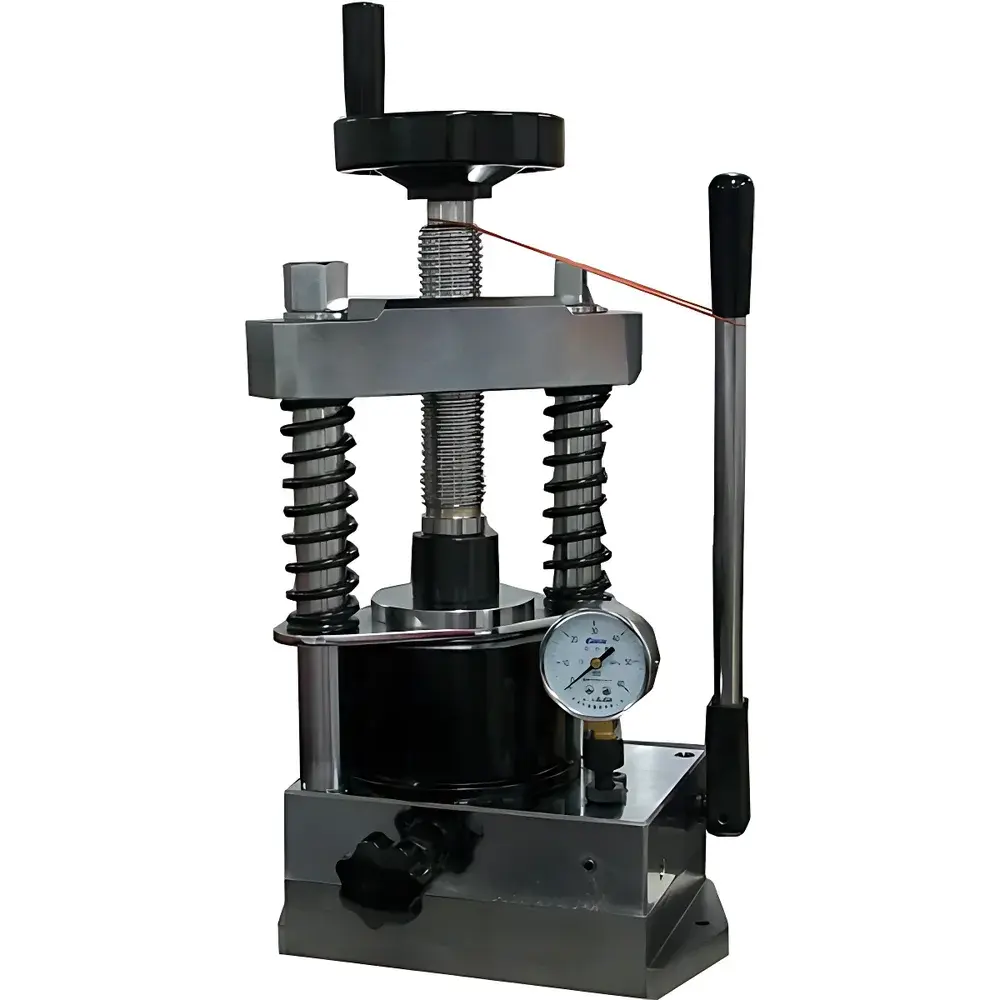
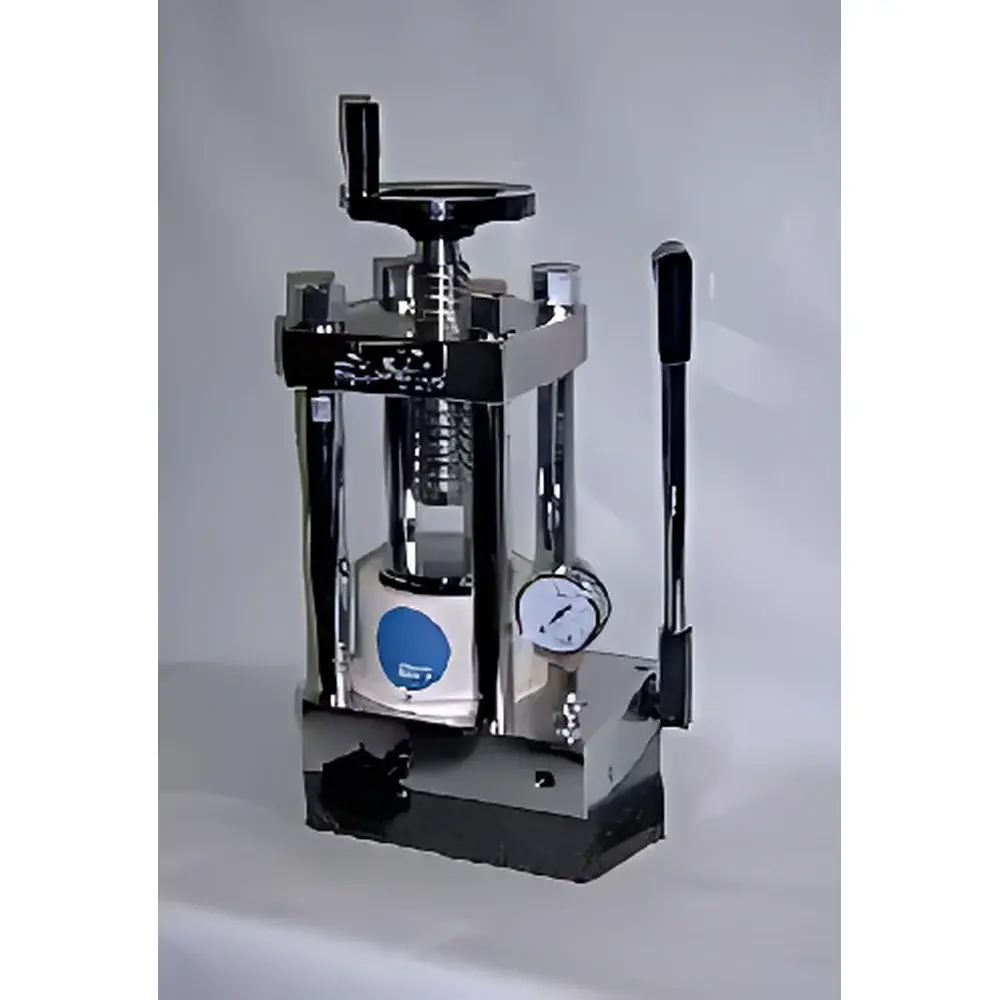
FW-4A Manual Hydraulic Pellet Press
| Origin | Beijing, China |
|---|---|
| Manufacturer Type | Authorized Distributor |
| Origin Category | Domestic (China) |
| Model | FW-4A |
| Price | USD 820 (FOB Beijing) |
| Instrument Type | Manual Hydraulic Pellet Press |
| Rated Working Pressure | 240 kN (24 metric tons, 38 MPa) |
| Ultimate Pressure | 300 kN (30 metric tons, 47 MPa) |
| Pressure Stability | ≤1 MPa drop over 5 min |
| Piston Stroke | 30 mm |
| Working Chamber Dimensions | 100 × 100 × 100 mm |
| Hydraulic Fluid | ISO VG 32 mineral oil |
| Overall Dimensions | 200 × 250 × 450 mm |
| Net Weight | 33 kg |
Overview
The FW-4A Manual Hydraulic Pellet Press is a precision-engineered laboratory instrument designed for reproducible preparation of optically transparent, mechanically stable pellets from fine particulate samples—primarily for Fourier Transform Infrared (FTIR) spectroscopy. Operating on the principle of uniaxial cold compaction under controlled hydraulic pressure, the FW-4A applies uniform compressive force via a manually actuated hydraulic system to consolidate powdered matrices such as potassium bromide (KBr), sodium chloride (NaCl), or cesium iodide (CsI) with analyte solids into homogeneous, low-scatter discs. Its rated working pressure of 240 kN (38 MPa) ensures complete particle rearrangement and interfacial bonding without thermal degradation—critical for preserving molecular integrity in spectral analysis. The press features a robust cast-iron frame, sealed piston-cylinder assembly, and calibrated pressure-hold circuitry engineered to maintain load stability within ≤1 MPa over 5 minutes—a performance benchmark aligned with ASTM E1254 and ISO 1833-1 requirements for FTIR sample preparation repeatability.
Key Features
- Manual hydraulic operation with dual-mode orientation capability—fully functional in both upright and horizontal configurations for flexible benchtop integration.
- Redesigned sealing architecture eliminates historical issues of pressure decay and hydraulic oil leakage, verified through 10,000-cycle endurance testing under sustained 38 MPa load.
- Piston stroke of 30 mm accommodates standard die sets (e.g., 13 mm, 16 mm, and 25 mm diameter) and enables consistent pellet thickness control across batch runs.
- Working chamber dimensions (100 × 100 × 100 mm) support oversized tooling and custom die assemblies for non-standard applications including XRD sample holders and electrochemical pellet fabrication.
- ISO VG 32 mineral oil reservoir with sight gauge and vented filler cap ensures long-term fluid integrity and simplifies routine maintenance per GLP-compliant lab protocols.
- Compact footprint (200 × 250 × 450 mm) and lightweight construction (33 kg) facilitate transport between analytical labs and shared instrumentation facilities.
Sample Compatibility & Compliance
The FW-4A is validated for use with infrared-transparent matrix materials including KBr, NaCl, CsI, and polyethylene (PE) dispersions, as well as non-hygroscopic pharmaceutical excipients (e.g., microcrystalline cellulose, lactose monohydrate) in QC tablet preformulation studies. It complies with mechanical safety requirements outlined in IEC 61000-6-2 (EMC immunity) and meets structural integrity criteria referenced in ISO 7435 for laboratory hydraulic presses. While not certified to UL/CSA standards, its design adheres to EN 61000-6-4 emission limits for laboratory environments. All pressure components are traceably tested to 125% of ultimate rating (375 kN) prior to shipment—documentation available upon request for audit readiness.
Software & Data Management
As a manually operated mechanical system, the FW-4A does not incorporate embedded electronics or digital interfaces. However, it integrates seamlessly into regulated workflows requiring documentation traceability: pressure application time, hold duration, and operator ID can be recorded in electronic lab notebooks (ELNs) compliant with 21 CFR Part 11 when used alongside validated external pressure loggers (e.g., HBM PMX series with TEDS-enabled load cells). Optional analog-to-digital adapters enable real-time force monitoring and export of CSV-formatted pressure-vs.-time profiles for statistical process control (SPC) analysis in JMP or Minitab.
Applications
- Preparation of KBr pellets for qualitative and quantitative FTIR analysis of organic compounds, polymers, and APIs.
- Compaction of soil, catalyst, and ceramic powders for X-ray diffraction (XRD) and scanning electron microscopy (SEM) sample mounting.
- Formulation screening of solid dosage forms under GMP-aligned development protocols.
- Reference material certification where mechanical consistency—not thermal history—is the critical variable.
- Teaching laboratories for hands-on instruction in powder rheology, densification kinetics, and Hookean vs. plastic deformation behavior.
FAQ
What is the maximum recommended operating pressure for routine KBr pellet preparation?
For optimal spectral transparency and minimal residual stress birefringence, we recommend operating at 200–220 kN (31–34 MPa) for 2–3 minutes hold time—well within the FW-4A’s rated 240 kN capacity.
Can the FW-4A accommodate custom die sets with non-standard diameters or heights?
Yes—the open-top chamber design and 100 mm vertical clearance allow installation of dies up to 25 mm in diameter and 20 mm in height; users must verify compatibility with their specific die manufacturer’s flange specifications.
Is ISO VG 32 hydraulic oil the only approved fluid?
While ISO VG 32 mineral oil is specified for optimal viscosity-temperature response and seal compatibility, equivalent API Group I oils meeting DIN 51524 Part 2 (HLP) specifications may be substituted—provided they contain no silicone-based additives.
Does the one-year warranty cover wear parts such as O-rings and piston seals?
Yes—the warranty includes replacement of all factory-installed hydraulic seals and pressure gauges if failure occurs due to material or workmanship defects under normal usage conditions.
How frequently should hydraulic oil be replaced in continuous-use environments?
Under daily operation (≤8 cycles/day), oil change is recommended every 12 months or after 2,000 compression cycles—whichever occurs first—as verified by visual inspection for discoloration or particulate contamination.



